
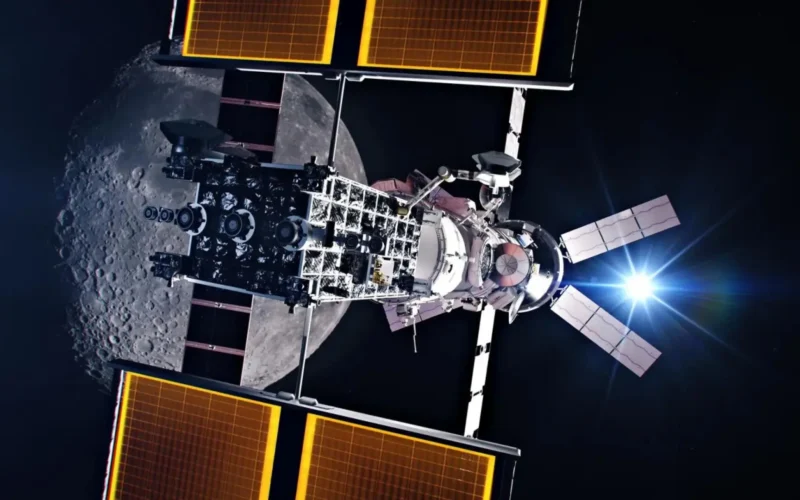
NASA’s Artemis campaign is spearheading humanity’s return to the Moon, aiming for sustainable exploration and eventual crewed missions to Mars with Gateway Lunar Dust Defense . As astronauts prepare for extended stays on the lunar surface, NASA engineers face a major challenge. They are managing the behavior of lunar dust.
This sharp and jagged dust has posed significant issues since the Apollo missions, clinging to spacesuits and jamming equipment. NASA is planning frequent trips between the Moon and Gateway, its first lunar space station. Therefore, the need for effective lunar dust defense is more pressing than ever.
Gateway’s Unique Lunar Dust Challenges
Unlike the Apollo-era spacecraft, which encountered lunar dust only once, Gateway will face repeated exposure. Every docking of a Human Landing System spacecraft at Gateway from the Moon’s South Pole presents a risk. Lunar dust could enter the station’s environment. This can damage sensitive instruments, solar arrays, and other essential hardware.
Josh Litofsky, a systems engineer at NASA’s Johnson Space Center, is leading a lunar dust adhesion testing campaign. His team examines how dust interacts with Gateway’s materials, ensuring the station can withstand these abrasive particles.
Simulations to Strengthen Lunar Dust Defense
“Lunar dust particles are jagged, sticky, and incredibly small,” Litofsky explains. “Even in tiny amounts, they can significantly impact equipment and systems.”
To combat this, NASA has developed the Gateway On-orbit Lunar Dust Modeling and Analysis Program (GOLDMAP). Created by Ronald Lee of Johnson Space Center, GOLDMAP simulates how lunar dust moves and settles on Gateway’s external surfaces. The model incorporates factors like the station’s design, materials, and the unique conditions of lunar orbit.
Gateway Lunar Dust Defense: Data-Driven Solutions for Sustainable Exploration
Early GOLDMAP simulations reveal that lunar dust can form clouds around Gateway, with larger particles adhering to surfaces. These insights are critical for safeguarding the station’s longevity during NASA’s Artemis missions.
Litofsky’s team is testing materials in vacuum chambers. They are simulating lunar conditions. This process generates data that will help protect Gateway and its onboard systems. This approach ensures that the space station remains operational for years to come.
NASA Gateway Lunar Dust Defense: Paving the Way for Deep Space Exploration
The lessons learned from Gateway’s lunar dust defense are shaping the future of space exploration. NASA and its international partners will use this knowledge to address the challenges of lunar exploration. They will also prepare for missions deeper into the cosmos.
