
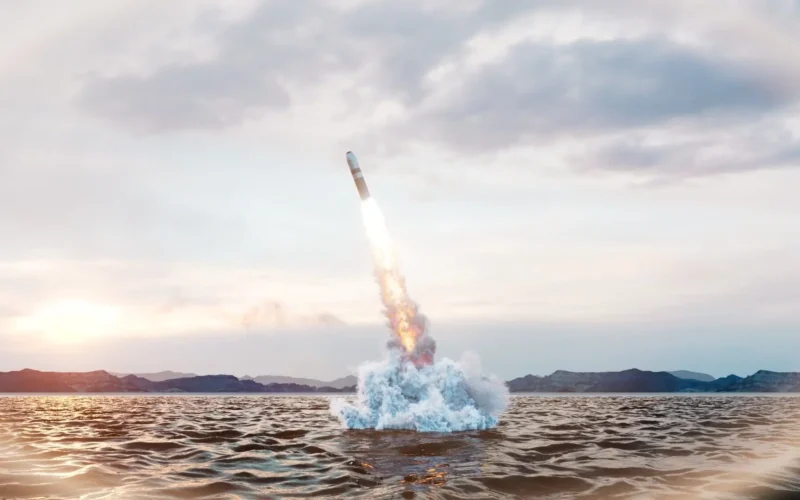
The U.S. Navy has awarded Lockheed Martin a $383 million contract to develop the next generation Trident II Strategic Weapons System (SWS) D5 submarine-launched ballistic missile (SLBM).
According to a press release by Lockheed Martin in late January, the upgraded missile called the Trident II D5 Life Extension 2 (D5LE2), will be carried aboard Columbia-class ballistic missile submarines (SSBN).
The U.S. Navy plans to keep this strategic weapon system credible through 2084, according to Lockheed Martin.
“The second life extension of the Trident D5 missile will enable the United States and the United Kingdom, through the Polaris Sales Agreement, to maintain credibility deterring evolving threats,” said Jerry Mamrol, vice president of Fleet Ballistic Missiles at Lockheed Martin.
“We are proud to continue our critical partnership with the U.S. Navy to take deterrence into this new era.”
Trident II D5 second life extension
The information about the new missile is limited. However, D5LE2 is required to support later Columbia-class missile inventory and seamlessly sustain the United States Strategic Command (USSTRATCOM) requirements.
D5LE2 seeks to ensure the SWS will be flexible and adaptable to maintain demonstrated performance and survivability despite the dynamic threat environment.
The missile must be designed, engineered, produced, and deployed by Columbia. It will also be incorporated into the UK’s Dreadnought class SSBNs.
D5LE2 may represent a hybrid of cost-effective technologies, such as solid rocket motors and igniters, along with redesigned components, including avionics, guidance, and system architecture.
D5LE2 is envisaged to maintain modern warfare’s unmatched reliability and demonstrated performance while unlocking untapped system potential to efficiently respond to emerging needs and maintain a credible Sea Based Strategic Deterrent.
The financial year (FY25) activities continue critical Missile and Guidance technology work, commencing multiple subsystem redesigns, industrial base development activities, and digitizing system-level requirements for the D5LE2 program.
The D5LE2 subprogram is aimed to achieve Milestone B in 2025.
Unlike SLBM programs of the past, D5LE2 does not benefit from a healthy defense industrial base that comes from maintaining production and continuous development.
The 2022 Nuclear Posture Review (NPR) reiterated the need for D5LE2. It stated that the United States will prioritize near-term investments to “ensure that D5LE2 is effective in the expected threat environment and delivers on time.”
The 2022 bi-partisan, congressionally mandated Strategic Posture Committee Report recommended fully supporting the development and deployment of D5LE2 “to ensure U.S. nuclear strategy remains effective in a two-nuclear-peer environment.”
In short, full support of D5LE2 today is vital to achieving the 2039 Initial Fleet Introduction and to embarking on a path that maintains an SLBM deterrent capability through the service life of the Columbia and UK Dreadnought-class SSBNs.
SBSD 2084
The U.S. Navy is developing this new missile as a part of the Strategic Systems Program’s (SSP) ‘Sustaining Sea-Based Strategic Deterrence 2084’ (SBSD 2084) mission.
According to the U.S.’s Defense Visual Information Distribution Service (DVIDS), SBSD 2084 is the “no-fail mission” tasked with sustaining SWS into the future on the Ohio class SSBN upon final boat decommissioning in 2042 and the integration of the D5LE weapons system on the new COLUMBIA class SSBNs.
The U.S. Navy said in a recent report that both the U.S.’s Ohio and UK’s Vanguard-class SSBNs continue to provide a superior return on investment to their nations through deterrence of major power conflict for approximately four decades.
However, both nations have concluded it is time to make a generational investment into their SBSD to deter potential future transitions from ‘Strategic Competition to Strategic Conflict.’
The Congress of the U.S. has already approved funding for Hulls 1 and 2 of the Columbia class SSBN (SSBN 826 and SSBN 827).
Planned for a minimum of a 12-ship Columbia class SSBN fleet, this highly advanced and ultra-quiet submarine is designed with a life of ship reactor core, which avoids a loss of operational availability due to a mid-life core refueling as was the case in previous SSBN classes, including Ohio.
The Department of Defense (DOD) and Navy were able to capitalize on the demonstrated accuracy and reliability of the Trident II D5 Weapons System to reduce the number of missile tubes on each submarine from 24 to 16, saving critical defense dollars to be invested in other areas of the DOD.
The UK is simultaneously developing their four-ship UK Dreadnought Class SSBN to replace the Vanguard submarines as they approach the end of life.
Both nations built on previous decades of collaboration through the Polaris Sales Agreement and the Mutual Defense Agreement to design and develop a Common Missile Compartment to support the Trident II D5LE2 weapons system while reducing costs and logistical overhead through commonality.
The D5LE2 missile will be designed to leverage the current stockpile warheads and reentry bodies of the W76/W88 and Mk4/Mk5 families while also incorporating the new W93/Mk7 warhead and reentry body assembly that will reduce stockpile risks and provide broadened targeting options to U.S. Strategic Command.
Strengthening submarine
The first Columbia will execute her Demonstrated Shakedown and Operations (DASO) for weapons system certification in 2028 using the D5LE system and embark on the first Columbia-class alert patrol in FY31.
Columbia-class hulls 1-8 will leverage the proven Trident II D5LE system, allowing SSP to introduce the new D5LE2 weapon system on a Columbia-class platform that will have been proven for a decade at the point of D5LE2 introduction on hull 9.
Through the 2040s, SSP will help oversee the commissioning of the final Columbia-class SSBNs and D5LE2 system while backfitting hulls 1-8 during routine maintenance periods executed through 2049.
To achieve this transition while meeting the assumptions and requirements of the Columbia-class program, investment into the research and development of new technologies for D5LE2 is essential now and throughout the 2020s to inform the milestones of the System Requirements Review in 2025, Preliminary Design Review in 2028 and the Critical Design Review in 2032.
Low-Rate Initial Production (LRIP) will commence in 2034 to enable both a buildup of the production industrial base as well as to provide test bodies to execute a series of land-based pad testing from Cape Canaveral, culminating in at-sea flight testing from an SSBN in 2036.
This gradual buildup of production capability, simultaneously executed with D5LE2 flight testing, will support the inventory requirements of full boat load-outs starting in 2039 without investing in excess production capacity that would support significant production over a short period but waste resources in the long term.
The Reentry Systems team at SSP will complement the Missile Branch’s efforts through the 2020s and 2030s to build more capability and resilience into the Navy’s nuclear weapons stockpile.
While maintaining surveillance and oversight of the W76/W88 families of warheads, SSP will lead efforts in conjunction with the National Nuclear Security Administration within the Department of Energy under the interagency Nuclear Weapons Life Cycle process to design, develop, and produce the W93/Mk7 warhead and reentry system as well as the Next Nuclear Warhead (NNW) to life extend or replace the W88-0/Mk5 ALT 370 system.
Ultimately, these efforts are intended to meet the dynamic and uncertain demands of evolving future threats through 2084.
Strategic Systems Programs will leverage the existing margin with D5LE to support current and future warheads (W76/W88/W93) until 2039.
At that time, SSP will introduce D5LE2, which will utilize state-of-the-art materials and avionics architectures to unlock additional capabilities required to support the payloads of the future.
In addition, SSP will develop and deliver the U.S. Navy’s non-nuclear Conventional Prompt Strike Hypersonic Missile capability to fill a critical deterrence gap in the U.S. Navy’s full spectrum of deterrence SWS.
