
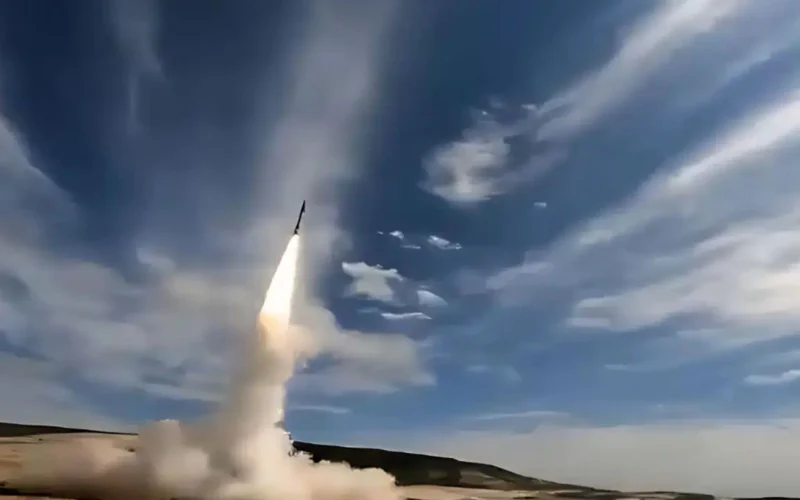
In a significant move to boost its hypersonic capabilities, Japan’s Ministry of Defense (MoD) has announced the test-fire of its domestically produced stand-off missile, known as the Hyper Velocity Gliding Projectile (HVGP).
Also referred to as Hypersonic Glide Vehicle (HGV), the new missile aims to strengthen Japan’s stand-off defense capabilities to “intercept and eliminate invading forces against Japan at a distance and an early stage,” the MoD said.
“Research into the HVGP for island defense is scheduled to be completed by [Japanese] fiscal year (FY) 2025, and we [Japan MoD] will continue to work towards early construction of stand-off defense capabilities,” the MoD added.
According to the MoD, the mass production of HGVP was started in FY 2023, and the ministry aims to deploy the missile to the Japan Self-Defense Forces (SDF) units starting FY 2026.
Japan’s new hypersonic weapons
To bolster Japan’s counter-strike missile capabilities, the MoD has initiated the development of new missiles such as HGVP, upgraded HVGP, and guided hypersonic cruise missiles.
The MoD’s Acquisition, Technology, and Logistics Agency (ATLA) is developing these missiles in partnership with Mitsubishi Heavy Industries (MHI).
ATLA started research on the HVGP in 2018. The weapon is envisaged as an anti-ship missile launched from a ground-based rocket. The HVGP will separate from the rocket at a high altitude and then glide to its target at hypersonic speed, and INS and GPS will guide it.
According to local media, the strike range of HVGP is 560 miles (900 km), allowing the weapon to be utilized for island-to-island fire.
The upgraded HVGP will extend the range significantly and improve capabilities compared to the original HVGP.
ATLA plans to complete the development of the upgraded HVGP in FY 2030.
According to the FY 2023 budgetary document, the MoD allocated JPY50.5 billion and JPY200 billion for the research and production of the HVGP and the development of the upgraded HVGP, respectively.
In addition, Japan is accelerating research on the guided SHW program, which in the 2023 budget received JPY58.5 billion.
Japan’s counter-strike strategy
Japan has started strengthening its counter-strike missile capabilities as a part of its National Defense Strategy (NDS) to address rising military threats posed by China, North Korea, and Russia.
The NDS – released in December 2022 – reshaped Tokyo’s military strategy, putting new emphasis on developing and acquiring counter-strike weapons. The new posture represents a shift in Japan’s defense strategy, away from a focus on diplomacy towards responding more forcibly to growing regional threats.
“[Japan] needs counter-strike capabilities, which, in the case of missile attacks by an opponent, enable Japan to mount effective counter-strikes against the opponent to prevent further attacks while defending against incoming missiles using the missile defense network,” the NDS said.
The Japanese MoD has developed counter-strike capabilities in response to the requirement. For ground-based operations, the strategy has two major phases.
The first is to develop stand-off missile capabilities, and the second is to enhance Japan’s ballistic missile defense (BMD) system, known as Integrated Air and Missile Defense (IAMD).
Increased defense spending
The NDS outlines a requirement for Japan by 2027, to spend 2% of its GDP on defense. The NDS’ associated Defense Buildup Program also identifies a target for Japan to allocate, in total, about JPY43 trillion (USD306 billion) on defense between 2023 and 2027.
The increased budget emphasizes Japan’s priority of acquiring counter-strike weapons as China, North Korea, and Russia boost military actions near Japan.
China has set the objective of completing national security and military modernization by 2035 and establishing a world-class force by the middle of this century.
North Korea announced a five-year plan in early 2021, which includes the development of hypersonic missiles, tactical nuclear weapons, hypersonic glide vehicles, intercontinental ballistic missiles, intermediate-range cruise missiles, ground-launched ballistic missiles, and multiple launch rocket launchers.
Moreover, Russian forces are increasing their military activities, including the deployment of newer-model equipment and conducting large-scale military drills near Japanese territory.
In recent years, Russia has ramped up its military coordination with China by conducting joint navigation of their naval vessels and joint flights of their bombers.
