
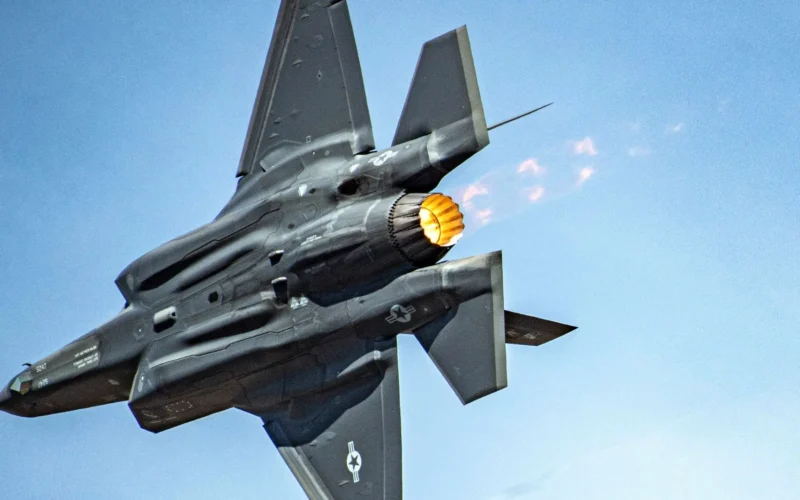
The United States has proposed the sale of F-35 Lightning II fighter jets to India, marking a significant development in the defense cooperation between the two nations.
The offer was made during recent high-level talks between US President Donald Trump and Indian Prime Minister Narendra Modi, underscoring Washington’s intent to strengthen India’s aerial warfare capabilities.
The move follows India’s ongoing efforts to modernize its air force, which has seen the gradual depletion of squadron strength and increasing threats from regional adversaries.
If accepted, the deal would place India among a select group of nations operating the advanced fifth-generation fighter. However, the offer also raises strategic, financial, and operational challenges for the Indian Air Force (IAF).
India’s Strategic Considerations
The IAF currently operates with a squadron strength well below the sanctioned 42 squadrons, increasing concerns about its ability to maintain air superiority in a two-front conflict scenario.
The IAF is in the process of phasing out aging MiG-21 and MiG-27 aircraft, increasing the urgency of acquiring next-generation fighters.
The acquisition of the F-35 would provide India with an edge over adversaries, particularly in potential confrontations with China’s J-20 and Pakistan’s JF-17 fighter programs.
The purchase would enhance India’s operational compatibility with US and allied air forces, reinforcing Indo-Pacific security cooperation.
However, several factors complicate India’s decision to acquire the F-35.
Challenges to F-35 Acquisition
Despite its advanced capabilities, the F-35 program has faced scrutiny due to high costs, maintenance complexities, and operational limitations.
The F-35 is among the most expensive fighter programs in the world. Reports suggest that export unit costs could exceed $144 million per aircraft, with additional costs for maintenance, logistics, and infrastructure upgrades.
The F-35 program is tightly controlled by the US, with limited technology transfer options. India’s emphasis on indigenous defense production under the ‘Make in India’ initiative may conflict with these restrictions.
The IAF’s fleet consists of a mix of Russian, French, and indigenous aircraft. Integrating the F-35 into this ecosystem would require significant upgrades to infrastructure, pilot training, and logistics.
The F-35’s maintenance and software updates require continuous US oversight, raising concerns over India’s strategic autonomy.
In addition, Tesla and SpaceX CEO Elon Musk has been vocal in his criticism of the F-35 program.
Musk has questioned the jet’s maneuverability and effectiveness against modern unmanned aerial systems, arguing that the fighter may not provide the decisive air dominance it was originally designed for. His remarks highlight broader concerns over the F-35’s cost-effectiveness and reliability.
US Strategic Interests in Selling the F-35 to India
The US sees India as a key partner in countering Chinese military expansion in the Indo-Pacific. By offering the F-35, Washington aims to achieve multiple objectives.
The US views India as a crucial regional ally and seeks to bolster its air power as part of a broader strategic alignment.
Enhancing defense ties with India allows Washington to counterbalance China’s growing military presence in South Asia.
The sale of F-35s to India would benefit the US defense industry, generating revenue and supporting domestic manufacturing jobs.
India has historically relied on Russian military hardware, including the Su-30MKI and S-400 missile systems. By integrating the F-35, the US aims to reduce India’s dependence on Russian technology.
India’s Alternative Options
While the F-35 presents significant advantages, India is also considering alternative fighter jet acquisitions.
India is developing its own fifth-generation fighter, the Advanced Medium Combat Aircraft (AMCA). Prioritizing AMCA would align with India’s long-term defense self-reliance goals.
India has already acquired 36 Rafale jets from France and has the option to procure additional units. Russia has also proposed co-development of its Su-57 stealth fighter under a revised Fifth Generation Fighter Aircraft (FGFA) program.
Other US aircraft, such as the F-15EX and F/A-18 Super Hornet, offer advanced capabilities at lower costs and are being considered for potential acquisitions.
The US proposal to sell F-35 jets to India presents both strategic opportunities and operational challenges.
While the aircraft would significantly enhance India’s air combat capabilities, considerations related to cost, technological dependence, and integration hurdles must be addressed.
The Indian government is expected to conduct a comprehensive assessment before making a final decision, balancing its long-term defense strategy with immediate operational requirements.
F-35 Technical Specifications
The F-35 Lightning II, developed by Lockheed Martin, is a multi-role stealth fighter designed for air superiority and precision strike missions.
It incorporates advanced avionics, stealth technology, and network-centric warfare capabilities.
- Stealth Capabilities: The F-35’s design and radar-absorbing materials significantly reduce its radar cross-section, enhancing survivability in contested airspace.
- Avionics and Sensors: The aircraft is equipped with the AN/APG-81 AESA radar, Electro-Optical Targeting System (EOTS), and Distributed Aperture System (DAS), providing pilots with unparalleled situational awareness.
- Propulsion: The Pratt & Whitney F135 engine enables speeds up to Mach 1.6 and a combat radius exceeding 500 nautical miles.
- Weapons Loadout: The F-35 can carry a mix of air-to-air and air-to-ground ordnance, including AIM-120 AMRAAM missiles, precision-guided bombs, and a 25mm internal cannon.
The F-35 is produced in three variants: the F-35A (conventional takeoff and landing), F-35B (short takeoff and vertical landing), and F-35C (carrier-capable). The variant being offered to India has not yet been disclosed.
Featured Image Description: An F-35A Lightning II assigned to the 354th Fighter Wing takes off during an Agile Combat Employment exercise at Eielson Air Force Base, Alaska. (Credit: US Air Force)
