
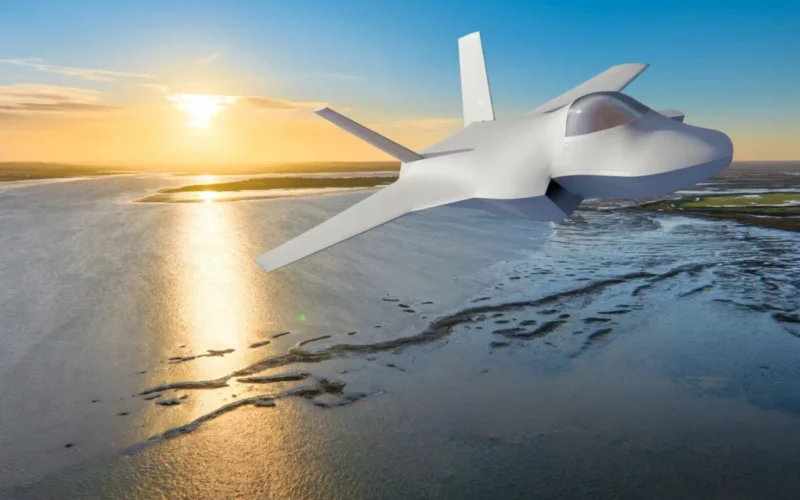
In a bold step towards redefining the future of air combat, the United Kingdom, Italy, and Japan have joined forces under the Global Combat Air Program (GCAP) to build one of the most advanced sixth-generation fighter jets ever conceived.
Known as “Tempest” in the UK, this new aircraft is designed to fly farther, carry more, and think faster than any combat platform in the air today.
This next-generation fighter will enter service by 2035 and remain operational until at least 2070.
It will form the core of a new air combat ecosystem meant to meet the challenges of high-end warfare beyond 2040.
On May 20, BAE Systems, the lead UK defense company on the program, revealed new details that confirm Tempest’s place as a defining weapon of future air dominance.
Tempest: An international alliance for air superiority
GCAP is not a typical defense project. It represents a deeply integrated alliance involving three major powers working as equals: the United Kingdom, Italy, and Japan.

The industrial leaders are BAE Systems (UK), Leonardo (Italy), and Mitsubishi Heavy Industries (Japan).
Together, these companies are creating a fighter aircraft and a networked combat system to dominate future battlefields.
The programme builds upon previous research under “Team Tempest” since 2018.
The cooperation has matured into a trilateral effort with formal treaties signed by the three governments.
Each country brings distinct expertise in airframe design, avionics, propulsion, and electronics, making GCAP a true international industrial and military collaboration model.
The fighter is expected to stimulate economic growth, secure thousands of high-skill jobs, and create lasting innovation across defense and civilian sectors.
Over 1,000 suppliers are already involved, many from high-tech industries outside the traditional defense sector.
Designed for tomorrow’s war
In a detailed interview, Group Captain Bill, the Royal Air Force officer leading capability definition for GCAP, recently shed light on the fighter’s mission.
The vision is clear: Tempest will not only strike hard and deep but will do so independently, without relying on vulnerable support systems like tankers or AWACS aircraft.
“We’re designing Tempest to fly far, carry heavy, and think fast,” he said. “That’s what the next generation of combat requires.”
The aircraft’s design focuses on three critical capabilities: range, payload, and autonomy. Let’s break them down.

Tempest will have an unprecedented combat radius. Unlike today’s fighters that need frequent aerial refueling, Tempest is built to fly deep into enemy territory on internal fuel alone.
RAF officials have stated that the aircraft could cross the Atlantic without needing mid-air refueling, a feat impossible for current fighters like the Eurofighter Typhoon, which needs up to four refuels for that journey.
This extended range is essential in future conflict zones where support aircraft may not survive.
As Group Captain Bill put it, “The threat environment means that range has become a big thing for all of us. You’ll have to leave the tanker a long way behind.”
The focus on fuel also brings strategic flexibility. It allows the RAF to operate from remote airbases, reduce dependency on logistics chains, and maintain pressure in denied airspace.
In future wars, survivability may depend less on stealth and more on endurance. Tempest aims to deliver both.
Tempest payload: More than just weapons
Tempest’s internal payload capacity will be nearly double that of the F-35A, America’s current fifth-generation stealth fighter.
While the F-35A can carry around 5,000 pounds of weapons internally, the Tempest is designed to exceed 10,000 pounds.
This makes it capable of launching longer-range missiles, new classes of guided munitions, and a wide array of electronic warfare tools.
“Weapons are obvious—and boy, will we have weapons,” said Group Captain Bill. But he emphasized that payload isn’t just about bombs and missiles.
The aircraft is essentially a “flying server rack,” packed with computing power and sensor suites that allow it to operate even when cut off from command links.

In combat scenarios where communications may be jammed or disrupted, Tempest can still find, track, engage, and assess enemy targets independently.
Payload also includes the aircraft’s ability to carry and control unmanned systems. In this role, Tempest will act as the command node, managing drone swarms and adjusting tactics in real-time.
This makes it not just a weapon platform, but a battlefield brain that can make decisions when others can’t.
Intelligence in the sky
Tempest is more than a fast, stealthy aircraft. It is an intelligent system. The aircraft has been built around digital engineering, Artificial Intelligence (AI), Machine Learning (ML), and adaptive mission systems since its inception.
This includes wearable cockpit technologies, where pilot biometrics and thought processes can be used to guide decision-making. Advanced AI support will filter threats, recommend actions, and even conduct split-second targeting on behalf of the pilot.
As Group Captain Bill put it, “The quarterback walks onto the field knowing the play. Some players won’t survive the play. The quarterback has to adjust, make the call, and still deliver the mission.”
This level of autonomy is critical in modern warfare. As anti-access and area-denial (A2/AD) systems grow stronger, Western air forces must build platforms that can adapt and survive even when isolated.
Digital factories and global supply chains
GCAP is also pioneering how future aircraft will be built.
Intelligent factories have been established in the UK, Japan, and Italy. These facilities use advanced robotics, 3D printing, and data-driven quality control to reduce cost and increase production speed.
Supply chains are global but digitally linked. This allows real-time collaboration across continents. Companies like Rolls-Royce (UK), IHI (Japan), and Avio Aero (Italy) are jointly developing the next-generation propulsion system.
Similarly, Leonardo, Mitsubishi Electric, and ELT Group are working on the fighter’s integrated sensors and electronic warfare suite.
This approach ensures Tempest will be advanced, affordable, maintainable, and upgradeable throughout its life cycle.
BAE Systems CEO Charles Woodburn states, “The agreement with Japan and Italy is fundamental to meeting the goals set out in the UK Combat Air Strategy. It will create and sustain thousands of high-value jobs and benefit hundreds of companies across the UK.”
He added that the programme will secure the UK’s sovereign combat air capability, a strategic priority in an era where reliance on foreign platforms can compromise national security.
Tempest ensures that the UK and its partners control critical technologies, mission software, and operational doctrines.
This is especially important in emerging peer threats and shifting alliances.
The fighter of the future
The Global Combat Air Programme is more than just a fighter jet project.
It’s a blueprint for future warfare and how allies can unite to maintain peace through strength.
Tempest is shaped by the harsh realities of future war: long distances, contested skies, and the need to act independently in high-threat zones.
Its design reflects these requirements, focusing on endurance, firepower, and intelligence.
If it delivers as promised, Tempest will not just replace current platforms. It will transform how air power is projected and how nations prepare for tomorrow’s battles.
Potential features of Tempest:
• Range: Capable of transatlantic flight on internal fuel.
• Payload: Over 10,000 lbs internal capacity; double that of F-35A.
• Stealth: Low-observable design for deep-penetration missions.
• AI Integration: Onboard cognitive systems for autonomous operations.
• Multi-Domain Control: Command node for drone swarms and other platforms.
• Digital Engineering: Fully model-based development and testing.
• Service Entry: Targeted for 2035; operational till 2070.
Featured image: Artist’s render of GCAP. (Credit: BAE Systems)
