
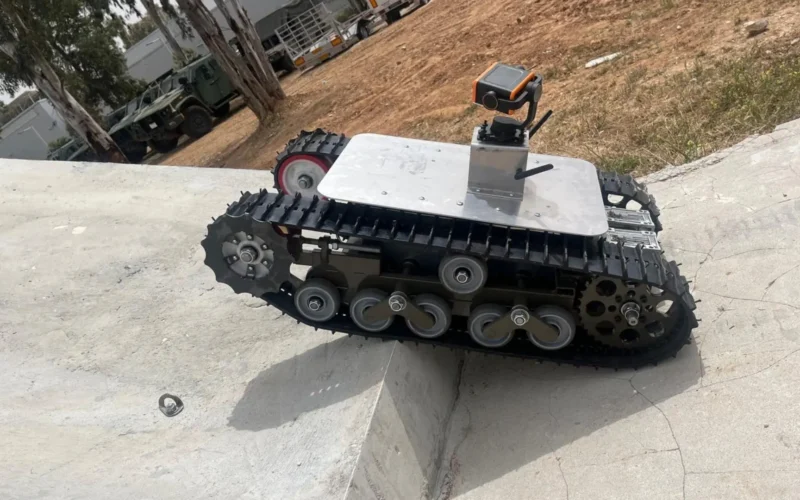
In a significant leap for urban warfare capabilities, the Israel Defense Forces (IDF) has begun operational deployment of a compact, tank-like unmanned ground robot known as The Centipede.
Developed to address the mounting challenges of close-quarters combat and IED detection, this low-cost platform is already making a difference on the battlefield.
Dr Adi Vaxman, founder and president of Operation Israel, the robot developer, confirmed with Tecrow that multiple prototype units are in active use across frontline and special operations units.
Tank-like robot
The Centipede’s deployment marks a shift in Israel’s approach to robotic systems, from expensive, rarely-used platforms to lightweight, mission-adapted, affordable, and readily deployable assets.
At an estimated unit cost of $10,000, the robot fills a critical capability gap for combat troops navigating dense urban terrain.
In an interview with Tecrow, Dr Vaxman, a senior development team member, shared previously undisclosed details about the robot’s technical specifications and real-world value to field commanders.
“From what commanders are telling us, including higher-ups in the counter-terrorism units, similar technologies exist in the IDF inventory, but those systems are much larger, far less maneuverable, and cost around 1 million NIS,” Dr. Vaxman explained.
“Units have been requesting those for months, but to our knowledge, no one has received them since the war began. That’s where Centipede comes in; it’s affordable, agile, and tailored for real missions.”
The Centipede’s low profile and track-based mobility allow it to enter spaces inaccessible to larger UGVs, such as narrow alleyways and rubble-strewn interiors.
Its small form factor combines a robust feature set that supports real-time reconnaissance and threat detection.
Technical Overview
According to information provided to Tecrow, the Centipede is equipped with various advanced features designed for versatile operations.
One of its key capabilities is remote-controlled operation, which enables operators to control the robot from a safe distance, significantly minimizing the risk to personnel involved in potentially dangerous missions.

In addition to its remote functionality, the Centipede boasts thermal imaging technology, allowing it to detect heat signatures even in complete darkness and through obstacles.
This feature is crucial for various scenarios where visibility is compromised.
Furthermore, the robot includes a day/night video feed that streams high-resolution, real-time footage to command units, enhancing situational awareness for operators on the ground.
The Centipede is also equipped with tactical illumination thanks to a built-in high-lumen flashlight, making it suitable for operations in dark or confined spaces.
Its all-terrain tracks enable it to easily climb stairs, maneuver through rubble, and navigate tight indoor environments.
The Centipede offers independent track control to enhance its maneuverability, allowing for pivot turns and full 360-degree rotation.
Regarding endurance, the Centipede delivers an impressive battery life of 5 to 6 hours of continuous operation per charge.
Its operational range extends roughly 1 mile, providing flexibility in urban and semi-urban theaters, making it a valuable tool for various tactical missions.
Dr Vaxman also confirmed that enhanced models are in development, with payload capability being added.
“The next version will be able to collect objects from field missions and bring them back.”
Operational Use and Demand
The Centipede is not just a prototype, it is already proving its utility in real combat environments, Dr Vaxman said.
“Several units of The Centipede are currently deployed with IDF field and frontline forces,” Dr. Vaxman added.
“They’ve been used to identify heat signatures, locate improvised explosive devices, and clear dangerous interiors before soldiers enter.”
These robots are being provided to IDF units through Operation Israel, a donor-funded initiative supporting technological solutions for combat troops.
While dozens of units have already been supplied, demand far outpaces production. “Dozens more units are requesting the robot right now. We need the resources to keep up with manufacturing,” Dr. Vaxman noted.
In a press release accompanying the Centipede’s rollout, the development team emphasized its strategic intent: providing a rugged, dependable, cost-effective solution for combat troops working in high-risk urban environments.
With full-scale wars often playing out block by block, tools like The Centipede may prove essential for survivability and mission success.
Unlike larger UGVs that are cost-prohibitive and logistically burdensome, this platform is designed to go where soldiers go, and sometimes, where they can’t.
As the war in Gaza and other regional threats continue to evolve, the Centipede offers a rare combination of affordability, deployability, and battlefield relevance, one that could soon become standard issue for modern infantry units operating in the world’s most dangerous urban theaters.
Featured image: The Centipede is a compact, tank-like robot that can scout buildings, tunnels, and collapsed structures remotely. (Credit: Operation Israel)
