
For decades, the dream of flying from New York to London in less than four hours has been more science fiction than reality.
Supersonic travel – flying faster than the speed of sound – promises a revolution in speed, but in the United States, it has long been grounded. The reason: the ear-splitting crack of the sonic boom.
That thunderous shockwave, which rattles windows and startles communities below, led the Federal Aviation Administration to ban overland supersonic flights in 1973.
The Concorde, the most famous supersonic passenger jet, could only cross oceans, and even then, it was notorious for noise complaints near airports.
Now, a US aerospace company says it has a solution – a new jet designed to fly faster than sound without leaving a disruptive boom behind.
If successful, the aircraft could bring back supersonic travel and slash the New York–London flight time to under four hours.
The Spike S-512 Diplomat
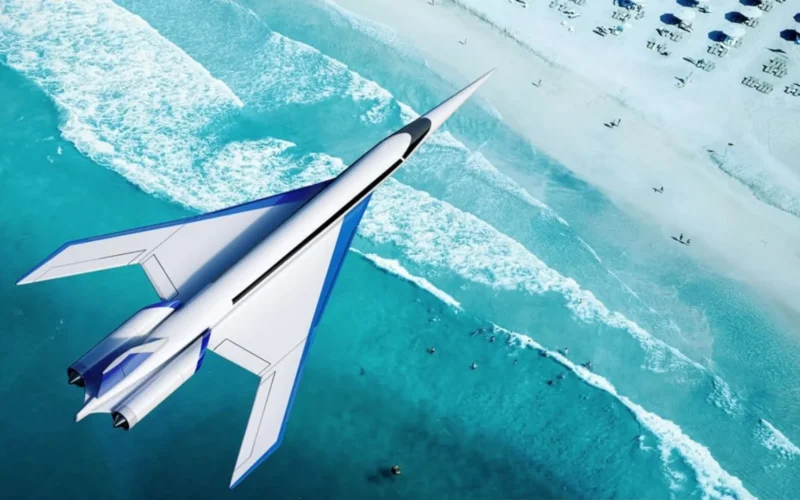
Boston-based Spike Aerospace announced that it is making significant progress on its flagship supersonic business jet, the Spike S-512 Diplomat – a plane engineered to deliver safe, quiet, and fuel-efficient supersonic travel over both land and water.
“Imagine New York to Paris in under four hours, without the disruptive sonic boom,” said Vik Kachoria, President and CEO of Spike Aerospace.
“The S-512 Diplomat is being engineered to connect cities like New York and Paris in under four hours, quietly and sustainably.”
The company has entered a new design phase, refining the jet’s aerodynamics, cabin configuration, and low-boom performance.
According to Spike, these refinements are aimed at meeting stringent noise requirements for overland supersonic flight, something that would dramatically expand route flexibility and make transcontinental flights feasible for the first time in decades.
“We have specifically shaped the elongated nose cone, high-swept wings, and tail to reduce the coalescing of the shock wave,” a company spokesperson told Tecrow.
“The nose has been shaped to reduce the shock wave propagated to the ground. In addition, we are using a multi-lobe lift distribution. The aircraft uses a number of elements from the X-59 program.”
Borrowing from NASA, pushing further
NASA’s X-59 program, currently in flight testing, is the most visible example of “quiet supersonic” design.
Engineers there have experimented with shaping the nose, fuselage, and wings so that the jet produces softer pressure changes instead of one loud boom – more like a thump or a “heartbeat” sound.
Spike says it is taking a similar route. “We have specifically shaped the elongated nose cone, high-swept wings, and tail to reduce the coalescing of the shock wave,” a company spokesperson added.
“The nose has been shaped to reduce the shock wave propagated to the ground. In addition, we are using a multi-lobe lift distribution. The aircraft uses a number of elements from the X-59 program.”
Much of that work is happening digitally. “At this time, our analysis is through CFD runs. We will conduct wind-tunnel tests for specific flight conditions which are more difficult to model in CFD,” the spokesperson said, referring to computational fluid dynamics simulations.
The jet’s body has also been “area ruled,” a classic aerodynamic principle that smooths out drag at high speeds.
On the engine side, the company is pursuing low-bypass turbofans and carefully considering placement.
“Yes,” the spokesperson said when asked if over-wing or tail mounting could help shield people on the ground from noise.
The regulatory hurdle
Even the most elegant engineering won’t matter if regulations don’t shift. The FAA and its European counterpart, EASA, still ban supersonic passenger jets over land. But Spike sees momentum changing.
“The recent executive order to repeal the ban will be key in making overland supersonic flight possible,” the spokesperson said.
“Of course, this has to be done in consideration of airport communities and people and animal life on the ground. An acceptable PLdB [a measure of perceived loudness] will need to be determined and certified to.”
At subsonic speeds, where airports are most sensitive, the firm says its design will comply with existing rules.
“Takeoff and landing noise is critical and of special concern in airport communities,” the spokesperson said. “We expect our aircraft to comply with Stage 5/Chapter 14 regulations.”
The team is modeling weather and atmospheric data to ensure the boom-free performance works in real-world conditions.
“We are incorporating weather data in our boom analysis and suppression,” the spokesperson added.
From Concorde to today
The effort marks a dramatic turn from the Concorde era, when supersonic travel was possible but unsustainable.
The British-French airliner entered service in 1976, slicing the New York–Paris trip to under 3.5 hours. However, with ear-splitting noise, limited range, and sky-high fuel costs, Concorde never attracted more than 20 operational aircraft. It was retired in 2003.
Other concepts followed – from Boeing’s studies of “quiet supersonic” airliners to smaller startups – but most failed to overcome the two major barriers: noise and economics.
What’s different today, advocates say, is computing power and advanced design methods. Engineers can now digitally sculpt shockwaves and test boom-softening strategies before any metal is cut.
Spike is also engaging industry veterans, academic partners, and certification experts to accelerate design and market readiness.
The race to reclaim speed
Much about the new jet remains undisclosed. The company declined to answer questions about whether it is pursuing active boom-cancellation systems, the trade-offs between low-boom shaping and cruise efficiency, or whether special composite materials will be used to handle heat and stress at Mach 1.5.
But the ambition is clear: to put the US back at the front of the supersonic race. “Supersonic travel has always been a dream,” the spokesperson said.
“We believe the combination of shaping, aerodynamic refinement, and regulatory support will make it possible to realize that dream – without the boom.”
If that vision holds, the crack of the Concorde could one day be replaced with something quieter: the sound of passengers landing in London before they’ve even finished watching a movie.
Banner Image: The S-512 Diplomat is designed to combine speed, comfort, and privacy for business leaders and discerning travelers. (Credit: Spike Aerospace)
