
The U.S. Navy has completed a two-week experiment in northern Michigan testing drones and unmanned surface vessels, part of an exercise called Silent Swarm 25 that focused on how autonomous platforms might survive and operate in future electronic warfare environments.
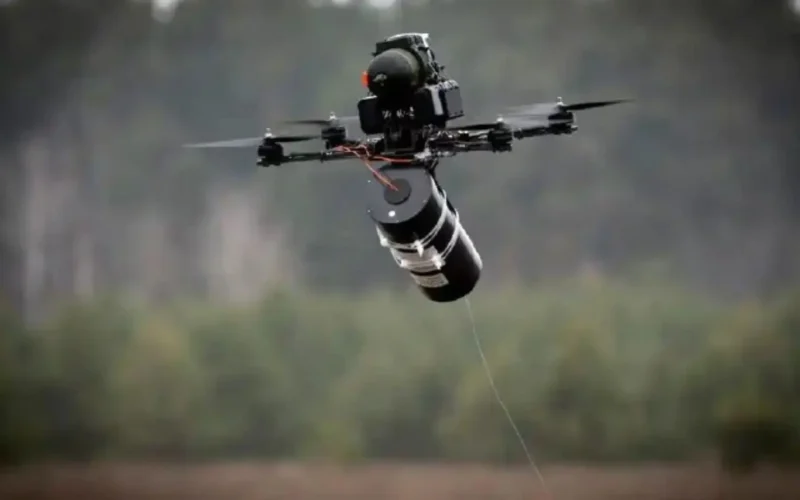
Among the systems evaluated was a drone controlled through a fiber-optic tether – a relatively new concept that has gained traction on battlefields in Ukraine and is now drawing interest from militaries across the world.
The Alpena drills, which concluded last month, marked one of the first public demonstrations of how U.S. forces are experimenting with spool-fed fiber-optic drones.
Unlike conventional drones that rely on radio communications, tethered drones use a lightweight fiber-optic cable to maintain a secure connection with an operator.
That design makes them highly resistant to electronic jamming, a feature already proven critical in Ukraine, where both sides are locked in a cat-and-mouse struggle to dominate the skies with unmanned systems.
Battlefield lessons from Ukraine
The emergence of fiber-optic drones in Ukraine reshaped tactical calculations on both sides of the war. Russia was the first to deploy them, introducing a first-person-view (FPV) model known as the “Prince Vandal of Novgorod” in August 2024 in the Kursk region.
The drones were used to disrupt Ukrainian convoys and attack fortified positions, often succeeding where radio-controlled drones failed.
Ukrainian troops quickly discovered that their electronic warfare units – which had been effective at downing most Russian drones – could not jam fiber-optic systems.
The new threat prompted Kyiv to launch urgent procurement efforts. By late 2024, Ukrainian defense officials were openly calling on domestic manufacturers to supply fiber-optic FPVs in large numbers, labeling them “urgently needed” for frontline operations.
Within months, Ukrainian forces began fielding their versions, but the episode underscored a striking reversal.
For much of the war, Ukraine had been a global leader in drone innovation, from mass-produced FPVs to long-range strike systems. In this case, it was forced to catch up to a Russian innovation that was difficult to counter.
Silent Swarm 25 suggests that the U.S. military is closely tracking these developments.
By integrating fiber-optic drones into its experimentation cycle, the Navy signaled interest in adapting the technology for swarming operations, electronic warfare missions, and persistent surveillance under contested conditions.
How fiber-optic drones work
Fiber-optic spool-fed drones operate on a simple principle. A thin cable, wound tightly on a spool and attached to the drone, unravels as the aircraft flies.
Both video feeds and control commands travel through the line, ensuring uninterrupted communication between the operator and the drone. Because the cable does not rely on radio frequencies, it is nearly impossible to jam.
The design has other advantages. Real-time video quality is often higher than radio-based drones, helping operators distinguish between real targets and decoys.
Fiber-optic drones can also maneuver in environments where radio-controlled aircraft struggle, such as tunnels, bunkers, or dense urban areas.
And because they do not emit strong electromagnetic signals, they are harder to detect with electronic warfare sensors.
Social media footage from Ukraine and Russia regularly shows tethered drones operating effectively on battlefields saturated with jamming equipment.
“The survivability of these systems is what makes them so disruptive,” said a Western defense analyst who monitors unmanned systems in Ukraine. “They are cheap, relatively simple to build, and extremely difficult to neutralize.”
Beyond Ukraine, militaries in Europe, Asia, and the Middle East are beginning to explore the role of fiber-optic drones.
Defense researchers say the technology could be particularly valuable in any conflict where electronic warfare plays a central role, including a potential confrontation in the Indo-Pacific.
In China, state-backed firms have demonstrated tethered drone prototypes at defense exhibitions. Iran has also publicized the development of similar systems for surveillance and one-way attack missions.
Israel, which has long invested in unmanned platforms, has reportedly tested fiber-optic drones for urban counterterrorism operations.
For the United States, Silent Swarm 25 was about evaluating drones and understanding how unmanned platforms can function as part of a larger, coordinated network.
Navy officials described the drills as an opportunity to experiment with “spectrum maneuvering,” or the ability to maintain operations even when communications are contested.
Benefits and drawbacks
The advantages of fiber-optic drones are clear, but not without limitations. Operators must account for the cable, which can tangle on the battlefield or glint in sunlight, potentially exposing the drone’s origin point. Long fiber lines can also act like sails, making drones harder to control in high winds.
Another drawback is logistics. Spools add weight, limiting the payload a drone can carry. Once a spool is fully unwound, the cable cannot be reeled back in, leaving the battlefield littered with strands that can pose hazards to vehicles or personnel.
Still, the advantages appear to outweigh the risks. For military planners, deploying a drone immune to jamming – capable of operating in underground or shielded environments – represents a significant tactical breakthrough.
U.S. commanders say exercises like Silent Swarm are essential for staying ahead of adversaries.
While no procurement decisions have been announced, integrating fiber-optic drones into test events allows engineers and operators to evaluate whether the systems fit into American doctrine.
“The operational environment is becoming increasingly saturated with electronic warfare threats,” a Navy spokesperson said. “Understanding how tethered systems can provide resilience is a priority.”
Army leaders are also paying attention. In a March 2025 issue of Stars and Stripes, Lt. Gen. Joseph Ryan warned that U.S. forces lag behind adversaries in adapting to fiber-optic drones.
Analysts note that while the U.S. military has invested heavily in counter-drone systems, many rely on detecting or jamming radio signals – a far less effective method against tethered drones.
The spread of fiber-optic drones underscores a broader trend: rapid innovation in unmanned systems is reshaping warfare faster than militaries can adapt.
In Ukraine, each new capability has sparked a countermeasure, only to be answered by another innovation. Fiber-optic drones remain one of the few technologies that have resisted effective countermeasures for more than a year, a rare longevity in the constant technological churn of the conflict.
Experts say it is only a matter of time before counter-technologies are developed. But until then, fiber-optic drones are likely to expand across global militaries.
Their low cost and resistance to jamming make them especially attractive to smaller states or non-state actors seeking to offset traditional power imbalances.
As Silent Swarm 25 showed, the United States is preparing for a future battlefield where the electromagnetic spectrum will be contested and resilience will be decisive.
Whether fiber-optic drones become a permanent fixture of American arsenals remains to be seen. Still, their rapid spread worldwide has already made them a defining feature of modern warfare.
