
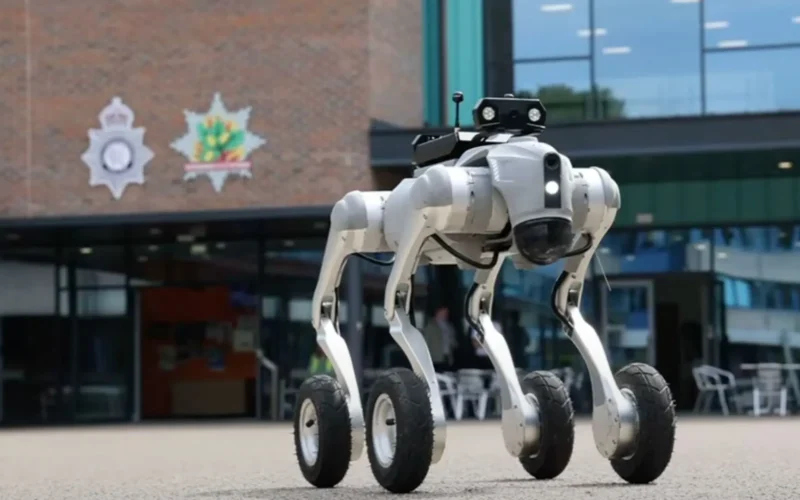
A state-of-the-art robot dog, equipped with thermal cameras and 3D scanning technology, is undergoing trials with British firearms officers in what could signal a new era of frontline policing.
The four-legged machine, remotely operated and built for difficult terrain, is being tested by Nottinghamshire Police to determine whether it can be deployed in armed sieges, hostage situations, and hazardous building searches. Police say the device, if successful, could be integrated into active service as early as 2026.
The robot, funded by the Office of the Chief Scientific Adviser, represents the U.K.’s latest push to blend robotics with policing, aiming to reduce risks to human officers in dangerous operations. The pilot program will run for 12 weeks, during which the robot will be placed in simulated training scenarios before results are presented to the Home Office.
How the robot works
The robot resembles a dog in its movement and structure, but operates with wheeled feet and advanced sensors. Its thermal imaging system allows officers to detect people in low-light environments, while its onboard scanners produce precise three-dimensional maps of rooms, corridors, and staircases.
Unlike small reconnaissance drones already used by British police, the robot can move silently inside buildings and climb stairs, giving officers an expanded ability to collect intelligence without revealing their presence. Officials say it can also navigate rubble and other obstacles where drones might be ineffective.
“This equipment can enhance officer and public safety but will always complement the deployment of armed officers,” Superintendent Louise Clarke of Nottinghamshire Police said in a statement. “We can gather vital intelligence about volatile situations without putting lives at risk.”
Police officials stress the device is not meant to replace existing canine units. Traditional police dogs remain irreplaceable for pursuits, narcotics detection, and weapons searches because of their speed and acute sense of smell. Instead, the robot dog is being framed as a reconnaissance tool that can enter areas considered too dangerous for people or animals.
A tool for extreme situations
The testing program comes at a time when U.K. law enforcement agencies are exploring new ways to address high-risk scenarios. Clarke said one possible use case is responding to incidents involving chemical or biological hazards, where human exposure could be fatal.
“In the unlikely event of an incident involving chemical or biological agents, we would have access to another form of reconnaissance to gather vital information,” she said.
The trials will include simulated armed sieges, live building entry exercises, and hostage negotiations. Each test will evaluate the robot’s performance under pressure and its ability to provide real-time intelligence to command units.
Part of a global shift
The U.K. is not alone in exploring robotic systems for policing and defense. Across the world, governments are investing heavily in quadrupedal robots, viewing them as versatile platforms for surveillance, search and rescue, and even tactical missions.
In the United States, the New York Police Department reintroduced robotic dogs, built by Boston Dynamics, into its fleet in 2023 after facing public backlash when they were first deployed in 2021. NYPD officials said the robots, dubbed “Digidogs,” are used primarily for hostage rescues and hazardous material incidents.
The U.S. Department of Homeland Security has also trialed robotic dogs along the southern border, testing their ability to patrol rough desert terrain and assist border agents. Defense contractors in the U.S. have increasingly adapted quadruped robots for military use, with models capable of carrying payloads and integrating with weapons systems.
China has moved aggressively in the same direction. In 2022, Chinese state media showcased a robotic dog mounted with a machine gun during military drills in Tibet, sparking international debate over the ethical implications of armed robots. The Chinese military has also demonstrated swarming tactics with quadrupedal robots, pairing them with drones for battlefield operations.
South Korea, Japan and Singapore have tested robotic dogs for disaster response, including entering collapsed buildings to search for survivors. In Tokyo, robots have been used in earthquake drills to complement human first responders. Singapore police have deployed quadruped robots in public parks to broadcast COVID-19 safety messages, demonstrating their potential for non-combat applications.
Israel has incorporated robots into border security operations as well. The country’s defense forces have trialed quadrupedal robots capable of carrying surveillance gear and operating semi-autonomously in contested areas.
Balancing security and ethics
The spread of robotic dogs in policing and military contexts has raised questions about accountability, surveillance, and civil liberties. Critics argue that their presence could normalize militarized policing and infringe on privacy rights if deployed in public areas.
Human rights groups have also expressed concern over the weaponization of robotic platforms, particularly after China’s display of an armed quadruped. Boston Dynamics, the U.S.-based robotics firm, has explicitly prohibited attaching weapons to its robots and urged other manufacturers to follow suit.
In Britain, Nottinghamshire Police emphasized that the robot dog currently under testing is unarmed and designed exclusively for reconnaissance and support. Officials framed the trials as a scientific evaluation, with the Home Office to make final decisions on whether such technology will see operational use.
If the pilot program is deemed a success, the robot could be introduced to frontline policing in 2026, potentially joining a growing suite of tools aimed at reducing risks to officers.
“This is really exciting technology,” Clarke said. “It is about enhancing safety, improving intelligence gathering, and making sure our officers are better equipped to respond to dangerous and unpredictable scenarios.”
Still, questions remain about cost, training, and public acceptance. Equipping forces with robotic dogs requires substantial investment in both hardware and operator training. Early versions of Boston Dynamics’ robots were priced at around $75,000 each, though prices have since declined as manufacturing has scaled.
For now, Nottinghamshire Police’s testing program is being watched closely, not only by other U.K. forces but by international observers monitoring how robotic platforms might reshape law enforcement in the coming decades.
Nearly a decade after the U.S. military retired its early quadrupedal “BigDog” prototypes, the vision of robots patrolling alongside human officers is no longer science fiction. With Britain’s trials underway, the global race to integrate robotic dogs into security operations is accelerating — and may soon redefine how governments approach safety, surveillance, and high-stakes policing.
