
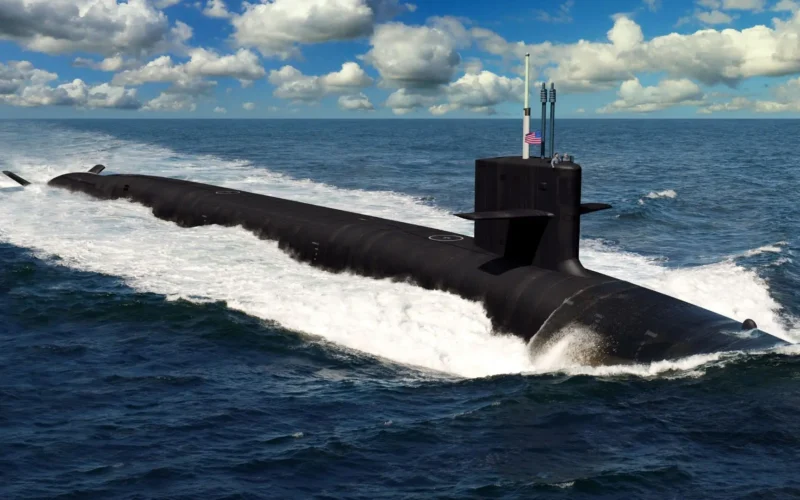
The United States Navy marked a pivotal step in its most consequential shipbuilding program in generations on August 27 when the keel of the future USS Wisconsin (SSBN-827) was laid at the General Dynamics Electric Boat facility in Quonset Point, Rhode Island.
The ceremony, rich in tradition and symbolism, underscored the industrial might behind the Columbia-class ballistic missile submarines and their strategic role as the most survivable leg of America’s nuclear deterrent.
The keel laying, a ritual dating back centuries, marks when a ship transitions from design to physical construction.
For the Navy, it is more than a symbolic gesture. It is the foundation of a vessel that will remain at sea for over four decades, carrying nuclear weapons as a silent guarantor of national security.
US Navy’s second next-gen nuclear submarine
The Wisconsin is the second submarine of the Columbia class, following the lead boat, the future USS District of Columbia (SSBN-826), now under construction. Together, they represent the beginning of a new era in undersea deterrence as the aging Ohio-class submarines approach retirement.
Admiral William Houston, director of the Naval Nuclear Propulsion Program, delivered the keynote address at the ceremony.
“From this keel, the Wisconsin will rise – an intricate structure of power, precision, and purpose,” Houston said.
“Just as the keel bears the weight of the ship, this vessel bears the weight of our nation’s most solemn responsibility: to deter war and preserve peace through strength.”
He praised the shipbuilders, engineers, and suppliers who have labored to translate blueprints into steel, describing their craftsmanship as the “foundation of security for generations to come.”
The ship’s sponsor, Dr. Kelly Geurts, a retired educator and longtime military spouse, authenticated the keel by welding her initials into a steel plate.
Her husband, James “Hondo” Geurts, is a former Assistant Secretary of the Navy for Research, Development, and Acquisition, whose leadership helped shepherd many of the Navy’s most complex modernization efforts.
The event drew naval leaders, shipyard workers, and local officials, all of whom recognized the moment’s gravity. The date carried symbolic resonance – August 27, chosen to match the hull number, SSBN-827.
USS Wisconsin
The name Wisconsin carries its own storied lineage. The first USS Wisconsin (BB-9) was an Illinois-class battleship commissioned in 1901.
It served as the flagship of the Pacific Fleet before joining the famed Great White Fleet on its world cruise. The second, USS Wisconsin (BB-64), was an Iowa-class battleship that fought in World War II, Korea, and the Gulf War.
Decommissioned in 1991, it now rests as a museum ship in Norfolk, Virginia. The third vessel to carry the name will not thunder across seas with 16-inch guns, but instead glide silently beneath the waves, armed with Trident II D5 ballistic missiles.
The Columbia-class program is the Navy’s top acquisition priority. Designed to replace the 14 Ohio-class SSBNs, which began entering service in the 1980s, the Columbia class represents a generational investment in nuclear deterrence.
Each boat will displace roughly 20,800 tons submerged, measure 560 feet in length, and carry 16 missile tubes – four fewer than the Ohio-class, but each missile more advanced thanks to the life-extension program for the Trident II D5 system.
Powered by a life-of-ship nuclear reactor, Columbia-class submarines will not require midlife refueling, allowing uninterrupted service over their projected 42-year operational lives. Navy planners expect the class to remain in service into the 2080s.
Central to the Columbia-class design is stealth and survivability. The submarines will use an electric-drive propulsion system paired with a pump-jet propulsor, reducing acoustic signature and making detection by adversary forces more difficult.
Their sonar suite and combat systems draw on technology from the Virginia-class attack submarines, integrating decades of lessons from the undersea fleet.
This combination ensures that the Columbia class will remain at the cutting edge of submarine technology throughout its service life.
Cost about $15 billion
The cost of such capability is considerable. The first boat, the District of Columbia, is projected to cost about $15 billion, including research and development. Subsequent submarines are expected to average $9.3 billion each.
According to Congressional Research Service estimates, the total program cost, covering all 12 vessels and associated infrastructure, may exceed $130 billion.
Lawmakers have raised concerns about the price tag, but Pentagon leaders insist the program cannot be delayed.
The Ohio-class boats, many already extended beyond their planned service lives, will begin to retire in the late 2020s. Without Columbia-class replacements, the Navy risks losing its continuous at-sea deterrent.
The strategic importance of ballistic missile submarines cannot be overstated. Often called “boomers,” these vessels form the most survivable element of the nuclear triad, complementing land-based intercontinental ballistic missiles and strategic bombers.
Operating deep beneath the oceans, they are exceedingly difficult to track and destroy, ensuring that any nuclear attack on the United States would be met with a devastating retaliatory strike.
This assured second-strike capability is what makes them the bedrock of deterrence. Adm. Houston noted that they are “the ultimate guarantee that no adversary will ever miscalculate America’s resolve.”
The Columbia-class program also represents a massive industrial effort. Electric Boat, headquartered in Groton, Connecticut, and its Quonset Point facility in Rhode Island, are the lead builders, supported by Newport News Shipbuilding in Virginia.
Thousands of suppliers across the United States contribute specialized components, from nuclear reactors to sonar arrays.
The program is already reshaping the American submarine industrial base, generating jobs, training new workers, and driving technological innovation.
Maintaining this workforce will be critical, as the Navy simultaneously continues to produce Virginia-class attack submarines to meet operational demands.
Columbia-class submarine
Globally, the Columbia-class enters service amid a renewed focus on undersea deterrence. Britain’s Royal Navy is developing the Dreadnought-class submarines to replace its Vanguard-class boats.
France is working on its third-generation SSBN, known as SNLE-3G. Russia is commissioning Borei-class submarines armed with Bulava missiles, while China continues to expand its Jin-class SSBN fleet, though Western analysts question their stealth.
Each of these programs reflects the enduring role of ballistic missile submarines as strategic stabilizers in an era of great power competition.
The Columbia-class is also designed with future adaptability in mind. Its missile tubes will be compatible with evolving versions of the Trident system, and its electronic architecture allows for upgrades as technology advances.
The Navy expects each Columbia-class boat to conduct about 124 deterrent patrols over its lifetime. With fewer boats in the fleet compared to the Ohio class – 12 instead of 14 – the Columbia design incorporates enhanced reliability to ensure that at least 10 SSBNs are available for operational patrols at any given time.
For Wisconsin’s namesake state, the keel laying carried special significance. Lawmakers and veterans groups from Wisconsin have celebrated the honor, noting that the vessel’s silent patrols will extend the state’s naval heritage into the 21st century.
The Navy’s milestone reaffirmed a commitment to maintaining dominance beneath the seas. “From seabed to space, the Navy delivers power for peace – always ready to fight and win,” the service said in a statement marking the occasion.
Construction of the Wisconsin will continue over the next several years, with modular sections assembled at Quonset Point and Groton before final integration. If the schedule holds, the submarine will be christened in 2029 and delivered to the Navy in 2031, just in time to replace retiring Ohio-class boats.
For the sailors who will one day crew her, and for the shipbuilders now welding her frame, the future USS Wisconsin is more than a warship. It is a vessel entrusted with safeguarding peace in an uncertain world.
The keel now lies in place, steel upon steel, initials etched in permanence. Above it rests not only the weight of the submarine that will rise, but the burden of deterrence it will carry silently into the depths.
With Wisconsin at its vanguard, the Columbia-class ensures that the US will continue to project its most powerful and survivable force – unseen, undetected, but always ready.
