
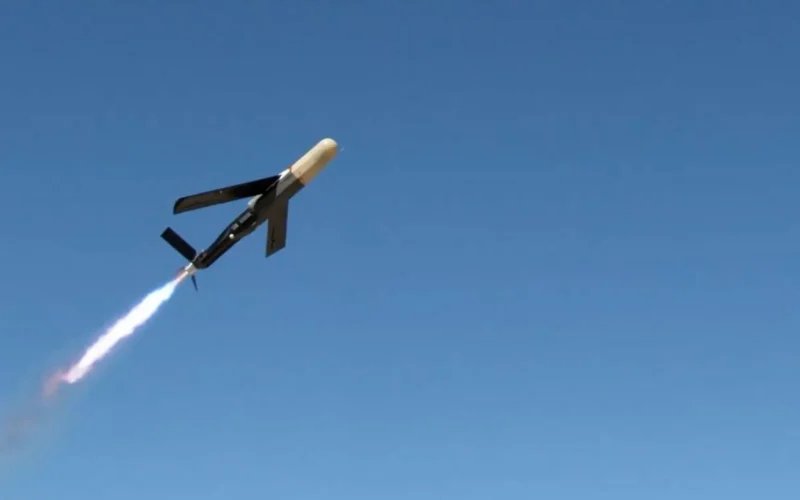
Raytheon, an RTX business, has demonstrated the capabilities of its Coyote Block 3 Non-Kinetic (NK) counter-unmanned aircraft system (C-UAS) during a recent US Army exercise, defeating drone swarms launched as part of the event.
According to the company, the demonstration validated the system’s launch, flight, intercept, and recovery performance. The Block 3NK variant employs a non-kinetic payload – such as directed energy effects, including laser or microwave – to neutralise drone swarms while minimising the risk of collateral damage.
Unlike expendable interceptors, the system can loiter in the engagement area and be recalled for reuse in subsequent missions.
Non-kinetic counter-swarm capability
Coyote Block 3NK forms part of the wider Coyote family of effectors developed by Raytheon for C-UAS and launched effects (LE) missions.
The non-kinetic variant is designed to counter small to large unmanned aircraft systems (UAS) at extended ranges and higher altitudes relative to comparable class effectors, the company said.
The system is integrated with Raytheon’s Ku-band Radio Frequency Sensor (KuRFS), which provides detection, tracking, and fire-control support.
Together, the Coyote effector and KuRFS radar architecture constitute a key component of the U.S. Army’s Low, slow, small-unmanned aircraft Integrated Defeat System (LIDS) programme.
Raytheon recently received its largest counter-drone contract to date under LIDS. The award follows increased demand for layered counter-UAS architectures capable of addressing both individual drones and coordinated swarm threats.
Tom Laliberty, president of Land & Air Defense Systems at Raytheon, said the Coyote family provides a “cost-effective defense for individual drones and swarms” and that the company continues to invest in production capacity and performance upgrades.
Kinetic and non-kinetic variants
The Coyote portfolio comprises both kinetic and non-kinetic configurations.
Coyote Block 2 is an expendable, rail-launched interceptor equipped with a kinetic warhead. It uses a boost rocket motor and turbine engine to achieve high speed for direct engagement of UAS targets.
By contrast, Block 3NK uses a non-kinetic defeat mechanism and is designed for loitering operations, enabling multiple engagements within a single sortie. The recoverable architecture is intended to reduce cost per engagement in high-density swarm scenarios.
Raytheon said ongoing upgrades across the Coyote line have focused on enabling faster launch sequences, higher speeds, and improved range at greater altitudes to counter next-generation UAS carrying heavier payloads over longer distances.
Expansion into launched effects
Beyond the dedicated C-UAS role, Raytheon has expanded the Coyote architecture into a family of launched effects systems.
In 2025 the company conducted the first helicopter launch of a new variant, Coyote LE SR, during testing at Nine Mile Training Center. The launch marked the first time a Coyote effector had been deployed from a rotary-wing platform.
The LE SR variant is designed to perform reconnaissance, surveillance and target acquisition; electronic warfare; precision strike; and communications missions. Unlike the kinetic C-UAS variants, the LE family is intended to provide distributed sensing and effects across air, land, and maritime platforms.
According to Raytheon, Coyote LE SR incorporates collaborative autonomy, enabling it to connect with nearby sensors and systems and adapt tactics based on real-time battlefield data. Additional tests of the LE SR variant are scheduled throughout 2025.
The Coyote system has been deployed operationally as a counter-drone interceptor and has intercepted hundreds of drones, according to the company.
Its integration within the US Army’s LIDS architecture reflects a broader shift towards layered, networked C-UAS solutions capable of addressing both single UAS incursions and coordinated swarm attacks.
With both kinetic and non-kinetic configurations and expansion into launched effects, the Coyote family represents a modular approach to counter-drone and distributed battlefield missions.
The recent demonstration of Block 3NK indicates a focus on reusable, lower-collateral defeat options within the Army’s evolving air-defence architecture.
