
Key ideas
- •Komatsu validated hydrogen fuel-cell excavator performance equal to diesel under real construction duty cycles.
- •The main barrier is refueling logistics and on-site hydrogen infrastructure, not machine capability.
- •Hydrogen enables off-grid electrification of medium heavy equipment with lower noise and zero exhaust emissions.
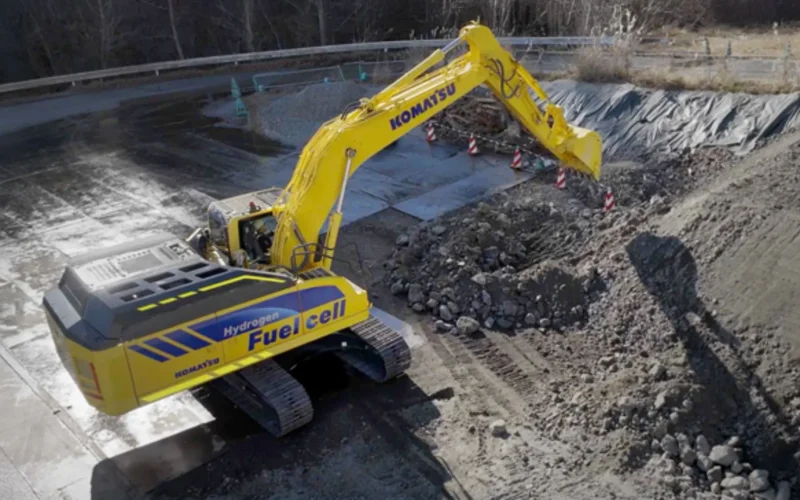
Japan has moved hydrogen construction equipment from controlled demonstrations into real operational conditions following a field trial of a fuel-cell-powered medium hydraulic excavator at an active highway construction project.
The proof-of-concept trial was conducted in December 2025 at the Joshin-Etsu Expressway rockfall mitigation works, where the machine performed soil relocation tasks under standard construction workflows rather than laboratory duty cycles.
The objective was not to confirm that the excavator could move earth, which had already been demonstrated in earlier controlled testing, but to determine whether hydrogen propulsion can sustain the complex load patterns, refueling routines, and safety requirements that define actual construction operations.
The trial, therefore, examined the entire operational chain, including power generation, hydraulic response, fuel storage, refueling logistics, and jobsite integration.
The electrification problem in heavy construction machinery
Medium-class hydraulic excavators represent one of the most difficult categories to decarbonize in off-road equipment. Smaller construction machines can rely on battery power because their duty cycles involve intermittent operation and shorter working durations.
Larger excavators, however, operate under continuous and highly variable hydraulic load, where power delivery must remain stable regardless of rapid operator input. Most construction site emissions originate from diesel engines because they combine endurance, high energy density, and fast refueling.
Replacing diesel, therefore, requires a power source capable of delivering sustained hydraulic energy over long shifts without tethering equipment to grid infrastructure. Battery electric systems struggle at this scale because increasing capacity adds significant weight and requires long charging intervals.
Hydrogen fuel cells instead generate electricity continuously from stored hydrogen, allowing refueling times closer to liquid fuel while retaining electric drive characteristics. This makes hydrogen particularly suited to machinery that must remain mobile and independent from external infrastructure.
Powertrain architecture and energy conversion
The tested excavator replaces the internal combustion engine with a hydrogen fuel-cell power module integrated into an electric drive system. Hydrogen stored in onboard high-pressure tanks feeds a fuel-cell stack, where it reacts electrochemically with oxygen from ambient air across a proton exchange membrane.
The reaction produces electrical power, heat, and water vapour rather than combustion exhaust. Electricity generated by the stack powers motors that drive the hydraulic pumps and traction systems.
A battery buffer manages rapid load fluctuations, absorbing spikes during aggressive digging and releasing energy during sudden hydraulic demand increases. The machine, therefore, operates as an electrically driven hydraulic platform rather than a mechanically driven one.
This architectural change fundamentally alters how the excavator delivers torque. Diesel engines rely on rotational speed and combustion pulses to produce mechanical power, while the electric system provides immediate torque independent of engine RPM.
During the trial, operators experienced consistent hydraulic responsiveness comparable to diesel models, indicating the control system successfully balanced fuel-cell output with battery buffering.
Hydraulic duty cycle behaviour
Excavators impose unpredictable and rapidly changing loads, particularly during bucket penetration and lifting phases. Conventional engines adjust fuel injection rates to compensate.
Fuel-cell systems instead require predictive energy management because electrochemical output cannot change instantaneously without affecting stack efficiency and durability.
Komatsu’s control software distributes power demand between the fuel cell and battery to maintain a stable hydraulic response.
The field test confirmed that the system could sustain continuous excavation tasks without noticeable delay in control feedback.
This outcome is significant because operator perception of responsiveness determines whether new propulsion technologies can be adopted in practice.
The trial showed that peak hydraulic loads did not exceed the capability of the electric-hydraulic architecture, demonstrating that the limiting factor in hydrogen machinery is not instantaneous power output but energy storage duration and replenishment.
Refueling and hydrogen supply logistics
The field evaluation placed particular emphasis on hydrogen handling rather than propulsion mechanics. The excavator was refueled on-site using a differential-pressure transfer system supplied by Iwatani Corporation.
Hydrogen flowed from a higher-pressure external storage unit into the onboard tanks through controlled pressure equalization.
Unlike diesel refueling, hydrogen transfer depends on temperature, pressure gradients, and safety zoning.
Construction sites continuously change layout as work progresses, which influences permissible refueling placement and safety distances. The trial, therefore, assessed how refueling procedures adapt to evolving site geometry rather than static station layouts.
The results identified two primary operational constraints: onboard storage capacity limits working duration, and transfer speed determines operational downtime.
These findings shift the challenge from machine performance to energy logistics, suggesting that deployment feasibility depends on refueling infrastructure design as much as equipment capability.
Acoustic and vibration characteristics
The electric drive significantly reduced vibration compared with diesel operation because combustion impulses were eliminated.
Lower vibration translated into reduced operator fatigue during extended operation, while reduced acoustic output improved situational awareness in the working area.
This operational effect is not directly related to emissions but affects safety and usability. Construction sites depend on auditory cues between workers and machine operators, and quieter equipment changes how environments are managed.
The test demonstrated that propulsion changes can influence human factors in addition to environmental impact.
The PoC indirectly clarified the boundary between battery and hydrogen electrification strategies.
Battery systems remain effective for compact machinery with predictable downtime for charging. Medium excavators require sustained power and minimal interruption, making refueling time critical to productivity.
Hydrogen allows refueling intervals closer to diesel while maintaining electric drive efficiency. However, unlike batteries, hydrogen introduces external supply complexity. The trial therefore showed that hydrogen adoption is less a question of vehicle engineering than of site energy management planning.
Operational integration and roles
Each participating organization addressed a different technical layer of deployment. Obayashi Corporation managed construction site integration and operational supervision, ensuring the machine functioned within realistic workflows.
Iwatani Corporation handled hydrogen supply technology and transfer methodology. Komatsu focused on machine design, control systems, and performance validation.
This division reflects the multidisciplinary nature of hydrogen deployment, where mechanical engineering, energy distribution, and safety regulation must operate simultaneously rather than sequentially.
During the trial period, the excavator performed standard soil relocation operations equivalent to diesel machines. The machine produced no exhaust emissions during operation and demonstrated stable digging performance under continuous workload. Operators reported reduced vibration exposure and improved working conditions due to lower noise.
However, the test also confirmed that commercialization challenges remain. Increased onboard hydrogen capacity and faster refueling processes are necessary to support full-shift operations.
The evolving construction site environment also highlighted the need to define criteria for safe hydrogen deployment areas under existing regulations. The trial, therefore, validated propulsion feasibility while emphasizing infrastructure requirements.
Future development path
The participating companies plan to expand development toward mobile hydrogen refueling systems and operational guidelines for site deployment.
A liquefied-hydrogen mobile refueling station is under development to increase capacity and reduce transfer time, while additional testing will determine which construction scenarios are best suited to hydrogen equipment.
Komatsu continues research toward commercial production of medium and large-sized hydrogen construction machinery, indicating the technology has progressed beyond experimental feasibility but has not yet reached operational standardization.
The significance of the trial lies in demonstrating that off-road electrification can function without grid dependence.
Hydrogen acts as transportable electrical energy rather than stored mechanical fuel, allowing electric machinery to operate in remote environments where grid charging is impractical.
The remaining challenge is integrating energy supply into construction workflow planning. Unlike diesel, which fits into existing logistics, hydrogen requires coordinated site layout, storage planning, and regulatory compliance.
The field trial shows that hydrogen construction equipment has crossed from propulsion development into operational integration.
The excavator itself achieved performance parity with diesel systems, meaning the limiting factor has shifted from mechanical capability to ecosystem readiness.
Hydrogen heavy equipment represents a systemic change rather than a simple engine replacement. The machine, the energy supply chain, and the jobsite design must be engineered as a combined system.
The December 2025 operation illustrates that hydrogen machinery is technically viable, but its adoption will depend on how efficiently construction operations incorporate energy infrastructure into project planning.
In that sense, the test does not mark the arrival of hydrogen construction equipment as a finished product. Instead, it marks the beginning of operational engineering, the stage where technology becomes dependent on industrial processes rather than laboratory performance.
