
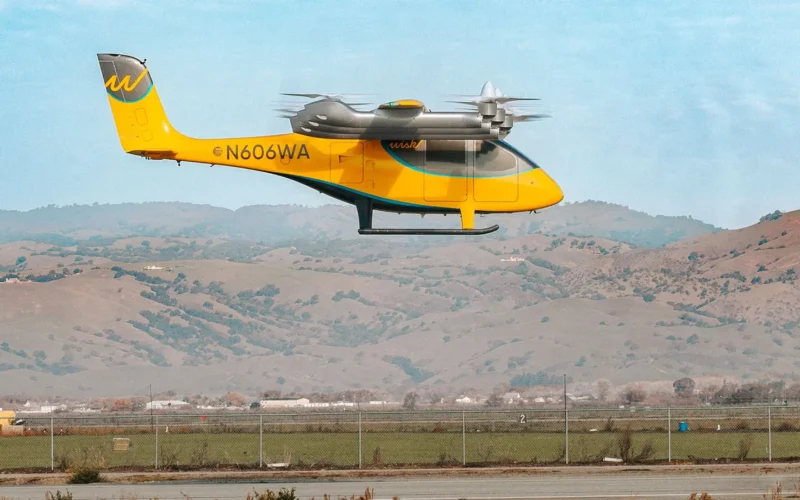
For years, air taxis have hovered on the edge of aviation’s imagination, talked about far more than they were actually flown. Sleek renderings promised quiet electric aircraft lifting commuters over traffic, while timelines slipped and certification remained an open question. At the 2026 Singapore Airshow, that story feels different. This time, Boeing is not showing a concept or a scale model, but an aircraft that has already flown.
At the Singapore Airshow, held at Changi Exhibition Centre from February 3 to 8, 2026, Boeing-backed Wisk Aero is debuting its Generation 6 autonomous air taxi, marking the aircraft’s first appearance in Southeast Asia. The showing comes just weeks after the aircraft successfully completed its first flight in December 2025 at Wisk’s flight test facility in Hollister, California.
The timing matters. Southeast Asia is one of the regions most often cited as a future market for urban and regional air mobility, thanks to dense cities, coastal geography, and heavy traffic congestion. By bringing Gen 6 to Singapore, Boeing and Wisk are signaling that air taxis are no longer a distant idea, but a system slowly being prepared for real-world use.
From concepts to certification candidates
What sets Wisk’s Generation 6 apart from many other air taxi projects is not its shape or its electric motors, but its role in the certification process. Gen 6 is the first-ever candidate for FAA certification of an autonomous passenger-carrying aircraft in the United States.
This is not a test vehicle built only to explore aerodynamics. It is the aircraft that Wisk intends to certify, produce, and operate commercially.
The Gen 6 aircraft completed its first flight in December 2025, performing vertical takeoff, hover, and stabilized flight maneuvers. These early flights may appear modest on the surface, but they represent the first step in a long and tightly controlled testing campaign designed to satisfy regulators.
“This first flight is the moment our team has been working toward,” said Sebastien Vigneron, CEO of Wisk, adding that seeing Gen 6 fly “reaffirms our belief in autonomy” and energizes the company’s push toward safe, everyday flight.
Unlike many other air taxi developers, Wisk is not planning to fly with pilots onboard. From the beginning, the company has focused on fully autonomous operations, with human oversight provided by a ground-based Multi-Vehicle Supervisor.
This approach is controversial in an industry still deeply rooted in piloted aircraft, but Wisk argues it is necessary for safety, scalability, and long-term affordability. Instead of training thousands of pilots for short-hop urban flights, the system is designed so that one supervisor can oversee multiple aircraft from the ground.
All Wisk aircraft are fully electric, designed to meet or exceed current commercial aviation safety standards, and built around redundancy rather than pilot reaction time. Autonomy, in this case, is not about removing humans, but about reshaping how human oversight works in aviation.
A quiet milestone backed by Boeing
Wisk’s presence at the Singapore Airshow also reflects Boeing’s deeper interest in the air taxi space. Boeing is not simply an investor; it is actively involved in the program’s technical and certification direction.
Brian Yutko, Vice President of Product Development at Boeing Commercial Airplanes and Chairman of the Board at Wisk, described Gen 6 as a valuable source of insight for Boeing’s broader future-of-flight work.
“The team at Wisk has built advanced technologies across flight controls, sensing, navigation, mission management, electric power, and systems integration,” Yutko said, noting that the aircraft is designed to meet a rigorous safety case rather than chase speed or range records.
That distinction is important. The Gen 6 aircraft is not trying to break performance barriers. Instead, it is trying to prove that autonomous flight can be certified within today’s regulatory framework.
Wisk’s confidence in Gen 6 comes from a long, often overlooked history. The company has now designed, built, and flown six generations of full-scale eVTOL aircraft, logging more than 1,750 test flights across earlier designs.
The first of those aircraft flew 14 years ago, long before “eVTOL” became a buzzword. Over that time, Wisk’s teams learned not just what works, but what fails, where models break down, and how real-world flight testing reshapes design assumptions.
Each generation fed into the next, and Gen 6 represents the accumulation of that experience rather than a clean-sheet gamble.
What the flight test program looks like
With the first hover flight completed, Wisk is now moving into a structured flight test program. Early testing will focus on takeoffs, landings, and low-speed stability, gradually expanding into higher speeds, higher altitudes, and more complex maneuvers.
These include longitudinal and lateral transitions, where the aircraft shifts between vertical lift and forward flight, as well as pedal turns and other controlled movements that stress flight control systems and structural loads.
Each test generates data that feeds back into simulation models and certification documentation, allowing engineers to refine control laws and confirm that the aircraft behaves exactly as predicted.
At the same time, Wisk continues to mature its detect-and-avoid systems, navigation software, and autonomy stack, working closely with the FAA, NASA, SkyGrid, and other partners to ensure the aircraft can operate safely within increasingly crowded airspace.
Singapore is not just a major aviation hub; it is also a testbed for future mobility concepts. The city-state’s dense urban environment, advanced regulatory ecosystem, and strong aerospace presence make it a natural place to showcase next-generation aircraft.
By debuting Gen 6 at the Singapore Airshow, Boeing and Wisk are speaking directly to governments, operators, and regulators across Asia-Pacific, a region where interest in air taxis has remained high but cautious.
The message is not that air taxis will flood cities tomorrow, but that the technology is finally entering a phase where certification, operations, and real-world deployment are being addressed systematically.
A shift in how air taxis are being built
Wisk’s initial launch markets are expected to include Houston, Los Angeles, and Miami, cities with complex traffic patterns and strong demand for short-range travel. These markets will serve as proving grounds before wider expansion.
The company is clear that the first flight was not the finish line, but the beginning of years of testing, data collection, and regulatory review. Thousands more flights lie ahead before passengers step aboard.
But that is precisely what makes this moment significant. For the first time, an autonomous air taxi designed for certification is flying, testing, and being shown not as a promise, but as a process.
What the Gen 6 debut at Singapore really highlights is a shift in tone across the air taxi industry. The emphasis is moving away from bold launch claims and toward slow, deliberate engineering.
Autonomous flight, especially with passengers onboard, demands a level of system reliability that aviation has rarely attempted outside commercial airliners. Wisk’s approach, backed by Boeing’s experience, reflects an understanding that trust is built through evidence, not ambition.
As the Singapore Airshow opens its doors, the Gen 6 aircraft sits as a reminder that the future of flight is not arriving in a single dramatic leap, but through careful steps, measured testing, and a willingness to let certification set the pace.
For air taxis, that may be the most important milestone of all.
