
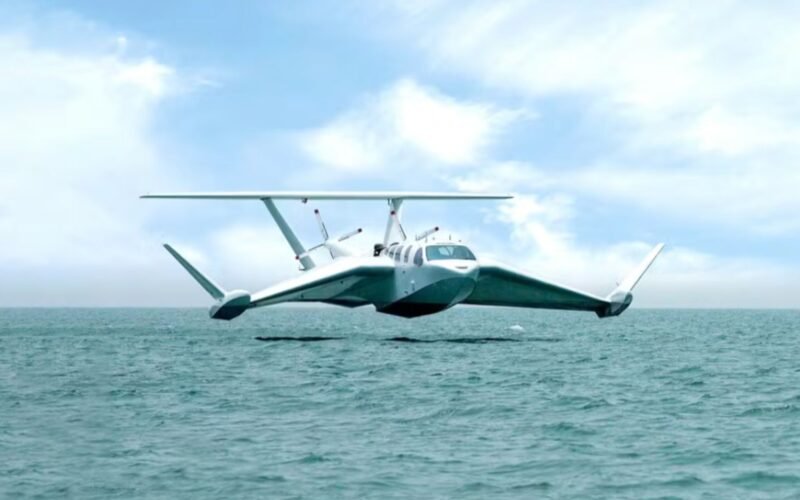
A new kind of maritime vehicle that flies just above the water rather than cutting through it could soon change how people move across short sea routes in Southeast Asia, after ST Engineering AirX announced new partnerships at Singapore Airshow 2026, being held from February 3 to 8 at the Changi Exhibition Centre, aimed at bringing its AirFish Wing-in-Ground craft into commercial service by 2026.
The company, a joint venture backed by ST Engineering’s Commercial Aerospace business, revealed agreements with ferry operators in Southeast Asia and India that would see the AirFish Voyager, a 10-seat wing-in-ground craft, enter real-world passenger operations for the first time, starting with a planned route between Singapore and Batam in Indonesia.
The vessel, which resembles an aircraft, lifts itself a few meters above the sea using aerodynamic lift and moves at speeds closer to those of a light plane than a ferry, while still being classified as a maritime craft rather than an aircraft. Yet the technology behind it is neither new nor experimental in principle, and ST Engineering believes it is now mature enough to operate safely, economically, and at scale.
Under the new partnership, regional ferry operator BatamFast plans to lease and operate an AirFish Voyager on the busy Singapore–Batam route. If regulators give the green light, the service is expected to start in the second half of 2026, becoming the world’s first commercial passenger route using a wing-in-ground-effect craft.
The AirFish Voyager is designed to carry up to 10 people, including crew, and cruise at speeds of up to 100 knots, or roughly 185 kilometres per hour, which is about three times faster than conventional fast ferries operating today. Unlike aircraft, it does not require a runway, airport, or helipad, and unlike high-speed boats, it does not rely on brute engine power to push through water resistance.
ST Engineering AirX is also working with Wings Over Water Ferries to bring the AirFish Voyager to India. Up to four aircraft could enter service from late 2026, starting in coastal and island regions like Andaman and Nicobar, Lakshadweep, Goa, Maharashtra, Gujarat, Andhra Pradesh, and Tamil Nadu, where travel by boat is often slow.
How wing-in-ground technology works
The key to the AirFish’s performance lies in something called ground-effect aerodynamics, a phenomenon that occurs when a wing operates very close to a surface such as water. When an aircraft flies within roughly one wingspan of the ground, the air trapped between the wing and the surface creates a cushion of high pressure, which reduces drag and increases lift at the same time.
In simple terms, the craft gets extra lift from the air trapped between its wings and the water, which lets it move much faster than a boat without needing much more power.
The AirFish Voyager flies just a few meters above the sea, staying within this ground-effect zone, which is why it is treated as a maritime vessel rather than an aircraft. It operates under international wing-in-ground rules, meaning it does not need aviation certification, air traffic control, or pressurized cabins.
Because it never climbs high, passengers experience no turbulence, no cabin pressure changes, and far lower noise levels compared to helicopters or seaplanes, which is a key reason ST Engineering believes the craft could appeal to premium travelers, tourists, and commuters alike.
The AirFish Voyager cruises at about 115 miles per hour, can travel up to roughly 350 miles on a single trip, and can carry loads of up to about 2,200 pounds. It can take off and land in moderate sea conditions and winds of up to around 17 miles per hour, which are common along coastal routes.
The AirFish uses car-based engines instead of aircraft turbines, which makes it cheaper and easier to maintain. It can be operated by a single crew member and only needs basic docking facilities and calm water to operate.
According to ST Engineering AirX, the AirFish is designed to be cheaper to run than helicopters, faster than ferries, and far less infrastructure-heavy than seaplanes.
A Technology with a long past
Wing-in-ground vehicles are not new. The best-known examples were the Soviet ekranoplans during the Cold War, large military craft that flew just above the sea at high speed. They showed the idea worked, but they were costly and built mainly for military use.
However, better materials, modern navigation systems, and clearer rules have made wing-in-ground craft more practical now. ST Engineering AirX, formed in 2023 with Wigetworks, is focusing on making these vehicles smaller, simpler, and suitable for everyday commercial use instead of niche military roles.
A larger AirFish 8 that weighs about 12,000 pounds and can carry eight passengers or roughly 2,900 pounds of cargo has also been developed. It cruises at around 100 miles per hour and can travel between 290 and 350 miles, and two prototypes are currently being tested in Malaysia as part of the certification process with Bureau Veritas.
One of the reasons the AirFish program has moved steadily rather than rapidly is the need to navigate certification carefully. Wing-in-ground vehicles fall into a regulatory space between aircraft and ships, and ST Engineering AirX has chosen to pursue maritime classification rather than aviation certification.
The company expects the AirFish Voyager to achieve classification by mid-2026, supported by the Maritime and Port Authority of Singapore, after which commercial operations can begin. For most civilian services, the craft will operate under Type A certification, meaning it stays within ground effect at all times.
Type B certification, which allows climbs up to 150 meters, is also being explored mainly for military and special-mission customers, not for routine passenger travel.
ST Engineering sees wing-in-ground craft as a middle option between ferries, helicopters, and small planes, especially in places with lots of islands, long coastlines, and heavy tourist traffic. The company says studies suggest there could be demand for thousands of these vehicles worldwide if they replace even a small share of today’s ferry, helicopter, and seaplane routes.
Outside Southeast Asia and India, the company sees opportunities in places such as Australia, Japan, the Maldives, the Caribbean, Turkey’s Black Sea coast, and parts of the US. These crafts could be used not just for passengers and tourism, but also for moving cargo, responding to emergencies, medical transport, and some military needs.
In addition, ST Engineering AirX is already studying a larger AirFish X variant that could carry 24 to 40 passengers and enter service around 2028, as well as exploring autonomous systems and alternative propulsion, including hybrid and hydrogen technologies, though there are no immediate plans to move away from conventional engines.
