
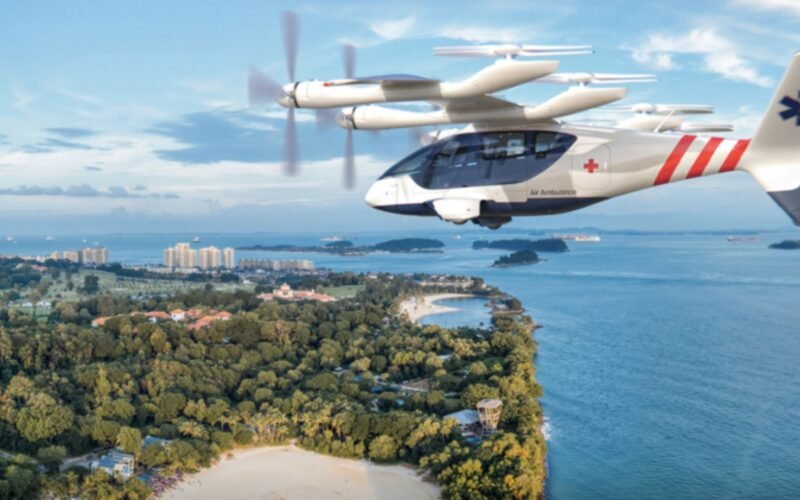
For more than a decade, air taxis have lived in an uncomfortable space between science fiction and startup pitch decks, often presented as sleek vehicles that would somehow leapfrog over regulation, infrastructure, and public trust to reshape cities overnight. But what is now unfolding looks very different. Instead of bold launch dates and flashy promises, the global air taxi push is taking a slower, more methodical path, driven by certification work, government partnerships, and carefully chosen real-world use cases that focus on safety before scale.
That shift is visible in a series of recent announcements from Vertical Aerospace, whose electric vertical takeoff and landing aircraft, known as VX4 and showcased under the Valo brand, are increasingly being positioned not as a futuristic novelty but as a practical new layer of transportation. Across Japan, Singapore, and the United States, the company is working with governments, emergency services, and infrastructure partners to answer a basic but critical question: not whether air taxis are possible, but where they actually make sense.
A global pattern begins to form
Look closely at the three regions highlighted in recent announcements, and a pattern starts to emerge. In Japan, Vertical Aerospace is working with Marubeni to explore operational routes and infrastructure for Valo aircraft, focusing on regulatory alignment and long-term adoption rather than quick commercial rollout. In Singapore, the aircraft is being studied for emergency medical services through a government-led innovation program that prioritizes safety and real operational needs. In New York, Vertical is testing how air taxis might fit into one of the most complex urban airspaces in the world, alongside operators and vertiport developers who already understand the realities of aviation in dense cities.
None of these efforts promises near-term mass deployment. Instead, they reflect a shared recognition that advanced air mobility will only work if it grows inside existing systems, not outside them.
As Vertical Aerospace put it in its Japan announcement, “Japan combines strong regulatory leadership, advanced infrastructure, and trusted industrial partners, making it one of the most promising markets globally for Advanced Air Mobility. Our partnership with Marubeni and engagement with JCAB demonstrate our careful, step-by-step approach to developing real-world Valo operations, grounded in safety, certification, and public acceptance.”
That sentence captures the tone of the entire effort. This is not about disruption in the Silicon Valley sense. It is about integration.
Why Japan matters
Japan has long been seen as a bellwether for aviation regulation and public acceptance of new transport technologies, especially those operating close to populated areas. By working with Marubeni and engaging directly with the Japan Civil Aviation Bureau authorities, Vertical Aerospace is signaling that it sees certification and route planning as inseparable.
Marubeni’s role is not just symbolic. As a major industrial and infrastructure player, it brings local knowledge of logistics, operations, and public-private coordination that a foreign aircraft manufacturer cannot replicate alone. The focus on the Kansai region reflects a desire to test air taxi operations in areas where geography, population density, and existing transport networks create real demand, rather than inventing routes for demonstration purposes only.
As Marubeni stated in the release, “We are pleased to take this next step with Vertical Aerospace as we progress toward demonstration flying in Japan. By advancing route development in the Kansai region, we see significant opportunities to build the operating infrastructure and ecosystem required to accelerate AAM adoption.”
The word “ecosystem” matters here. Air taxis do not succeed on aircraft performance alone. They depend on charging infrastructure, airspace coordination, emergency procedures, pilot training models, and public confidence, all of which take time to develop.
Singapore and the case for emergency use
If Japan represents the long-term commercial pathway, Singapore highlights another important truth about air taxis: their first meaningful applications may not be passenger commutes at all.
Through Singapore’s Dimension X Challenge, Vertical Aerospace is working with public-sector safety and security agencies to evaluate how electric and hybrid-electric aircraft could support emergency medical response. In a dense city-state where every minute matters, the ability to move patients or medical teams quickly without relying on congested roads is an obvious use case.
Vertical described this collaboration clearly, stating, “We are proud to work closely with Singapore’s public-sector safety and security experts to explore how electric and hybrid-electric aircraft could support emergency response operations safely and effectively. This is an important step in making AAM a reality in the region.”
Emergency services impose some of the strictest operational requirements in aviation, because reliability, predictability, and safety are non-negotiable. If an aircraft can meet those standards, it builds credibility that no marketing campaign can replace.
Singapore’s Home Team Science and Technology Agency echoed that focus, saying, “Through the Dimension X Challenge, HTX partners with industry innovators to explore how emerging technologies can responsively address real operational needs. Our collaboration with Vertical Aerospace allows us to assess the potential of Advanced Air Mobility for emergency medical response, while maintaining a strong focus on safety, regulation, and operational readiness.”
In other words, air taxis are being tested where failure is not an option, not where spectacle is the goal.
New York and the hardest test of all
If Japan and Singapore represent structured regulatory environments, New York represents complexity in its purest form. Few places have airspace as crowded, regulated, and politically sensitive as that is precisely why Vertical Aerospace chose it as the next stop in its U.S. outreach.
The company’s Valo tour in New York is less about announcing routes and more about understanding how electric aviation could fit alongside existing helicopter operations, commercial traffic, and city infrastructure. Working with partners such as Bristow and Skyports, Vertical is exploring practical use cases rather than theoretical ones.
As Vertical explained, “The US Valo tour builds on the momentum from our London unveiling and a year of strong execution across testing, partnerships, and certification. New York is a natural next step to explore how electric aviation could support urban and regional travel in the US, working with partners like Bristow and Skyports to keep safety, certification and real-world operations at the core.”
Bristow, which operates complex aviation services globally, sees this as an extension of its existing expertise rather than a break from it. The company noted, “Bristow operates complex aviation services all over the world, from offshore energy to government and passenger transport. Exploring future eVTOL use cases in a market like New York allows us to apply that operational experience to new, sustainable aviation concepts as the technology and regulatory environment continue to mature.”
Meanwhile, Skyports emphasized that aircraft alone are meaningless without places to land, stating, “Skyports creates and operates the essential infrastructure that will support the integration of new eVTOL aircraft into existing cities and transport networks.”
The tech beneath the headlines
What ties all of this together is not a single aircraft or route, but a deeper technological shift. Electric vertical flight sits at the intersection of battery systems, power electronics, flight control software, certification standards, and operational modeling. None of these elements can be rushed without consequences.
Unlike conventional helicopters, eVTOL aircraft are being designed around distributed electric propulsion, fly-by-wire control systems, and redundancy architectures that assume component failure as a design condition, not an exception. Certification authorities are still defining how these systems should be evaluated, which is why partnerships with regulators appear so prominently in every announcement.
Just as important is the human factor. Training models are being reconsidered, maintenance practices are evolving, and public acceptance depends on noise profiles, safety records, and visible government oversight. This is why the early focus is on demonstration flights, emergency roles, and controlled routes, rather than open commercial services.
What these three announcements reveal is an industry growing out of its speculative phase and into something more mature. Air taxis are no longer being sold as replacements for subways or cars. They are being positioned as tools for specific problems, in specific places, under specific rules.
That may not make for flashy headlines, but it is how aviation has always progressed. Commercial flight did not become routine because it was fast or exciting, but because it became reliable, regulated, and trusted.
The rise of air taxis now appears to be following the same path, not by trying to leap over reality, but by embedding itself carefully within it. If and when electric vertical flight becomes a common sight above cities and coastlines, it will likely be because of the quiet groundwork being laid today, in places like Kansai, Singapore, and New York, where technology is being tested not against imagination, but against the real world.
