
Key ideas
- •Hyundai is turning its electric vehicle platform into a modular robotics system for extreme environments.
- •The firefighting robot’s real innovation lies in its thermal management and mobility architecture.
- •The tech is less about one robot and more about automakers expanding into industrial and safety robotics.
When Hyundai Motor Group delivered its unmanned firefighting robots to South Korea’s National Fire Agency, the event appeared to be a public safety initiative and a demonstration of corporate social responsibility.
However, something important is happening beyond the ceremony, showing that Hyundai is changing how it thinks about mobility technology. This moment marks a shift for Hyundai from being an automotive manufacturer to building a broader mobility ecosystem that extends advanced vehicle technology into new, high-stakes environments.
Hyundai is testing what its electric mobility platform can do beyond roads, including in smoky warehouses, falling buildings, and fire zones that reach 800 degrees Celsius (1472 degrees Fahrenheit).
The company’s initiative demonstrates how an automaker can transform its EV architecture into a modular robotics platform, not just by deploying a robot with a water cannon.
The chassis is the story
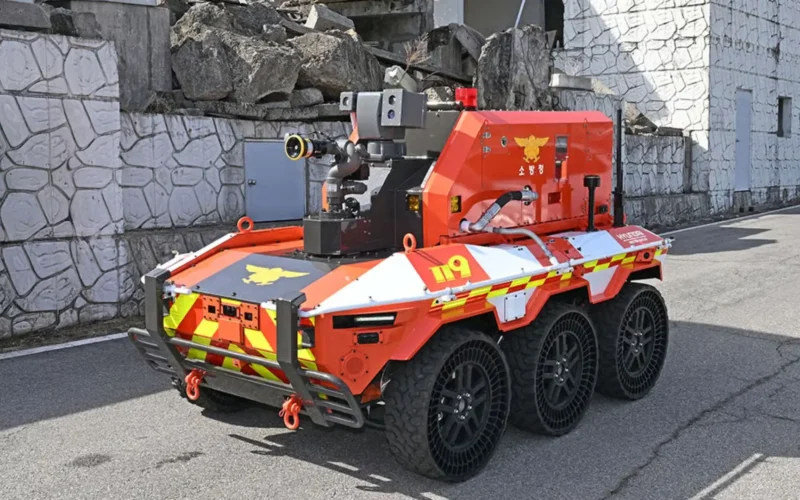
The firefighting robot is built on Hyundai Rotem’s HR-Sherpa unmanned vehicle platform, which is actually more important than the firefighting tools it carries.
The HR-Sherpa is a flat electric base with six motors in its wheels. This lets each wheel move independently without a central shaft, so it can move smoothly over debris and quickly adjust to rough ground. It uses electric vehicle design in robotics.
Modern electric vehicles use software to control wheel power. Hyundai is using this idea for tough situations.
The result is a flexible platform that can be used for jobs like firefighting with a water cannon, handling dangerous materials, doing inspections with sensors, and moving on its own.
Such flexibility means the same robotic base can be quickly changed for different jobs, so there is no need to design a new vehicle each time. By switching attachments, operators can use the platform for different tasks, making work more efficient and saving money by reusing the main system.
Surviving 800 degrees
While it might seem like using electric power is just for showing off how green the company is, the real reason is practical. Electric systems help address problems that arise in disaster situations.
Gas engines need oxygen, which is hard to find and often dangerous in fires. Their exhaust also makes things worse. Electric motors do not have these problems.
Electric motors give instant power, which is important on rough ground. The robot moves right away with no gear changes or waiting.
In tight spaces, less shaking and smoother movement help remote operators control the robot more accurately.
Here, using electric power is more about control, survival, and flexibility than about cutting emissions. The system’s most important technical feature is its heat management.
Fire scenes can reach 800 degrees Celsius, which is hotter than electronics and batteries can withstand. Hyundai solves this with active heat protection.
The robot sprays coolant to block the heat. Insulation inside keeps the electronics and batteries at 50 to 60 degrees Celsius. This is an active cooling system that works while the robot moves and uses its tools, not just a simple heat shield.
Managing heat is crucial as lithium batteries and electronics must stay within safe temperature ranges, and all parts must withstand significant temperature changes.
The engineering problems are more like those faced by military vehicles than by regular robots.
Seeing through fire
Fire scenes are hard to see in as smoke blocks normal camera views, flames bend light, and falling buildings cast unexpected shadows.
The robot uses infrared to see through smoke and flames. Operators can find fires and maybe trapped people using heat-sensing cameras.
This information is sent to a remote operator immediately via a wireless connection. The operator gets live video and controls the robot and water cannon from a safe place.
A steady wireless connection is needed for live video and control. Smoke and obstacles can mess up the signal. Fast response times help the robot move accurately.
This problem is like what self-driving cars and military robots face, where it is important to keep track of what is happening, even in tough conditions.
The firefighting robot operates in one of the most challenging environments for perception systems. The biggest change is in the basic design.
Hyundai is going beyond just making vehicles and is now building a reusable base for moving robots.
The HR-Sherpa platform acts as a base for robots. The firefighting tools are just one setup, and the base can be used for other jobs too.
This shows Hyundai’s focus on making its platform easy to expand. A single base can be quickly set up for different jobs by changing attachments, helping teams respond quickly and get the most value from the system.
One electric base could be used for disaster response, inspecting hazardous industrial sites, moving military supplies, or monitoring infrastructure.
As carmakers invest in robotics, AI, and data systems, making things modular becomes increasingly important. Software-controlled mobility lets them take on new jobs without having to start from scratch.
Fire scenes as real-world testing grounds
Deploying these robots in live operations generates valuable data. Every time the robot moves over debris, faces heat, or navigates around obstacles, it provides data that helps improve future designs.
Firegrounds are unpredictable as surfaces may collapse, visibility can shift, temperatures can spike, and human operators must make split-second decisions.
Training these mobility systems in tough conditions can accelerate progress in how robots see, how people control them remotely, and, eventually, how they operate autonomously.
Even if this version is still controlled by people, the experience will help develop robots that can move autonomously in the future. In this way, emergency response serves as a testing ground for robotics architecture.
Hyundai has shown it wants to do more in robotics and artificial intelligence. Reports say it is investing a lot in advanced robotics, hydrogen technology, and data systems. The firefighting robot fits within that larger strategy.
Electric drivetrains, battery management systems, electric motors, battery systems, and software that controls power are not just for regular cars; they can also be used in other machines.
Once defined, it becomes modular and can be deployed in industrial sites, disaster zones, and hazardous environments. This transformation is underway.
However, this development is not about replacing firefighters. It is about extending human reach into dangerous spaces. More importantly, it demonstrates how automotive technology is transitioning into robotics.
The electrical system in a family SUV can be modified for firefighting. The same software that keeps a car steady on wet roads can help a robot stay steady on burning debris. The line between making vehicles and making robots is blurring.
Hyundai’s firefighting robot may appear to be a specialized tool, but technically, it represents a broader innovation.
It gives a glimpse of mobility systems designed not just to move people, but also to operate in places too dangerous for humans.
