
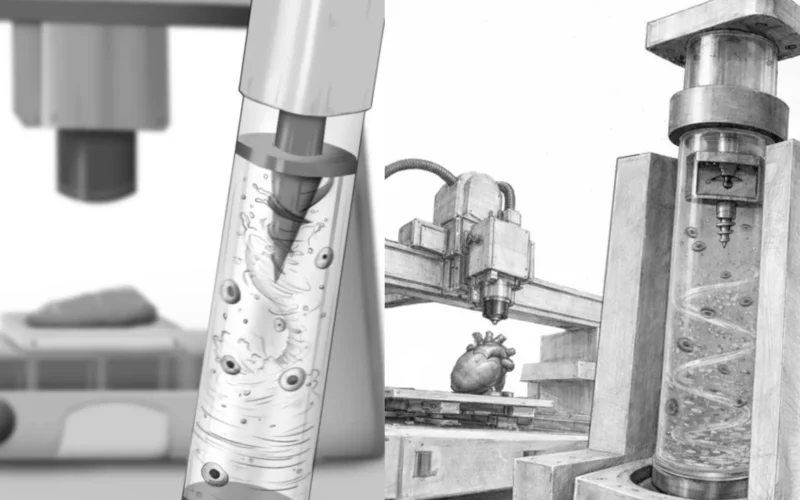
Researchers at the Massachusetts Institute of Technology (MIT) have developed a magnetically actuated mixing system designed to prevent cell sedimentation during extrusion-based 3D bioprinting, addressing a persistent limitation in the fabrication of engineered tissues.
The approach, described in a study published on 2 February in the journal Device, introduces an active in situ mixing mechanism that maintains uniform cell distribution within bioinks during extended print sessions. The work was led by Ritu Raman, the Eugene Bell Career Development Professor of Tissue Engineering and assistant professor of mechanical engineering at MIT.
Addressing cell sedimentation in bioinks
Extrusion-based 3D bioprinting relies on bioinks composed of living cells suspended in soft hydrogels. During long print runs, however, gravity causes cells, which are denser than the surrounding hydrogel, to settle toward the bottom of the printer syringe. This sedimentation can lead to nozzle clogging, uneven cell distribution, and variability between printed tissues.
According to Raman, existing mitigation strategies such as manually stirring bioinks or using passive mixing components are unable to maintain homogeneity once printing begins.
To address this, the MIT team developed “MagMix,” a compact magnetic mixing system designed to operate inside standard bioprinter syringes without altering bioink composition or printer hardware.
MagMix comprises two components: a small magnetic propeller inserted into the syringe barrel and a permanent magnet mounted to a motor positioned externally. The external magnet moves vertically, actuating the internal propeller and maintaining continuous mixing of the bioink during printing.
The system can be integrated into existing 3D bioprinters and is intended to preserve uniformity without disrupting normal printer operation. The research team used computational simulations to optimise propeller geometry and rotational speed before validating performance experimentally.
Across multiple bioink formulations, the system prevented cell settling for more than 45 minutes of continuous printing, reducing clogging while maintaining high cell viability. The researchers reported that mixing parameters could be tuned to balance homogenisation with minimal mechanical stress on embedded cells.
As a proof-of-concept, the team demonstrated that cells printed using MagMix matured into functional muscle tissue over several days.
Applications in tissue engineering and drug development
Maintaining consistent cell distribution is considered critical for replicating the structural and functional properties of native tissues. According to lead author Ferdows Afghah, a postdoctoral researcher in mechanical engineering at MIT, precise control over bioink properties is necessary to produce reproducible biological constructs.
Engineered tissues with improved uniformity could support applications in disease modelling and preclinical drug testing. The work aligns with broader interest from the US Food and Drug Administration in developing alternatives to animal testing that are faster and potentially more predictive of human responses.
The researchers also indicated long-term interest in regenerative medicine applications, including the potential replacement of damaged or diseased tissues with 3D printed constructs.
The project received support in part from MIT’s Safety, Health, and Environmental Discovery Lab (SHED), which focuses on translating laboratory-scale biofabrication methods into scalable and reproducible technologies.
According to Tolga Durak, founding director of SHED, the laboratory’s role includes providing infrastructure and interdisciplinary collaboration to facilitate technology adoption and long-term sustainability.
Beyond medical applications, the research team is exploring non-clinical uses for engineered tissues, including biohybrid robotic systems powered by printed muscle constructs.
By introducing active magnetic mixing during extrusion printing, the study aims to enhance the reproducibility and scalability of 3D bioprinting processes. The authors suggest that such improvements could support broader adoption of engineered tissues across biomedical research and translational applications.
