
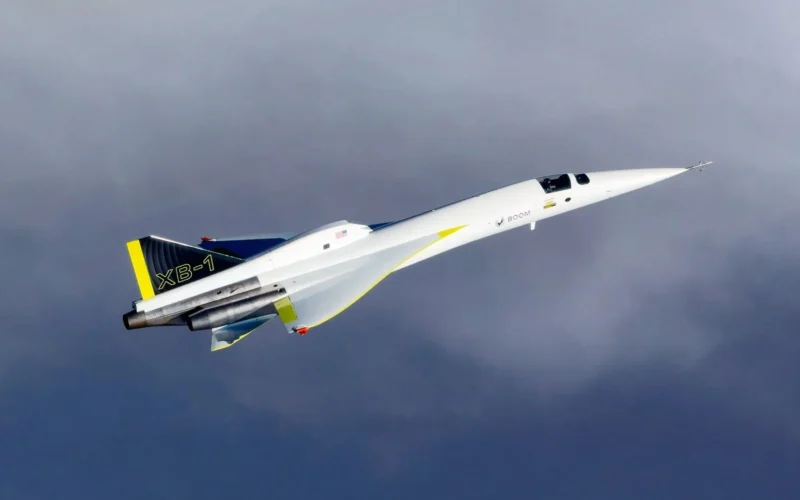
In a historic achievement for civilian aviation, Boom Supersonic successfully executed the world’s first-ever independently-developed supersonic flight with its XB-1 demonstrator aircraft on January 28, 2025.
The milestone flight occurred at the Mojave Air & Space Port, known for its significant contributions to aerospace advancements.
Driven by Chief Test Pilot Tristan “Geppetto” Brandenburg, the XB-1 ascended to an altitude of 35,290 feet and accelerated to Mach 1.122, roughly 750 miles per hour, breaking the sound barrier, according to a press release by Boom Supersonic.
This achievement is particularly noteworthy as it marks the first instance where a supersonic aircraft has been developed outside of military or government programs, signaling a new era for civil aviation.
3.5-hour New York-London flights
XB-1’s successful supersonic flight represents the first human-piloted civil supersonic flight since the retirement of the Concorde over two decades ago, paving the way for the revival of commercial supersonic travel aboard Overture.

Designed to transport 64 to 80 passengers at Mach 1.7—roughly twice the speed of current subsonic airliners—Overture plans to offer service on more than 600 global routes.
Overture is expected to travel from London to New York in just 3.5 hours, more than half of the current 8.5 hours taken.
The XB-1 is predominantly made of carbon fiber composite materials, enabling a robust yet lightweight structure that contributes to its sophisticated aerodynamic design.
This choice of materials is consistent across the XB-1 and the forthcoming Overture, reinforcing the emphasis on efficiency and performance.
XB-1 and Overture supersonic similarities
According to Boom Supersonic, the XB-1 aircraft incorporates the forthcoming Overture model, including carbon fiber composites for enhanced structural integrity, a digital stability augmentation system, and an augmented reality vision system to improve landing visibility.
After its inaugural flight in March 2024, the XB-1 underwent an extensive series of eleven human-piloted test flights, challenging its systems and evaluating aerodynamics under varying conditions.

Throughout these tests, the XB-1 team systematically pushed the flight envelope, exploring subsonic, transonic, and supersonic speeds while emphasizing safety and risk management.
The XB-1 flight is a foundational step for the Overture project, validating several innovative technologies integral to both aircraft.
Among these technologies is the augmented reality vision system designed to aid pilots during takeoff and landing, a task complicated by the aircraft’s long nose and high angle of attack.
This system allows for optimal runway visibility without the mechanical complexity of a moveable nose, a feature seen in historical supersonic aircraft like the Concorde.
Another significant advancement is the digitally-optimized aerodynamic profile derived from computational fluid dynamics (CFD) simulations.
Engineers employed these simulations to evaluate numerous design possibilities for XB-1, leading to an optimized aircraft structure that balances safety during operation with aerodynamic efficiency at supersonic speeds—a strategy that will also inform the design of the Overture.

The XB-1 is predominantly made of carbon fiber composite materials, enabling a robust yet lightweight structure that contributes to its sophisticated aerodynamic design.
This choice of materials is consistent across the XB-1 and the forthcoming Overture, reinforcing the emphasis on efficiency and performance.
A notable feature of the XB-1 is its specialized engine intakes, which decelerate supersonic air to subsonic velocities, effectively transforming kinetic energy into pressure energy.
This adaptation allows conventional jet engines to power the XB-1 through takeoff and supersonic flight. The technology gleaned from developing these intakes is expected to influence the design of Overture’s purpose-built turbofan engine, Symphony.
Overture’s Symphony engine
Boom Supersonic is making significant strides in developing its Symphony engine, with hardware testing in progress and the full-scale engine core expected to come online in approximately 18 months.
The company has outlined its complete production strategy for the Symphony engine, expanding its collaboration with StandardAero to include assembly and testing operations at their San Antonio, Texas facility.
In June, Boom disclosed that it had commenced the construction and rig testing of Symphony components, beginning with a comprehensive evaluation of combustor aerodynamics.
The production of the first 3D-printed parts for the engine, such as fuel nozzles and turbine center frames, marks a critical step in the development process.

These hardware assessments began just a year after the Symphony’s initial announcement, highlighting the company’s commitment to a rapid development timeline.
Boom plans to perform over 30 rig tests to validate and optimize various engine components, focusing on critical aspects like fan and nozzle acoustics and combustor fuel efficiency.
Furthermore, the full-scale engine core development is being expedited, with testing slated to analyze the compressor, combustor, and turbine sections set for late 2025.
Data collected during this phase will enhance engineering efforts and streamline the production of a fully certified engine.
The company is collaborating with Florida Turbine Technologies (FTT) to conduct the necessary testing and further the Symphony project.
Overture flight deck
According to Boom Supersonic, the flight deck of Overture represents a significant evolution in cockpit design, informed by extensive input from pilots across commercial, business, and military aviation.
By integrating the Honeywell Anthem avionics suite, Overture enhances pilots’ situational awareness and streamlines aircraft control, prioritizing passenger safety during flight.
One notable innovation is the introduction of force-feedback sidesticks, a first for commercial airliners.
This technology lets pilots physically sense the aircraft’s responses and inputs from their co-pilot and autopilot, fostering a more intuitive flying experience.

Additionally, Overture incorporates an advanced augmented reality vision system that aids takeoff and landing processes, negating the need for the droop nose feature seen in the Concorde.
This system, viewed on a head-mounted device and the pilot’s primary flight display, empowers pilots to utilize autoland or augmented reality for safer landings.
The flight deck also boasts large 17-inch high-definition touchscreens, replacing the numerous buttons and breakers typical in traditional cockpits.
Essential flight functions are accessible through this modern interface, with physical controls reserved for critical operations like the throttle and landing gear.
Furthermore, Overture will benefit from over-the-air software updates that allow airlines to regularly implement new features and enhancements across their fleets, maintaining the flight deck’s technological edge.
130 supersonic planes pre-booked
The significance of the XB-1 flight was not lost on aviation enthusiasts; the aircraft flew in airspace once navigated by aviation legend Chuck Yeager when he famously broke the sound barrier in 1947.
Mike Bannister, former Chief Concorde Pilot for British Airways, shared his enthusiasm for the successful flight.
“I’ve been anticipating the return of supersonic speeds for over 20 years, and XB-1’s flight is a significant milestone towards making that dream a reality,” he said.
“When I last piloted the Concorde in 2003, I saw this day on the horizon. Boom’s work is paving the way for sustainable supersonic travel, positioning Overture as a leading successor to the Concorde.”
Boom Supersonic’s efforts have attracted considerable industry interest, with a robust order book totaling 130 pre-orders from American Airlines, United Airlines, and Japan Airlines.
The company is focused on completing the construction and development of the Overture aircraft, with advancements expected to reshape the future of air travel.
As the aviation industry watches closely, the successful test flight of XB-1 underscores a new chapter in civilian supersonic flight, revitalizing public interest and setting the stage for innovations that may transform how we travel.
