
Key ideas
- •UK selects SONUS passive acoustic system to locate artillery without radar emissions.
- •GPS-synchronised microphones triangulate gunfire origin and impact for counterfire targeting.
- •Passive sensing improves survivability in electronic-warfare and anti-radiation environments.
The United Kingdom has contracted Leonardo to supply its SONUS passive acoustic weapon-locating system to the British Army under an £18.3 million ($24.73 million) programme known as Project SERPENS.
The system will equip the Army’s dedicated surveillance formation, the 5th Regiment Royal Artillery, providing a radar-independent capability to detect and locate hostile artillery, mortars, and gunfire.
Rather than introducing a new sensor concept, SONUS represents the latest evolution of Leonardo’s Hostile Artillery Location (HALO) acoustic counter-battery family, a system lineage developed over more than 25 years and operationally fielded by multiple NATO users.
The programme reflects a shift toward passive detection technologies as electronic warfare and anti-radiation threats increasingly challenge conventional radar-based weapon-locating radars (WLRs).
Passive detection in the counter-battery battle
Traditional counter-battery doctrine relies heavily on radar to track ballistic trajectories. Weapon-locating radars calculate the launch point by following the projectile’s flight path.
While effective, radar emissions create a detectable signature that can expose the sensor to electronic surveillance, jamming, or anti-radiation attack. Acoustic weapon location reverses the sensing model.
Instead of tracking the projectile in flight, the system detects the sound generated at the moment of firing or impact. Every artillery discharge produces a complex acoustic pressure wave, a combination of muzzle blast, ballistic shockwave, and environmental reflections.
By capturing this wave across multiple distributed sensors and measuring arrival-time differences, algorithms triangulate both the Point of Origin (POO) and Point of Impact (POI).
Because the system emits no radiofrequency energy, it operates without revealing its position.
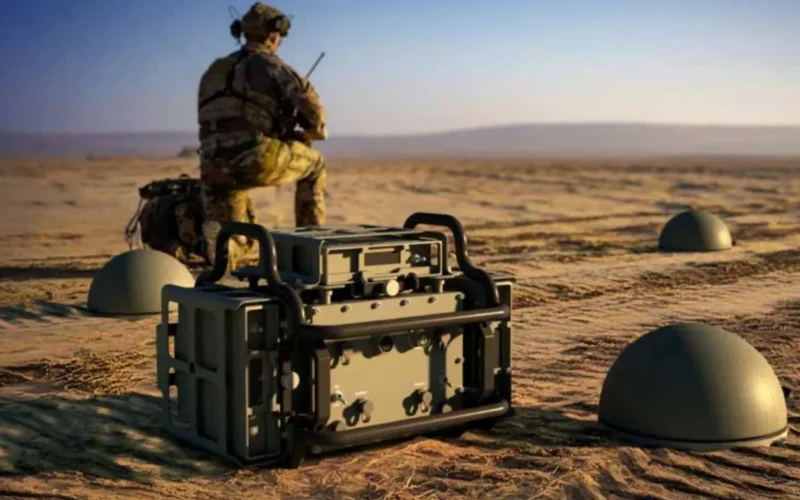
SONUS is designed around this passive detection principle. Uncrewed sensor posts equipped with calibrated microphones continuously monitor the acoustic environment and transmit waveform data to a central command node, where localisation algorithms calculate threat coordinates.
Acoustic processing architecture
The effectiveness of acoustic weapon location depends on precise timing and environmental modelling rather than signal strength alone. Sound travels slower than electromagnetic radiation and is affected by temperature, humidity, wind, and terrain.
To compensate, systems such as SONUS rely on synchronized sensors using integrated GPS timing and advanced signal processing.
Each sensor post records pressure wave signatures and timestamps them with microsecond precision. The command post correlates arrival time differences across multiple sensors and applies atmospheric propagation models.
From this, the system derives coordinates with circular error probabilities comparable to counter-battery radars at similar ranges.
The system can identify both launch events and impact events. While the launch detection supports counterfire targeting, the impact detection enables artillery correction and battle damage assessment
Unlike trajectory tracking radars, acoustic systems do not require line-of-sight to the projectile. This allows detection in complex terrain and urban environments where radar tracking is degraded.
Performance envelope and coverage
The HALO-derived architecture underlying SONUS is designed for wide-area monitoring rather than narrow beam observation.
A distributed sensor array provides 360-degree coverage across a frontage of approximately 40 km (25 miles) and an area exceeding 2,000 square kilometres (1,240 sq miles), depending on sensor spacing.
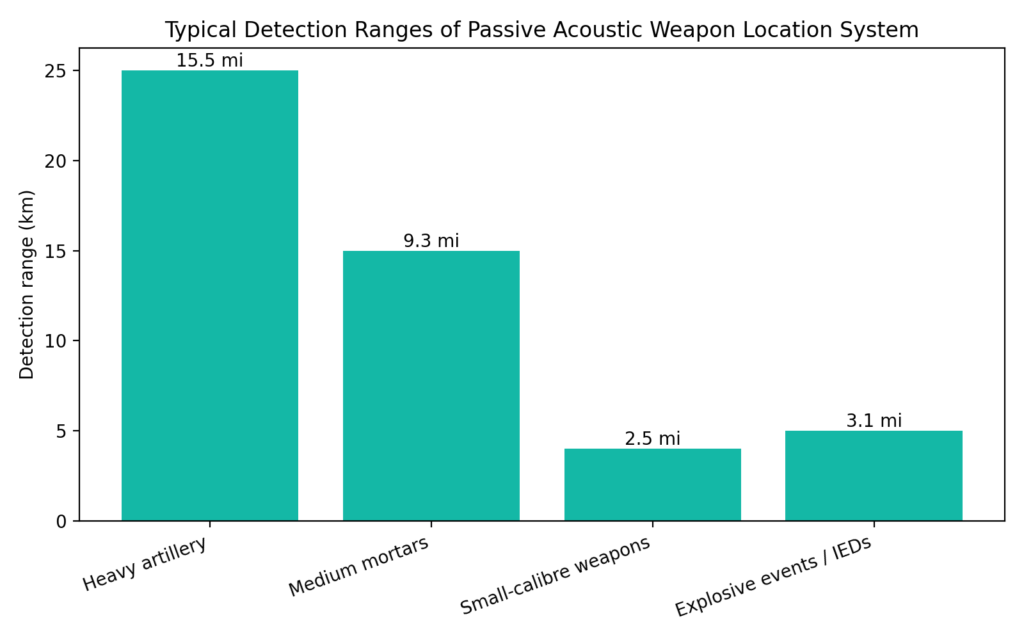
Accuracy depends on range and atmospheric conditions, but typically approaches roughly 100 m CEP within medium ranges and proportional accuracy beyond.
Because detection relies on acoustic signatures rather than radar reflection, the system continues functioning in cluttered electromagnetic environments or under active jamming.
Field deployment and survivability
One of the defining design characteristics of SONUS is portability. The latest generation is approximately 50% smaller and 70% lighter than earlier HALO systems.
Sensor posts can be emplaced in under three minutes, and command posts in roughly ten minutes.
Reduced setup time directly lowers exposure risk for deploying troops, particularly in forward reconnaissance or contested environments.
Power consumption is similarly optimized. Sensor nodes can operate for multiple days on battery, extended by a fuel cell or solar augmentation. This enables prolonged unattended monitoring and reduces logistics resupply cycles, a key consideration in dispersed operations.
The absence of emissions significantly improves survivability. Counter-battery radars have historically been high-priority targets because they broadcast continuously.
Passive acoustic arrays instead function as low-signature sensors, making detection and targeting by adversaries substantially more difficult.
Integration within ISTAR networks
SONUS is designed as an Intelligence, Surveillance, Target Acquisition and Reconnaissance (ISTAR) component rather than a standalone sensor.
Open architecture interfaces allow integration with target management and command-and-control systems.
In practice, acoustic location complements rather than replaces radar, as radar provides trajectory tracking, and acoustic sensing confirms origin and impact. The combined correlation improves confidence.
Data fusion between acoustic arrays and other sensors enables higher reliability targeting, particularly when radar coverage is intermittent or denied.
The system can also cue artillery corrections in near-real time by reporting impact coordinates, improving friendly fire accuracy, and reducing ammunition expenditure.
Operational relevance in electronic warfare environments
Recent conflicts have highlighted vulnerabilities in traditional sensor architectures.
Radar-centric surveillance networks face increasing pressure from electronic warfare, anti-radiation missiles, and counter-sensor reconnaissance.
Passive sensing systems address these vulnerabilities by removing the emission signature entirely.
The operational use of HALO-family systems in multiple theatres, including Bosnia, Iraq, Afghanistan, and Ukraine, demonstrated their ability to operate when radar performance is degraded.
In high-density artillery environments, acoustic arrays can continue generating targeting data even when electronic sensors are jammed or suppressed.
This characteristic underpins renewed interest in passive sensing technologies across NATO forces.
Industrial and programme context
Under Project SERPENS, deliveries to the British Army will occur over approximately 12 months.
The procurement was accelerated relative to earlier planning, aligning with broader modernization efforts and increased defence spending commitments.
The programme supports domestic industrial participation across multiple suppliers and sustains a distributed manufacturing base while introducing new battlefield sensing capability to frontline surveillance units.
The HALO lineage has evolved through continuous refinement in sensor miniaturisation, processing algorithms, and integration capability.
SONUS extends this evolution with reduced weight, lower power requirements, and open-architecture interoperability.
Future development pathways include passive detection of unmanned aerial systems, vehicle-mounted acoustic arrays, and airborne-deployed microphones, and expanded rocket detection capability.
The broader trajectory suggests acoustic sensing transitioning from a niche counter-battery tool to a persistent multi-domain situational awareness sensor.
Technology implications
The introduction of SONUS reflects a structural shift in battlefield sensing philosophy. Rather than relying solely on active sensors optimized for detection range, modern sensor networks increasingly combine active and passive modalities to balance survivability and coverage.
Acoustic detection cannot replace radar entirely; radar retains advantages in trajectory measurement and high-altitude tracking, but passive arrays provide resilience when emissions become liabilities.
In environments saturated with electronic warfare, survivability becomes a performance parameter as important as detection range.
By enabling continuous monitoring without revealing sensor position, passive acoustic systems contribute to persistent situational awareness and counterfire capability even under contested spectrum conditions.
Analytical perspective
The adoption of SONUS indicates recognition that counter-battery effectiveness depends not only on detection accuracy but also on sensor survivability.
As adversaries prioritize targeting high-value emitters, low-signature sensors become operationally significant.
Rather than representing a new category of weapon location technology, SONUS represents the maturation of a complementary sensing layer, one designed to function when traditional electromagnetic sensors are unable to.
The system’s emphasis on portability, low power, and network integration suggests that it is intended as part of a distributed sensing architecture rather than a centralized radar node.
Within that framework, passive acoustic detection becomes a resilience layer in artillery warfare, supporting targeting, protection, and battle damage assessment while reducing exposure to counter-sensor attack.
As battlefield detection moves toward multi-sensor fusion networks, systems such as SONUS illustrate how legacy sensing modalities, sound rather than radar, are being re-engineered into modern digital targeting infrastructure.
