
Key ideas
- •The B-21 enterprise has turned U.S. air base perimeters into active counterintelligence zones.
- •Detection now focuses on pattern analysis and data fusion, not just individual incidents.
- •Homeland security architecture is evolving to counter incremental, gray-zone reconnaissance.
For decades, American air bases were designed around a clear security assumption that the most serious threats would materialize far from home. Installations inside the continental United States were hardened against intrusion, sabotage, and espionage, but they were not treated as continuously contested terrain. That logic is shifting.
Today, the challenge is not necessarily a breach of a gate or a forced entry into a hangar. It may begin with something far more ambiguous, including a vehicle parked outside a perimeter fence, a camera pointed toward infrastructure, or a pattern of return visits across multiple installations. The battlefield, increasingly, is the fence line.
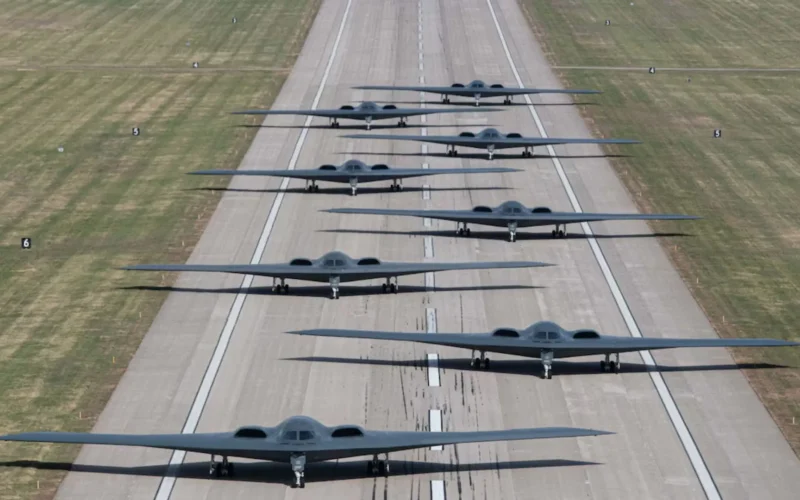
At installations such as Whiteman Air Force Base, Dyess Air Force Base, and Ellsworth Air Force Base, the three bases anchoring the emerging B-21 Raider enterprise, counterintelligence is evolving from static perimeter defense to a technology-driven detection architecture built around pattern recognition, data fusion, and inter-base coordination.
This is not a story about a single encounter outside a gate. It is about how the US military is engineering a new sensing framework for gray-zone reconnaissance at home.
From gates and guards to data and correlation
Traditional base security is built in layers. Physical fencing defines the perimeter. Entry control points regulate access. Security Forces patrol both inside and outside the boundary. Surveillance cameras monitor gates and high-value facilities.
Those measures remain foundational. But gray-zone reconnaissance does not attempt to break through a gate. It studies the gate.
Modern counterintelligence around strategic air bases increasingly depends on correlating small data points that, in isolation, may appear benign. A vehicle parked legally on a public road may not constitute an offense. A camera photographing an installation from outside the fence line may fall into a legal gray area. But when those activities occur repeatedly, across different sites, and focus on infrastructure rather than aircraft, they begin to form a recognizable signature. The technology challenge is separating curiosity from collection.
That separation depends on structured documentation and rapid information sharing. Security personnel log time, location, vehicle identifiers, and behavior patterns. Digital systems archive imagery and contextual details. Analysts compare incidents across installations. The goal is not simply to record an event but to determine whether that event fits a broader reconnaissance pattern.
This is counterintelligence as analytics rather than confrontation.
Infrastructure is the real target
The basing of the B-21 Raider adds a new dimension to installation security. The aircraft itself is highly classified and physically protected. But modern airpower depends on far more than a runway and a hangar.
New bomber infrastructure includes hardened facilities, specialized maintenance bays, communications nodes, data systems, power distribution networks, and fuel storage. Construction projects at these installations create visible changes in physical layout, which can be observed from outside the fence line.
In this context, reconnaissance focused on perimeter roads, lighting systems, access routes, or construction zones may reveal more about operational resilience than photographs of aircraft.
High-resolution digital imaging, commercially available mapping software, and open-source geospatial tools make it possible to combine small pieces of visual information into detailed infrastructure models. A handful of photographs taken over time can be stitched into a structural understanding of entry points, blind spots, patrol rhythms, and support facilities.
Countering that requires recognizing that the installation’s outer boundary is not just a physical barrier. It is an intelligence surface. The task is to detect not just cameras, but intent.
The Raider triad and networked detection
One of the most significant architectural shifts in this environment is the emphasis on cross-base coordination. The installations scheduled to host the B-21, Whiteman Air Force Base, Dyess Air Force Base, and Ellsworth Air Force Base, are tied together not only operationally but analytically.
Within the Air Force Office of Special Investigations Region 8, detachments share information quickly and directly when perimeter-related incidents occur. The importance of this is technical as much as organizational.
If suspicious behavior appears at one installation, comparable behavior at another installation days or weeks later may not be a coincidence. But correlation requires speed. Data must move before it becomes stale.
This networked model reduces analytic latency. Instead of waiting for formal reporting cycles, relevant information flows between detachments in near real time. Vehicle descriptions, behavioral details, and contextual insights become part of a shared analytic environment.
The system moves from reactive to anticipatory. Security teams at one base can know what to look for before an individual appears on their perimeter. In gray-zone counterintelligence, early awareness is deterrence.
Legal framework meets digital capability
An additional layer of complexity lies in the legal authorities governing photography and surveillance of military installations. Many statutes were written in an era before smartphones, high-resolution digital cameras, and AI-assisted image processing.
Today, an individual can capture detailed imagery from public roads and enhance it with commercially available tools. Publicly accessible satellite imagery can complement ground-level photography. Infrastructure plans and construction contracts can be mined from open sources.
For investigators, this means that identifying suspicious activity is only the beginning. Building a legally sound case requires demonstrating pattern, intent, and impact. Digital evidence must be preserved carefully. Geolocation, timestamp,s and metadata become critical.
The architecture of detection is therefore intertwined with the architecture of accountability. Systems must collect enough contextual information to distinguish lawful behavior from deliberate reconnaissance, without overstepping constitutional protections.
This balance between vigilance and restraint is central to gray-zone counterintelligence.
The homeland as a contested space
Perhaps the most significant conceptual shift is geographic. For much of the past two decades, the homeland was treated as relatively insulated from daily intelligence probing tied to strategic military platforms. That assumption is eroding.
Modern adversaries operate incrementally. They test response times. They probe legal thresholds. They observe how installations react to boundary activity. They collect small amounts of information repeatedly rather than seeking dramatic breakthroughs.
This requires a sensing philosophy built around anomaly detection. Not every incident is meaningful. The signal emerges from repetition.
Behavioral analytics tools can help identify patterns across datasets, but human judgment remains essential. Analysts must understand local context, installation layout, and operational tempo. The difference between an aviation enthusiast and a structured collector may lie in subtle behavioral cues rather than overt acts.
The architecture must therefore be layered, combining automated data aggregation with experienced interpretation.
Infrastructure under evolution
The B-21 enterprise involves ongoing construction and infrastructure modification. Construction phases inherently introduce variability. Temporary storage yards, equipment staging areas, and new facility foundations alter the visual and physical footprint of a base.
From a counterintelligence perspective, this dynamic environment increases exposure. Areas under construction may temporarily reduce line-of-sight barriers or create new access routes. Patrol patterns may adjust to accommodate work zones.
Security architecture must adapt accordingly. Surveillance systems and patrol plans require regular recalibration as infrastructure evolves. Digital mapping tools enable installations to update their understanding of vulnerability surfaces in near real-time.
In this sense, installation defense becomes a continuous engineering problem rather than a static configuration.
The fence line as a sensor
The cumulative effect of these changes is a redefinition of what the perimeter represents. It is no longer merely a boundary separating secure space from public space. It is a detection zone.
The fence line becomes a place where data is generated. Encounters, observations, and anomalies feed into a broader analytic framework. The question is no longer simply whether someone crossed the line. It is what they were trying to learn from standing just outside it.
The most effective gray-zone reconnaissance is incremental and deniable. The most effective countermeasure is persistent and patient.
In this emerging model, the United States is not responding to dramatic intrusions. It is building a system designed to detect subtle probing before it matures into something more consequential.
The new battlefield does not begin in distant theaters. It begins at the edge of a runway, along a rural highway, beside a stretch of fencing where cameras meet caution tape and concrete.
The technology behind that response is not flashy. It is a quiet integration of surveillance, analytics, coordination, and law. And increasingly, it is where national security begins.
