
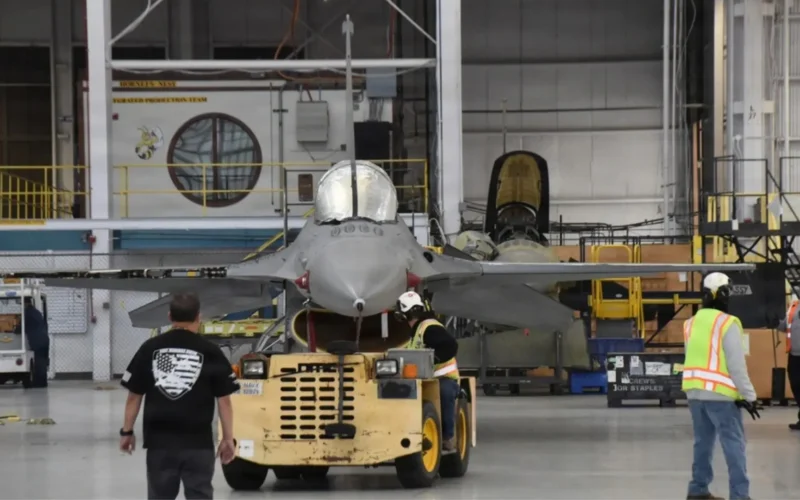
Fleet Readiness Center Southwest (FRCSW), in coordination with Program Executive Office Tactical Aircraft Programs (PMA-226), has established depot-level maintenance capability for the US Navy’s F-16 Aggressor aircraft in an 18-month activation timeline, using repurposed F/A-18 sustainment infrastructure to accelerate stand-up.
The effort positions FRCSW as the Navy’s primary depot location for F-16 Programmed Sustainment and Structural Repairs (PSSR), a maintenance construct comparable in scope to the High Flight Hour Inspection performed on the F/A-18 fleet. The Navy’s F-16s operate in the adversary training role, supporting fleet pilot readiness.
Cross-platform tooling adaptation
A central element of the rapid activation was the reuse and modification of legacy F/A-18 depot tooling for F-16 structural work. Rather than waiting for new equipment procurement, FRCSW engineers adapted existing inner wing removal and installation stands originally designed for the F/A-18 to support F-16 wing maintenance operations.
The adaptation required structural validation and engineering approval to ensure compatibility and safety. By leveraging in-house engineering authority and working with PMA-226, the depot established a compliant maintenance process without introducing significant procurement delays.
In addition to tooling adaptation, the depot addressed supply chain constraints by identifying refurbishment pathways for critical fasteners that were unavailable through the Navy’s supply system. The reused components were requalified through engineering review prior to incorporation into maintenance procedures.
Engineering authority and sustainment documentation
The stand-up effort also included the development of a Local Engineering Specification (LES) tailored to the Navy’s F-16 sustainment requirements. The LES formalizes depot-level technical standards and provides structured guidance for structural repair and modification activity at Naval Air Station North Island.
According to PMA-226 Program Manager Capt. Jason Pettit, the collaboration between the program office and FRCSW enabled accelerated readiness outcomes through coordinated procurement, workforce training, and equipment installation within the compressed timeline.
FRCSW personnel received platform-specific training from Hill Air Force Base, which supports U.S. Air Force F-16 depot operations, while industry support from Lockheed Martin assisted with radar-absorbent coating processes and structural repair methodologies.
Expanding depot sustainment scope
The first Navy F-16C Viper inducted under the new program was delivered to FRCSW in January 2025, with initial PSSR work completed in February. The depot is expected to perform sustainment on more than half of the Navy’s F-16 fleet, with additional work packages planned, including Special Structural Inspections and Service Life Assessment Program (SLAP/SLEP) activity, canopy longeron repairs, and radar low-observable coating applications.
By leveraging F/A-18 sustainment infrastructure, workforce experience, and internal engineering capabilities, FRCSW reduced activation timelines and avoided platform-specific tooling delays. The approach reflects a broader model of cross-platform depot flexibility, enabling naval aviation sustainment organizations to absorb new aircraft types without establishing entirely separate infrastructure pipelines.
As the Navy continues to operate a mixed fixed-wing fleet that includes legacy and non-native platforms, the rapid stand-up of F-16 depot capability at FRCSW demonstrates the potential for multi-aircraft sustainment scalability within existing industrial frameworks.
