
Key ideas
- •As the US Navy’s Super Hornets age, new smart weapons like StormBreaker are set to provide them with a firepower boost.
- •StormBreaker uses a tri-mode seeker that combines millimeter-wave radar, infrared homing, and semi-active laser homing.
- •StormBreaker can find, track, and hit moving targets all by itself, even in bad weather or when the enemy tries to hide.
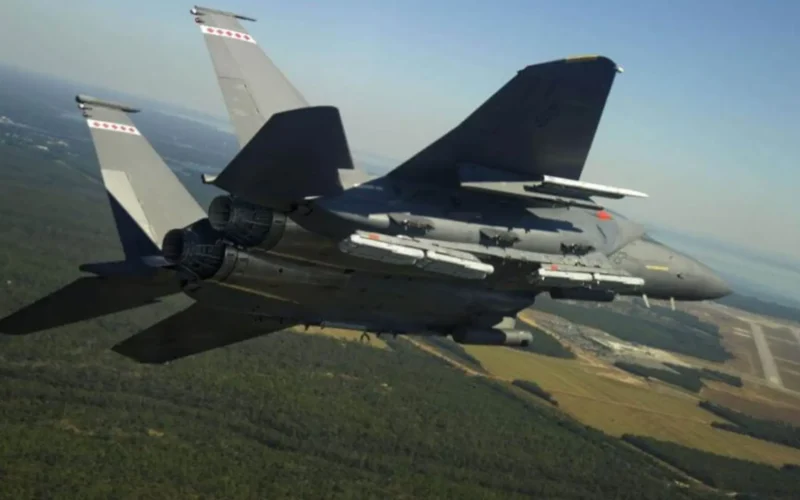
The US Navy has approved RTX subsidiary Raytheon’s StormBreaker smart weapon, also known as GBU-53/B, for operational use on the F/A-18-E/F Super Hornet strike fighter.
In a press release on February 20, Raytheon announced this approval and added, “StormBreaker is the only operational smart weapon that can engage moving and stationary targets in both fair and adverse weather conditions, at land or at sea.”
The weapon can also fly more than 45 miles to strike mobile targets, according to Raytheon. The approval of StormBreaker for operational use on the Super Hornets would enable the fourth-generation aircraft to carry more weapons due to the weapon’s compact size.
However, the most important technology behind the weapon’s advanced, all-weather, precision-strike capabilities is its seeker.
StormBreaker is equipped with a tri-mode guidance architecture that combines millimeter-wave radar, imaging infrared, and a semi-active laser, layered over GPS and inertial navigation.
The tri-mode seeker
Most precision weapons use a single primary guidance system, such as a laser or GPS, and require external support or favorable conditions. In contrast, the GBU-53/B StormBreaker uses a tri-mode seeker that combines millimeter-wave radar, infrared homing, and semi-active laser homing, improving target tracking and discrimination across varied environments.
The millimeter-wave radar operates in the Ka-band, detecting targets through bad weather and obscurants, while infrared identifies heat differences, and the laser mode enables external designation. The three modes work together to enhance tracking and target discrimination.
Unlike optical systems, radar energy is not degraded by low visibility in the same way. It allows the weapon to maintain track continuity against moving vehicles, maritime targets, or fast repositioning threats even when the target is invisible to the human eye.
Together, radar and infrared allow the weapon to discriminate targets within vehicle clusters, reducing unintended strikes and improving aim-point accuracy.
The semi-active laser mode enables external designation. A ground unit, aircraft, or unmanned system can mark a target, and the weapon will home in on reflected laser energy. This mode provides valuable capability in dynamic targeting scenarios where a forward observer identifies a time-sensitive threat.
Combining radar, infrared, and laser data ensures effective target tracking and adaptability to changing conditions or countermeasures.
Glide capability
StormBreaker is a winged, powered glide weapon capable of traveling more than 40 nautical miles (45 miles) after release, depending on launch altitude and profile. That standoff distance changes the risk equation for aircrews.
Instead of descending into the threat envelope of short-range air defenses to visually prosecute moving targets, the Super Hornet can release from a higher altitude and greater range.
The weapon utilizes GPS guidance to approach the target area, then activates its integrated sensors to autonomously identify and engage the designated target. This process increases operational efficiency and contributes to pilot safety.
This capability is particularly critical in the maritime environment, where the detection and discrimination of vessels are complicated by sea clutter. The weapon’s radar can identify and track moving ships even in degraded weather, reducing the need for pilots to acquire targets visually.
Ultimately, this system functions more as an autonomous, networked precision munition than as a conventional unguided bomb.
When the Navy began integrating StormBreaker on the Super Hornet, it leveraged operational experience from its deployment on the F-15E. The use of advanced software and modeling techniques reduced the requirement for live test flights by enabling extensive validation through computer simulations prior to airborne testing.
Moreover, pilots are not required to manually select between radar, infrared, or laser guidance modes; the munition autonomously adapts based on mission parameters and target characteristics. The platform operates within an integrated digital ecosystem supporting collaborative targeting.
Integration with F-35
The StormBreaker weapon is small enough for a Super Hornet to carry more weapons per mission compared to larger glide bombs, and it can carry smart munitions that can operate autonomously, turning a single-target strike into an ability to engage multiple targets at once.
StormBreaker is now fielded on the F-15E and the Super Hornet. Integration work is in progress for all F-35 variants, requiring each aircraft to address unique roles and system compatibility.
On the F-35, integration will require connecting StormBreaker’s sensors and guidance to the aircraft’s advanced sensor suite, coordinating these with the F-35’s mission systems, and using the F-35’s low-observable features for survivability.
For the Super Hornet, integration includes adapting the weapon’s interface for Navy-specific avionics and communications and enabling standoff strikes from carriers. In both platforms, StormBreaker’s core three-mode guidance operates consistently, even as the integration steps are tailored to each aircraft’s mission systems and architecture.
StormBreaker’s design flexibility supports integration across diverse aircraft. Its seeker and guidance systems are engineered to connect with the unique mission computers and communication systems of each platform while maintaining all core targeting and guidance functions, ensuring adaptability without losing capability.
Adding StormBreaker to Navy Super Hornets is not just about increasing firepower. It’s about speeding up decision-making in uncertain situations.
The three-mode seeker enables operation in low visibility, extends pilot safety, and its compact size increases weapon load and flexibility.
Although these fighter jets are aging and production is ending, the integration of a smart weapon like StormBreaker enhances operational capability. The aircraft can now autonomously detect targets, engage moving objects from extended distances, and maintain performance in adverse weather.
