
Key ideas
- •Purdue’s new turbine designs can operate across a far wider Mach range than traditional turbines, solving a major airflow limitation in modern engines.
- •The technology is built to handle the unstable pressure environment of rotating detonation engines, which are more compact and potentially more efficient than conventional gas turbines.
- •If successfully integrated at scale, these turbines could enable next-generation propulsion systems for aerospace, power generation, and marine applications.
Purdue University has demonstrated turbine designs that accommodate transonic inlet speeds, where air enters the turbine at or near the speed of sound.
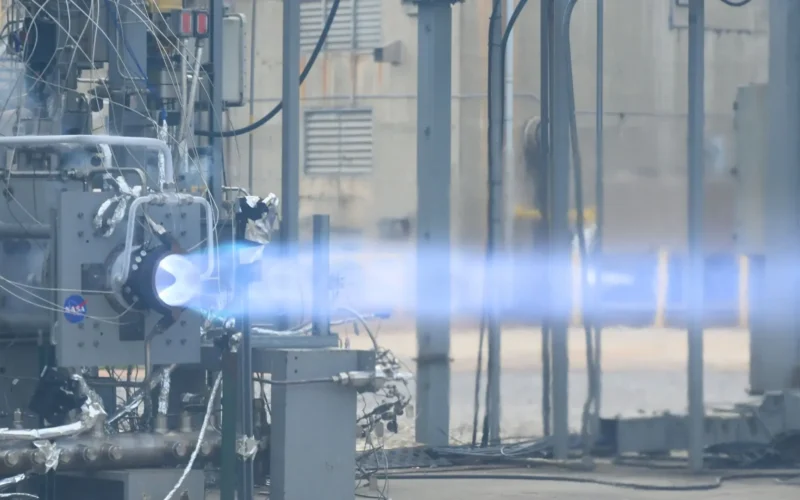
Research at Purdue’s Maurice J. Zucrow Laboratories aims to demonstrate that next-generation combustion systems can operate effectively in practical engines.
The main challenge lies not only in combustion, but in integrating these systems. The turbine is central to this integration challenge.
The rotating detonation promise
Rotating detonation engines (RDEs) have attracted attention in the past decade. Unlike conventional gas turbines, which use deflagration, RDEs employ continuously propagating detonation waves, combustion waves traveling at supersonic speeds, moving around an annular combustor.
RDEs improve energy extraction efficiency and reduce engine size, maintaining performance and fuel economy.
This combination has industrial applications for power generation, aerospace, and marine propulsion. Smaller engines delivering equal or greater thrust or shaft power improve packaging, weight distribution, and mission range.
RDEs generate intense, high-frequency pressure oscillations that affect both upstream and downstream turbine operations. These oscillations can cause compressor stall, flow separation, and fluctuating structural loads.
The main obstacle is no longer sustaining a detonation wave, but whether the rest of the engine can withstand it.
Inlet Mach constraint
Traditional turbines operate within narrow inlet Mach number envelopes.
In land-based power plants, inlet Mach numbers are usually below 0.3, while in liquid rocket turbomachinery, they may reach 0.6. These machines are optimized for steady, subsonic inflow.
As inlet Mach numbers approach transonic speeds, shock waves form, increasing energy losses, increasing the risk of flow separation, and reducing turbine efficiency.
For decades, turbine design has focused on keeping Mach numbers below critical thresholds.
The research at Purdue directly challenges this longstanding constraint.
Guillermo Paniagua, Reilly Professor of Mechanical Engineering, and his team have developed a turbine geometry that operates across transonic inlet conditions and, as previously disclosed, into supersonic regimes beyond Mach 2.5.
The difference lies in the architecture of the flow passage.
Geometry as a control mechanism
The design of the transonic inlet turbine alters the airflow within it. The endwalls are smoothly shaped, and the channel height increases steadily as the air moves through.
Importantly, the throat area is larger than the inlet area, which goes against traditional ideas about how constriction and expansion should work.
Traditional turbine stages condition the inlet flow to prevent shock formation (sudden pressure jumps) within the blade passage. In contrast, Paniagua’s design manages compressibility (how much the air can be compressed) through its geometry.
By gradually increasing the passage height, the design allows high-speed flow to decelerate gradually, preventing abrupt shock structures that cause losses and flow separation.
Rather than avoiding transonic conditions, the turbine accommodates them.
Removing the restriction on inlet Mach numbers enables new engine configurations and improved interaction between the combustor and turbine, which is especially valuable when integrating rotating detonation engines and pursuing more compact engine designs.
Bridging the integration gap
A main challenge is managing pressure fluctuations between the rotating detonation combustor and the downstream turbine.
Detonation waves generate high-pressure pulses that can disrupt compressors and turbines, leading to problems such as compressor surge or turbine instability.
To address this, engineers have suggested using diodic valves, one-way valves that control airflow direction. These devices allow flow in one direction while blocking backward-propagating pressure waves.
Conventional diodic solutions reduce efficiency gains from detonation combustion due to pressure losses.
Purdue’s second concept, the diodic turbine, embeds flow rectification within the turbine stage itself, providing directional flow control and limiting the propagation of reverse pressure waves, thereby minimizing pressure losses and preserving efficiency gains.
According to a dissertation from Purdue University, researchers have developed a quasi-one-dimensional model for rotating detonation engines that is suitable for studying overall engine performance, with run times much faster than those of traditional two- or three-dimensional computational methods. Experimental validation of this model is planned.
If validated at scale, this approach could provide a structural solution to a core integration challenge for RDEs.
Continuous Mach operation
The broader turbine concept is important for its continuous operational envelope.
Paniagua’s team has demonstrated turbine stage designs optimized for supersonic inlet conditions, and their new architecture is analyzed as suitable for a range of Mach numbers, potentially allowing operation from low subsonic through supersonic regimes, a level of flexibility that conventional turbine designs do not provide.
A turbine handling a wide Mach range reduces upstream constraints and adapts to real-world changes. Such a turbine reduces the need for strict upstream flow conditioning and increases combustor flexibility.
This operational flexibility is particularly valuable for aerospace applications, including high-speed and variable-cycle engines.ion
If transonic inlet turbines move beyond lab testing, they will impact many industries.
In aerospace, smaller gas turbines with rotating detonation combustors could make engines shorter and lighter, helping fighter jets, drones, and future high-speed transport aircraft.
In marine propulsion, where fuel efficiency and power are important, detonation-based gas turbines can perform better thermodynamically.
According to Purdue University, researchers are developing a Tesla valve-inspired injection manifold that could improve the performance of rotating detonation engines, potentially making turbines more adaptable and efficient for distributed power generation applications.
While improvements in combustors often get attention, good turbine design and integration are just as important. Without these, detonation engines will stay experimental.
Experimental validation and scaling
The designs have advanced from computational analysis to experimental demonstrations at Zucrow Laboratories, the world’s largest academic propulsion lab. Testing under various operating conditions is crucial.
When scaling up to full-scale gas turbine test rigs, additional challenges arise, including ensuring structural durability, managing thermal gradients, addressing material limitations, and integrating blade cooling.
The researchers need to minimize pressure losses to keep the system efficient and operational. Collaboration with industry partners will be critical in determining whether the concept transitions from an academic prototype to a commercial engine.
The US Department of Energy’s funding highlights the broader interest in advanced combustion systems for power generation and propulsion.
Historically, propulsion breakthroughs have rarely resulted from single-component innovations. The jet engine needed new compressor technology, more durable turbine materials, and stable combustion.
The stable performance of high-bypass turbofans is strongly linked to advancements in fan blade materials. For rotating detonation engines, similar improvements in materials technology may be necessary.
Advancements in combustion physics alone do not guarantee a viable engine; the surrounding architecture, including compressors, turbines, seals, and flow paths, must also evolve in parallel.
Paniagua’s research suggests turbine geometry may be the critical missing link in this evolution.
By removing inlet Mach constraints and enabling flow rectification, this turbine design addresses two main technical barriers to integration. To guarantee that RDEs will replace conventional gas turbines, it significantly lowers the barrier to practical experimentation.
From laboratory to engine bay
The objective is to bridge the gap between laboratory demonstration and industrial deployment. This change often reveals challenges for propulsion concepts.
Computational fluid dynamics can show potential, and wind tunnel tests can confirm how well something performs. However, putting these together into full engine cycles often reveals unexpected interactions.
If the transonic inlet turbine can stay efficient and control pressure changes across different operating ranges, it might serve as a key structural solution.
This progress would help not only with rotating detonation engines but also with any propulsion system that operates at higher inlet Mach numbers than are usually accepted.
For decades, turbine design has focused on controlling and suppressing compressibility effects, but the new work suggests a different approach: shaping the geometry to accommodate them.
The researcher’s approach involves permitting transonic and even supersonic flow into the turbine stage, smoothly managing expansion, and avoiding abrupt shock formation through careful contouring.
The design approach reflects recent trends in high-speed aerodynamics. Designers now recognize that shock waves will form and focus on managing where they occur and how strong they are.
If adopted in mainstream turbomachinery, this mindset could fundamentally redefine the constraints on engine design.
In parallel with new turbine developments, propulsion is adapting to ongoing shifts such as electrification.
One way to improve efficiency is through detonation combustion. The next step is to ensure it works well with robust turbine hardware.
These designs mark a shift in thinking about Mach limits and flow changes. They could enable efficient small engines across many conditions. This progress rethinks turbine design, not just combustors.
