
Key ideas
- •Europe is moving from fusion research to planning a grid-connected stellarator power plant.
- •The project pairs public funding, private capital and utility expertise to industrialize stellarator technology.
- •If successful, it could position Europe at the forefront of commercial fusion energy.
For decades, fusion energy has stayed in labs as a tough physics problem involving magnets and math. Now, Europe seems ready to see if this science can become real-world energy systems.
Proxima Fusion, a Munich-based startup spun out of Germany’s Max Planck Institute for Plasma Physics, has signed an agreement with the Free State of Bavaria, utility giant RWE, and the Max Planck Institute to pursue what they describe as the world’s first commercial stellarator fusion power plant.
The plan starts with a test machine called Alpha in Garching and aims to build a power plant, Stellaris, at the old nuclear site in Gundremmingen. Europe wants to build working stellarators before anyone else.
From research machine to industrial system
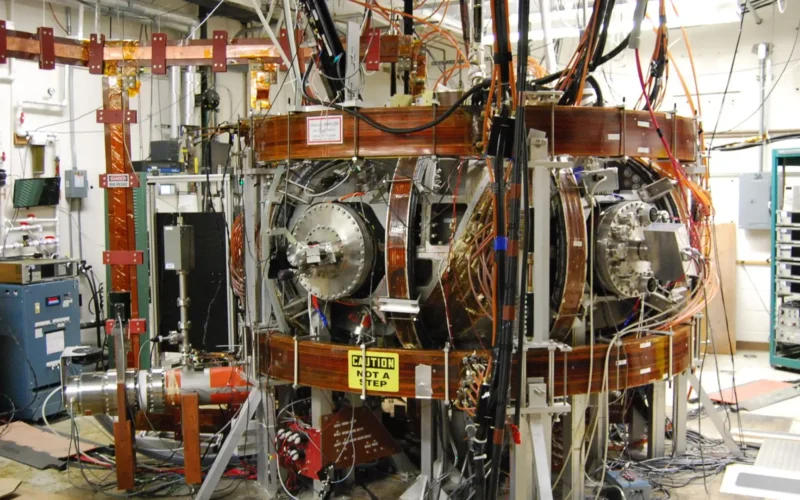
Fusion research in Europe is not new. Germany’s Wendelstein 7-X stellarator, operated by the Max Planck Institute for Plasma Physics, has spent years refining magnetic confinement physics.
It has shown better plasma stability and can keep the plasma contained for longer than older stellarator designs. The new part is moving from experiments to actually building working power plants.
Alpha, the demonstration stellarator planned for Garching, is intended to demonstrate net energy gain, where the plasma produces more energy than it consumes.
Alpha will also be a key place to test engineering problems and how all the parts work together, which must be solved before fusion power can operate in the real world. Reaching these goals would be a big step forward in science and technology.
Alpha’s bigger job is to connect plasma science with real-world engineering for future power plants. It will test designs and ways to run the plant, and check that maintenance and safety steps work in real use.
Getting more energy out of the plasma than you put in does not automatically mean you can make electricity for the grid. A real power plant must remove heat efficiently, convert it to electricity, handle neutron flow, and run smoothly for years. It also has to pass regular checks and comply with rules.
It must connect to the power grid and give a steady supply of electricity. Alpha is mainly for engineering tests, not just for show.
Why stellarators, not tokamaks
Most fusion startups worldwide are building tokamaks. Tokamaks confine plasma using magnetic fields, with a strong current running through the plasma itself. They are relatively symmetrical machines and, historically, easier to design.
Stellarators work differently. Their magnetic coils are twisted into complicated 3D shapes. They do not need a big electric current in the plasma to keep it in place. This reduces the risk of sudden problems that could damage internal parts.
For years, people thought stellarators looked good on paper but were impractical because their magnets were too difficult to design and build well. Even tiny mistakes in the coils could make the plasma unstable.
What has changed is computer power. New computer programs and faster computers now let researchers design magnetic fields much more accurately than before.
Wendelstein 7-X demonstrated that well-designed stellarators can operate more effectively with plasma. Proxima is betting that computer design and modern building methods can make stellarators not just stable, but also good enough to use for business.
This is a big deal. Tokamaks can still experience sudden plasma issues that require careful control. In theory, stellarators can operate smoothly for long periods without requiring plasma current control.
If the engineering problems are solved, this could make running the plant easier over time. Europe wants to build this type of machine because it could work better for many years.
Reusing nuclear infrastructure
The choice of Gundremmingen as the site for Stellaris is not symbolic. It is practical.
Gundremmingen hosted one of Germany’s nuclear power plants, which is now being decommissioned. The location already has grid connections, cooling infrastructure, and regulatory familiarity with nuclear-grade operations.
People in the area already know how to work in energy plants. Building a fusion plant where a nuclear plant used to be means they can use the power lines and follow the rules they already know.
Fusion is very different from fission. It does not have a chain reaction that can get out of control. But a fusion plant still deals with very hot plasma, lots of neutrons, and some radioactive materials, such as tritium. It needs strict rules and oversight.
Locating Stellaris at a nuclear site signals fusion as real energy infrastructure, not just a lab project.
Financing the transition
The agreement uses a mix of funding sources. Proxima plans to pay about 20 percent of the costs with private money. Bavaria may add another 20 percent if the federal government helps. RWE has also said it wants to join in.
Fusion has historically been the domain of state-funded megaprojects, most notably ITER in France. ITER represents multinational collaboration and long-term research investment. It does not aim to deliver commercial electricity in the near term.
Proxima’s plan combines startup funding, government funding, and support from a major utility company. They want to move faster than government-only projects but still have strong support.
To build fusion plants, you need companies that can make magnets, special materials, precise parts, and systems to remove heat. Funding must pay for all these things, not just lab tests.
Europe appears to be attempting to anchor that ecosystem locally.
The technical hurdles ahead
Making a stellarator into a real power plant means solving several tough, interconnected engineering problems.
The special magnets must be made with very exact shapes. Even small mistakes in the coils can change the magnetic fields. In a big power plant, the coils also have to last for years under heat and stress.
The materials must withstand exposure to neutrons for many years. Neutrons from fusion can damage parts and make them radioactive. Strong metals and good shielding are needed.
Systems to remove heat must capture the energy from fusion and efficiently transfer it to turbines or other machines that generate electricity. Even small losses in turning heat into power can make the plant too expensive to run.
Many fusion plans use deuterium and tritium, which are rare fuels produced in the reactor from lithium. Producing enough fuel and handling it safely are key to running the plant.
Alpha is expected to serve as a testbed for many of these components under conditions more realistic than those allowed in laboratory experiments.
The real question is not just about making more energy than you use, but whether the system can be built to run continuously and make money.
Europe’s competitive position
Europe has long been strong in fusion physics. German institutions, particularly the Max Planck Institute for Plasma Physics, have been central to stellarator research. The continent hosts ITER, one of the most ambitious scientific collaborations in history.
What Europe has not yet demonstrated is commercial fusion infrastructure.
In the United States, several private companies are pursuing tokamak-based systems. China continues to invest heavily in magnetic confinement research. The global fusion landscape is shifting from publicly funded research toward a mix of private and public efforts.
By choosing stellarators, Europe is making its own path in fusion technology. If running these machines smoothly works out, Europe could become a leader in this area.
That leadership would go beyond just making energy. It would also affect how magnets are made, how new materials are developed, and how powerful computers are used.
Industrial ambition, not just physics
The agreement signed in Munich does not promise fusion power plants in the 2030s. Fusion projects have often taken longer than first expected.
What makes this effort different is how it is set up. The agreement brings together research groups, a private company, a major utility, and the state government to work toward a stellarator power plant connected to the grid.
This is a big change: fusion is now about actually building, getting approval for, paying for, and running a real power plant.
If it works, Stellaris would be more than just a new technology. It would show that Europe has turned years of plasma physics knowledge into real energy systems.
Europe wants to build working stellarators before others do, not just keep testing fusion in labs.
Whether this plan works will depend not just on how well the plasma performs, but also on good engineering, careful building, and ongoing political support.
For now, this effort shows that Europe wants to turn fusion from an idea into real energy systems, and do it in its own way.
