
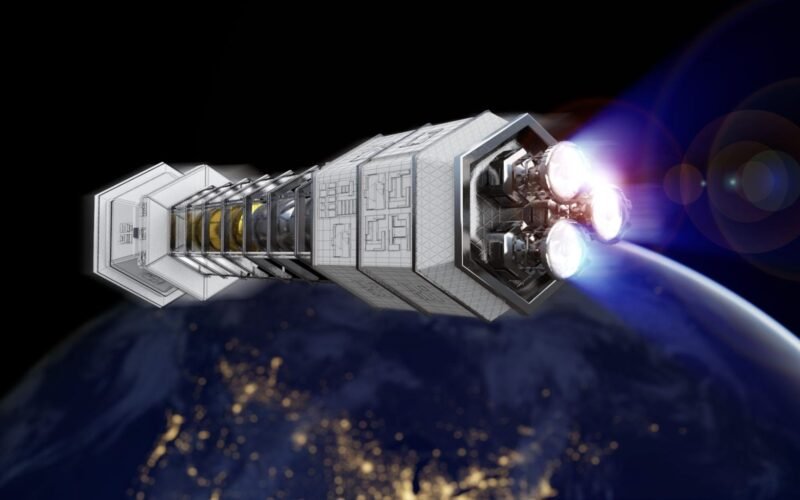
The United States is evaluating whether to pursue a large-scale 100–500 kilowatt-electric (kWe) fission reactor on the Moon as part of a broader effort to establish long-term leadership in space nuclear power.
The discussion follows a directive by National Aeronautics and Space Administration to pursue fission surface power, with a stated objective of placing a nuclear reactor on the lunar surface by fiscal year 2030.
A report funded by Idaho National Laboratory, titled Weighing the Future: Strategic Options for US Space Nuclear Leadership, outlines three development pathways, including a large 100–500 kWe system intended to deliver a significant step increase in available power.
From radioisotopes to fission surface power
US space missions have relied for decades on radioisotope power systems, which convert the decay heat of plutonium into electricity.
These systems have powered spacecraft such as Voyager and Mars rovers but operate at much lower power levels than would be required for sustained lunar or Martian surface operations.
A 100–500 kWe reactor would represent a transition from mission-scale energy support to infrastructure-scale generation, enabling continuous power for habitats, in-situ resource utilization, communications arrays, and industrial systems.
According to Sebastian Corbisiero, national technical director of the Department of Energy’s Space Reactor Initiative, fission systems provide a “step increase” in available power compared with radioisotope systems.
Engineering divergence from terrestrial reactors
While advanced terrestrial reactors provide a technological baseline, space reactors face distinct constraints. Weight is a primary driver, as every kilogram must be launched from Earth.
Conventional water-based cooling systems used in commercial nuclear reactors would require heavy pressure vessels, making them unsuitable for space deployment.
Temperature and endurance requirements also differ. Space reactors are expected to operate at higher temperatures to maximize power density and are being designed for up to 10 years of maintenance-free operation, in contrast to terrestrial reactors, which typically undergo refueling and maintenance every 18–24 months.
Component durability, shielding mass, and long-duration electronics survivability in vacuum and radiation environments remain central design considerations under NASA’s Fission Surface Power effort.
Three strategic pathways
The INL-funded report outlines three potential approaches.
The first, described as a high-impact option, proposes development of a 100–500 kWe lunar reactor led by NASA or the Department of Defense, with Department of Energy support.
This pathway would require sustained federal funding and centralized leadership but could deliver rapid capability at infrastructure scale.
A second option proposes two sub-100 kWe projects executed through public-private partnerships, one focused on lunar surface or orbital deployment, the other on in-space applications.
This approach is intended to reduce risk and distribute technological responsibility across government and industry partners.
A third, incremental pathway would focus on a small, sub-1 kWe demonstration system to establish regulatory precedent and technical groundwork for future deployments.
Each strategy reflects differing assumptions about funding stability, risk tolerance, and timeline urgency.
Industrial positioning and acceleration
Idaho National Laboratory is positioned as a coordinating hub for space reactor development, leveraging facilities such as the Transient Reactor Test Facility for fuel and materials testing.
The laboratory is tasked with integrating efforts across federal agencies, national laboratories, and private industry to accelerate technology readiness.
The report suggests that while US investment in space nuclear technologies has been consistent, the pace of development must increase to maintain leadership in surface power and propulsion.
The decision between incremental demonstration and large-scale deployment will shape whether lunar nuclear power remains an experimental capability or becomes foundational infrastructure for sustained human presence beyond Earth orbit.
With NASA’s 2030 target approaching, the United States faces a strategic choice: pursue gradual validation of small systems or commit to a higher-power lunar reactor capable of anchoring long-duration operations.
