Key ideas
- •North Korea is expanding its uranium enrichment capabilities, crucial for nuclear warhead production.
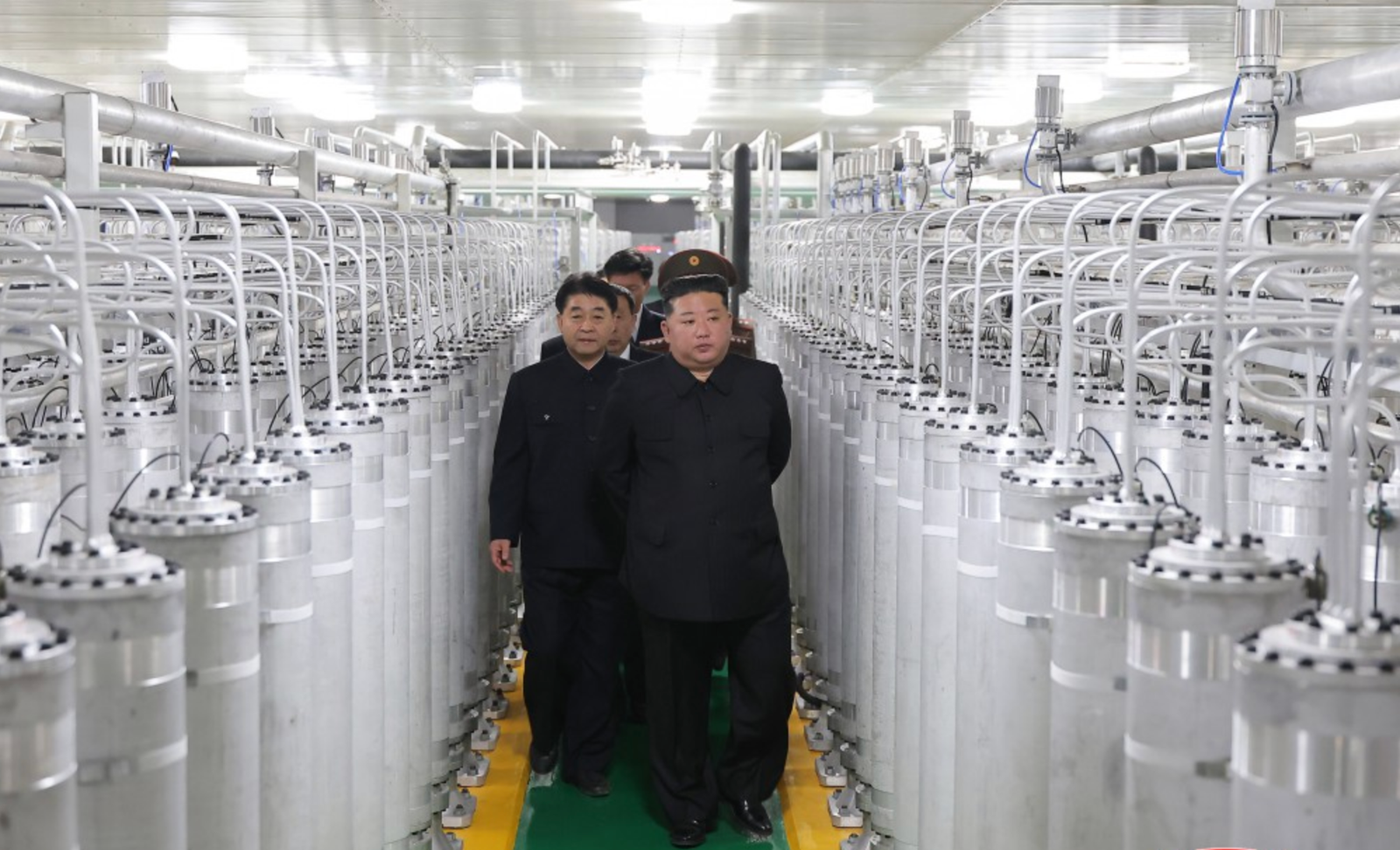
- •Recent images of Kim Jong Un at a suspected enrichment facility highlight the secrecy surrounding the country's nuclear program.
- •Estimates suggest North Korea may possess over 100 nuclear warheads, with significant growth in production capacity over the past five years.
North Korea has spent years showing off its missiles. This week, it highlighted something more important to its nuclear program. Pyongyang’s state media shared images of leader Kim Jong Un visiting what South Korean officials assessed as a uranium enrichment facility. At the same time, officials announced plans to speed up the growth of the country’s nuclear weapons.
North Korea did not disclose the site’s location. However, the images and statements provide a rare look into the production of fissile material as part of the country’s nuclear program, which is usually kept secret. Missiles capture attention, but nuclear weapons start long before a missile is launched. They begin with highly enriched uranium or plutonium, the materials needed to build nuclear warheads.
Looking beyond the missiles
North Korea regularly tests missiles. The country has previously launched intercontinental ballistic missiles, submarine-launched systems, hypersonic weapons, and solid-fuel rockets as part of its efforts to modernize its military. However, missiles are just one part of their nuclear force.
A country can develop advanced systems to deliver nuclear weapons, but the number of nuclear warheads it can build depends on how much weapons-grade material it can produce. The speed at which it can make more warheads relies on its enrichment facilities, reactors, and reprocessing plants.
The photographs released by the Korean Central News Agency showed Kim walking through what appeared to be a centrifuge hall with rows of cylindrical enrichment machines connected by pipes and supported by equipment.
While North Korea provided no technical details, South Korea’s Joint Chiefs of Staff assessed the site as a uranium enrichment facility. If that assessment is correct, the facility would form part of the industrial foundation that supports North Korea’s growing nuclear program.
Need for uranium enrichment
Nuclear weapons require special materials that can create a chain reaction. To make uranium-based weapons, countries need to enrich uranium to very high purity levels by using centrifuges, machines that spin uranium gas at high speeds.
The process separates the rarer uranium-235 isotopes from the more common uranium-238 isotopes. The more uranium-235 present, the closer the material gets to weapons-grade. Building and running enrichment facilities is a complex task. A large number of centrifuges must operate continuously and with very high accuracy.
Even small problems can lower output or damage the equipment. Because the amount of enriched uranium produced is closely linked to enrichment capacity, it is often seen as a key indicator of how strong a nuclear program can become over time. North Korea has earlier revealed its enrichment facilities at Yongbyon, and it is believed that the country also has a facility at Kangson.
The new site could be either an expansion of what it already has or a separate operational facility. It is hard to verify this information because international inspectors currently cannot access North Korea’s nuclear facilities.
Production capacity doubled over the past five years?
During the visit, Kim stated that North Korea’s weapons-grade nuclear material production capacity had more than doubled over the past five years. That claim cannot be independently verified, though North Korean nuclear sites are still active, as shown by satellite images and other reports, and fit a larger trend noticed by outside experts who monitor these activities.
North Korea has stressed the need to grow its nuclear forces since talks with the United States ended in 2019. Since then, the country has carried out many missile tests and introduced new weapons. The most recent information shows that North Korea is not only investing in missiles but also in building the necessary infrastructure to support a larger stockpile.
Ankit Panda from the Carnegie Endowment for International Peace reportedly said that North Korea’s facility seems to show a big increase in its ability to enrich nuclear material. He believes North Korea’s efforts to expand its nuclear capabilities are not going to stop anytime soon.
While experts have different opinions on how many nuclear weapons North Korea has, many agree that the country’s stockpile has grown a lot over the last ten years.
The arsenal size?
It is hard to know exactly how many nuclear weapons North Korea has. The country does not release official numbers, and outside estimates vary widely. South Korean officials have suggested that North Korea has enough highly enriched uranium to create many weapons.
Some experts believe that North Korea may have over 100 nuclear warheads. However, it is hard to confirm because the country’s nuclear program is secretive. In September 2024, North Korea showcased its uranium enrichment facility for the first time.
At the time, South Korea’s Unification Minister Chung Dong-yong said North Korea was running four nuclear enrichment sites and might have up to 2,000 kg of highly enriched uranium with 90 percent purity or higher. He added that around 10 to 12 kg of uranium is enough to make one bomb. However, one fact everyone agrees on is that the production of fissile material is a major limitation on future growth.
Increasing uranium enrichment capacity can boost the production of weapons-grade uranium. However, it doesn’t mean more warheads are deployed. Developing warheads involves several steps, such as designing, manufacturing, testing, and integrating them with delivery systems. Still, the ability to enrich materials is one of the most crucial parts of building a nuclear arsenal.
The intent
The timing of the announcement may be as important as the facility itself. North Korea has repeatedly stated that it is a nuclear-armed state. During his visit, Kim said that expanding nuclear capabilities is necessary for national security and deterrence. He also mentioned plans to strengthen the country’s nuclear forces further.
North Korea is focusing on strengthening its nuclear capabilities, including both improving the quality and increasing the quantity of its weapons. The country recently unveiled a new facility to enrich nuclear material as part of this plan. Instead of showing off a new missile or testing a weapon, North Korea emphasized its ability to produce nuclear materials. It shows that North Korea is confident in its current weapons and in its future production capabilities.
Though much remains unknown about the facility, its exact location has not been disclosed, its production capacity remains uncertain, and independent inspectors have not verified North Korea’s claims regarding output or technological advances. Even with some limitations, this disclosure offers a rare glimpse into an important part of the country’s nuclear program. Missiles are a clear symbol of nuclear power, while enrichment facilities are the tools that enable expansion.
For years, the world has watched North Korea’s missile launches and military parades. The recent images now show the industrial facilities behind these displays. It is unclear whether the new facility is an expansion of an existing site or part of a larger network. The country wants to show it is investing in the infrastructure needed to maintain and possibly grow its nuclear arsenal. While missiles are the most visible part of this plan, the factories that produce materials for future warheads might be just as important.