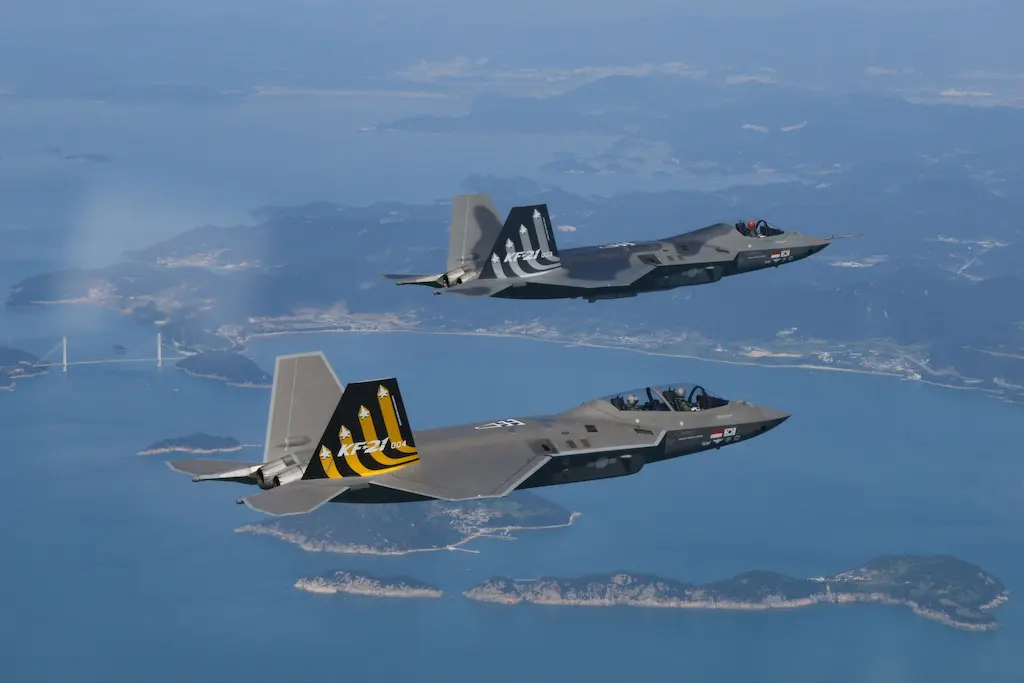
Key ideas
- •The KF-21 became South Korea's first fighter to complete full government airworthiness certification after a 40-year aerospace journey.
- •South Korea evolved from assembling US-designed F-16s to independently designing, testing, and certifying a modern combat aircraft.
- •While some key components remain foreign-made, the KF-21 gives South Korea control over the aircraft's design, development, and future upgrades.
In the late 1970s, a maintenance crew from Korean Air Lines, working for the US Air Force, began repairing several American aircraft, including F-15 Eagles, A-10 Warthogs, C-130s, and various helicopters. The group began repairing US F-16 fighter jets in 1983 at their specialized technology center in Busan. All the knowledge about how these planes work, including their design and engineering choices, came from the country that built them.
On June 15, 2026, a government review committee in Gwacheon completed its check of 745 flight-safety standards in 14 categories. The committee decided that the KF-21 Boramae, a fighter jet built entirely by South Korea, is safe to fly. The jet now has full type certification from the South Korean government, and the journey to reach this point took over 40 years.
How South Korea developed KF-21
South Korea began developing modern fighters with the F-16. Through the Peace Bridge programs, Lockheed Martin (then the military aircraft division of General Dynamics) set up a production line in Korea and trained hundreds of Korean engineers in the United States. Samsung Aerospace put together the jets in Korea and called them the KF-16. The partnership taught Korea how to run a precise aerospace manufacturing line, manage a supply chain, and build aircraft to exact standards without mistakes.
However, license production could not teach design authority. Decisions about aerodynamic curves and the jet’s performance had already been made in Texas. Korea was manufacturing airplanes but not designing them.
The first real attempt to close that gap came almost by accident, as an offset clause buried inside the F-16 deal. In 1992, South Korea began developing an indigenous supersonic trainer under the KTX-2 program, intended to prepare pilots for the KF-16 and the incoming F-15K. By 1995, the Asian Financial Crisis had gutted the government funding on which the program depended, and KTX-2 nearly died before it produced a single prototype.
Lockheed Martin, however, decided to become a full partner in the project, rather than just a design consultant, to save it. In July 1997, the company signed an agreement to assume responsibility for the aircraft’s fly-by-wire flight control system and to integrate the avionics. The company also agreed to manufacture the wings at its Fort Worth plant.
Two years later, in October 1999, the Korean government initiated a merger to combine Samsung Aerospace, Daewoo Heavy Industries, and Hyundai’s aerospace division into a single company, naming it Korea Aerospace Industries (KAI). Before this, Korea’s aviation capability was spread across three competing firms, but thereafter it was consolidated into a single national entity.
The aircraft that was later developed, the T-50 Golden Eagle, first flew in August 2002 and entered service with the Republic of Korea Air Force in February 2005. The Korean government funded 70 percent of the project, while KAI contributed 17 percent and Lockheed Martin provided 13 percent. It is often called Korea’s first home-made supersonic aircraft.
However, it’s important to note that KAI designed the fuselage and tail, while a foreign partner developed the systems that enable a modern jet to fly. The T-50 was a learning experience for Korea, showing that Korean engineers could co-design a combat aircraft, but it did not yet demonstrate that they could do so entirely on their own.
The jump
The ambition to do it alone is older than people usually assume. In March 2001, President Kim Dae-jung announced at an Air Force Academy graduation ceremony that Korea intended to develop its own fighter, with an original target of beginning development in 2003 and reaching service by 2015.
The program that emerged, originally called KF-X, found its funding partner in Indonesia in 2010, but the nature of that partnership differed from Lockheed Martin’s with the T-50. Indonesia wasn’t brought in to hold design authority over any subsystem. It was brought in as a 20 percent financial stakeholder, buying its way into eventual aircraft and a cut of future manufacturing work through state firm PT Dirgantara Indonesia.
Korea and KAI retained the other 80 percent of both the cost and the engineering decisions. When the program formally launched in 2015 with an 8.8 trillion won budget, the design authority was in Korea for the first time. The prototype rolled out on April 9, 2021, almost exactly twenty years after Kim Dae-jung’s original speech, and the aircraft was renamed KF-21.
With that, Korea became one of 13 countries worldwide to build its own fighter jet with modern radar and avionics. The first flight took place in July 2022.
What forty years of effort actually built
The KF-21 that resulted is a twin-engine, single-seat, multirole fighter measuring roughly 16.9 meters in length and 11.2 meters in wingspan, and is classified by Korean officials as a 4.5-generation aircraft. It is powered by two General Electric F414 turbofans, each producing close to 98 kilonewtons of thrust with afterburner, pushing the jet to a top speed of Mach 1.81, a combat radius of roughly 1,000 kilometers, and a service ceiling near 65,000 feet.
The key feature of the KF-21 that Korean engineers are most proud of is its advanced radar, which includes a locally developed active electronically scanned array, an indigenous infrared search-and-track sensor, and an electronic warfare suite. Instead of creating full internal weapons bays, which would have taken more time and increased costs, KAI opted for semi-recessed conformal weapons carriage for the first production blocks.
The aircraft design allows missiles to be stored in shallow spaces on the body, which helps reduce radar visibility. It has ten hardpoints and can carry about 7,700 kilograms of weapons outside. A future version, the KF-21EX, will include a fully internal weapons bay and better links to networked combat systems, making it closer to fifth-generation capability.
KF-21 is the design that just finished a five-year airworthiness review, beginning in April 2021, before the jet had even flown, and concluding this June, with all 745 inspection items satisfied. That review is a separate, distinct process from the “fully combat suitable” operational certification the KF-21 received in May, which tested whether the jet can fight. June’s certification tested whether it’s safe to fly. Korea now holds independent, government-verified answers to both questions about an aircraft that no one else in the world has ever certified.
What still isn’t Korean
However, Korea did not build the KF-21 jet without any outside help. The engines come from the American company GE Aerospace and are manufactured under license by Hanwha Aerospace; they are not designed in Korea. The canopy and windshield, which are designed to withstand bird strikes, are supplied by the American firm Texstars.
Like many fighter jets that countries claim as “indigenous,” the KF-21 relies on an international supply chain for its most specialized parts. What changed over forty years isn’t that Korea stopped needing anyone else’s parts. It’s that Korea no longer needs anyone else’s design authority, and now, as of this month, anyone else’s certification authority either.
Kim Il-dong, Deputy Administrator of the Defense Acquisition Program Administration, who presided over the Airworthiness Certification Review Committee, said, “The airworthiness certification capabilities and experience we have accumulated over the years have served as a foundation for objectively verifying the flight safety of the KF-21, and this will be a decisive factor in securing the trust of overseas purchasing countries during future export processes.”
He added, “Based on the flight safety certified by the government, we expect this to contribute significantly to the expansion of K-defense exports.” Over the last forty years, South Korea has learned to make fighter jets. First, it learned how to build them. Next, it learned how to design them. Then it proved that its designs are safe. Each of these steps is necessary to sell fighter jets to other countries rather than just buying one.