Key ideas
- •A floating nuclear plant can generate power for years without relying on oil and gas flowing through Hormuz.
- •South Korea is combining its shipbuilding expertise with small modular reactors to create a new type of energy infrastructure.
- •For island nations, industrial hubs and military bases, floating nuclear power could offer energy security without building a traditional plant on land.
In December 2025, Samsung Heavy Industries received certification for a floating nuclear power platform. Six months later, amid disruption to Asia’s main energy route and governments across the Indo-Pacific urgently changing their energy plans, people are now looking at the same platform in a new light.
In 2026, the closure of the Strait of Hormuz exposed one of Asia’s biggest energy vulnerabilities. Before the disruption, China, India, South Korea, and Japan together used about 89.2% of the oil that flowed through Hormuz. The current alternative routes can only replace about 35% of that oil flow. Now, energy officials in the region are wondering how to build energy infrastructure that doesn’t rely on this single 39-kilometer waterway.
Samsung Heavy Industries is building one answer. It is not a pipeline or a new LNG terminal. It is a floating nuclear power plant.
Samsung’s floating offshore nuclear platform
Samsung Heavy Industries received approval from the American Bureau of Shipping for a floating offshore nuclear power platform, the floating small modular reactor (FSMR), in December 2025. The platform will use two SMART100 small modular reactors developed by the Korea Atomic Energy Research Institute (KAERI).
The certification is an important technical milestone. The ABS checks if ships and offshore structures meet safety and engineering standards. Getting its approval means the design has been found technically correct. It shows that the engineering makes sense, the safety plans are credible, and the concept can move on to detailed design and construction. For a floating nuclear power plant, this verification step is the toughest.
As part of the approval process, ABS held a Hazard Identification workshop focused on the non-reactor parts of the design to identify potential safety and operational risks. The reactor parts were evaluated against Korean nuclear regulations, and the SMART100 already met them.
The reactor
The SMART100 is a small modular reactor (SMR) developed by the Korea Atomic Energy Research Institute since the 1990s. It builds on the original SMART design, which was the first SMR in the world to gain standard design approval in 2012. The upgraded SMART100 received new standard design certification from South Korea’s Nuclear Safety and Security Commission in September 2024.
SMART100 differs from traditional reactors, such as the pressurized water reactor, which is the most common type in use today, in that it keeps its main parts separate. These parts include the reactor core, steam generators, pressurizer, and cooling pumps, all connected by external piping. These pipes can cause major accidents, known as large-break loss-of-coolant accidents. Conventional nuclear safety systems are mainly designed to address this issue.
In the SMART100 design, the pressurizer, cooling pumps, steam generators, and core are all inside the reactor pressure vessel. It means there are no external pipes carrying the coolant. Having no external piping prevents a major failure that could quickly lead to coolant loss from a large pipe break. Since there are no pipes outside, this situation can’t happen. The entire cooling system fits into a single vessel, which is about the size of a large industrial boiler.
The SMART100 has a safety system that can cool the reactor without needing outside power. It uses natural forces, such as gravity and changes in fluid density, to move coolant during a shutdown or an emergency. Samsung’s floating offshore nuclear power platform is designed to carry two SMART100 units. Together, they can generate about 200 megawatts of electricity, enough to power a city of around 200,000 homes, a large industrial facility, or an important military base, depending on how they are used.
Design of the platform
The main challenge Samsung faced was not building the reactor; KAERI handled that. Instead, the company had to fit a land-based reactor into a structure that moves and floats, withstands marine conditions, and meets nuclear safety standards.
The platform has separate sections for reactor, power generation, and safety, which allow it to use different SMR technologies in the future by changing only the relevant section, without requiring redesign of the entire floating structure. Samsung is not just developing a platform for the SMART100; it is building a flexible platform that can support any reactor technology.
The reactor and safety system are built as a single unit within a containment vessel. Moreover, the SMR can be tested on land before installation on a ship, reducing construction time. Traditional land-based nuclear plants often take years for on-site testing and commissioning. In comparison, a floating SMR reduces that timeline.
In addition, the SMART100 uses passive cooling, meaning that if the floating platform loses all its external systems, such as generators, grid connection, and pumps, the reactor can cool itself naturally. No action from operators is needed.
South Korea’s shipbuilding capability
The floating SMR may not seem like a clear choice for a shipbuilder, but it is a suitable product for this specific shipbuilder. Samsung Heavy Industries has shipyards in Geoje, where it builds some of the largest and most complex ships in the world, including LNG carriers, drillships, floating production storage and offloading (FPSO) vessels, and naval platforms.
Ahn Young-kyu, the Executive Vice President and Head of Technology Development at Samsung Heavy Industries, has said, “This certification is a milestone for leading the offshore nuclear power generation market. With our floating technology, Samsung Heavy Industries will continue to develop safe and cost-effective offshore nuclear power technology.”
The important point is the accumulated floating technology. Building and maintaining a ship with a nuclear reactor at sea requires the same engineering skills Samsung uses for FPSOs. FPSOs are offshore structures that house oil and gas processing equipment. The FSMR is a highly specialized type of FPSO from a structural engineering perspective. Samsung already knows how to build FPSOs.
KAERI, meanwhile, has spent three decades developing the SMART reactor through repeated cycles of design, review, and certification. Jinyoung Cho, Senior Vice President and Head of KAERI’s Advanced Nuclear Reactor Laboratory, said, “This award proves the innovativeness of our nuclear power technology. We will accelerate technology development so that our country can establish itself as a leading country in the marine nuclear power industry.”
The combination is what makes South Korea specifically positioned for this product. China’s shipbuilders are building a competing floating reactor. China National Nuclear Corporation expects to begin commercial operation of its ACP100 floating reactor in 2026, but it is working from a different reactor design and without the nuclear export track record that Korea has established through the Barakah plant in the UAE. No other country in the Indo-Pacific has both the reactor certification and the shipbuilding industrial base to execute this simultaneously.
Tackling the infrastructure problem
When energy supply is disrupted, the common solution is storage, which involves maintaining strategic oil reserves, building additional liquefied natural gas (LNG) terminals, and signing long-term supply contracts. India’s strategic oil reserve can cover about nine to ten days of consumption, which is not as good as China’s more developed storage systems. Japan and South Korea also have larger reserves, but storage can run out.
A floating nuclear power plant generates power for three years on a single fuel load, without needing any imports. After the Hormuz crisis, Australia strengthened its energy security by signing agreements with Japan on May 3 and seeking fuel and LNG swaps with Malaysia. While these actions provide short-term solutions, they do not address the larger issue. A 200 MWe floating nuclear platform near a coastal industrial site or island grid could offer a better solution.
Though the deployment scenarios vary by region, Indonesia’s outer islands rely on diesel generation because they are not connected to the main Java power grid. The Mindanao grid in the Philippines faces ongoing power shortages, and Vietnam is looking to restart its nuclear power plans. Southeast and South Asia lack adequate energy storage and resilience because commercial storage infrastructure is scarce or missing. A floating SMR can be docked without needing land for a plant, transmission systems, or fuel import terminals. It only requires a harbor and a cable to connect to the grid.
There is also a defense aspect to consider. Forward operating bases in the Indo-Pacific depend on fuel that needs to be shipped, stored, and protected. A floating nuclear platform can generate 200 megawatts of electricity, provide desalinated water as a secondary benefit, and operate for three years without needing resupply. This innovation reduces a key logistics risk for any facility it supports.
The deployment timeline
Samsung’s ABS certification takes the FSMR project from the planning stage to detailed engineering. However, the company has not shared when construction will start or who its commercial customers are. Turning the Approval in Principle into an operational floating nuclear platform requires a thorough design review, working with regulators in the target country, buying long-lead components, and building the platform. It will take several years, not just a few months.
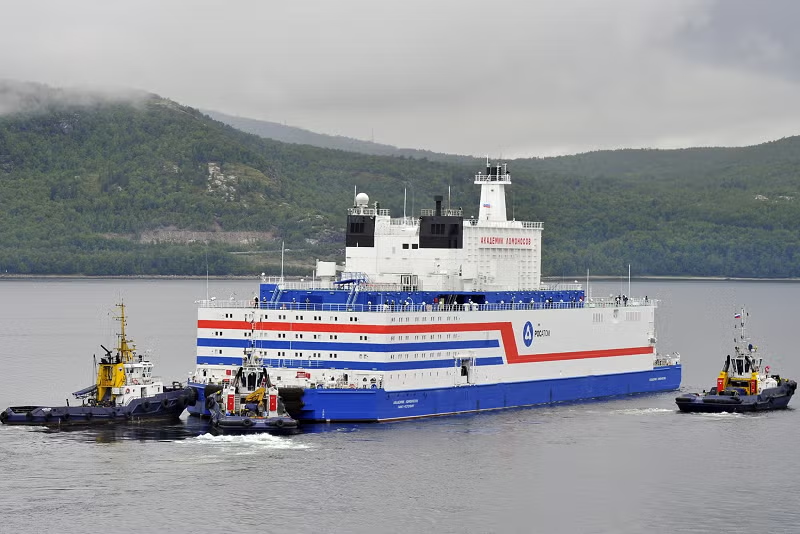
However, China’s ACP100 is ahead of schedule. Russia’s Akademik Lomonosov floating nuclear plant, which uses older ship-based reactor technology, has been working off the coast of Chukotka since 2019. It shows that the idea of using nuclear plants at sea is workable.
Samsung has confirmed the engineering foundation for a Korean floating nuclear power product at a time when the need for it has shifted from theoretical to urgent. The Hormuz crisis didn’t create the demand for floating nuclear power; it simply made the need clear and impossible to overlook.