Key ideas
- •South Korea has brought together Samsung, SK, Hyundai, NAVER, NVIDIA, OpenAI, Anthropic, and Broadcom in a $500 billion AI alliance.
- •The partnership spans the entire AI supply chain, from HBM memory and GPUs to AI factories, sovereign AI, and physical AI.
- •The alliance is a response to China's rapid rise in AI, with eight of the world's ten most-used developer AI models now coming from Chinese companies.
Eight out of the ten most-used AI models by developers around the world are now from China. The fact, from the AI analytics firm OpenRouter, was something South Korean President Lee Jae Myung kept in mind when he went to San Francisco on July 24.
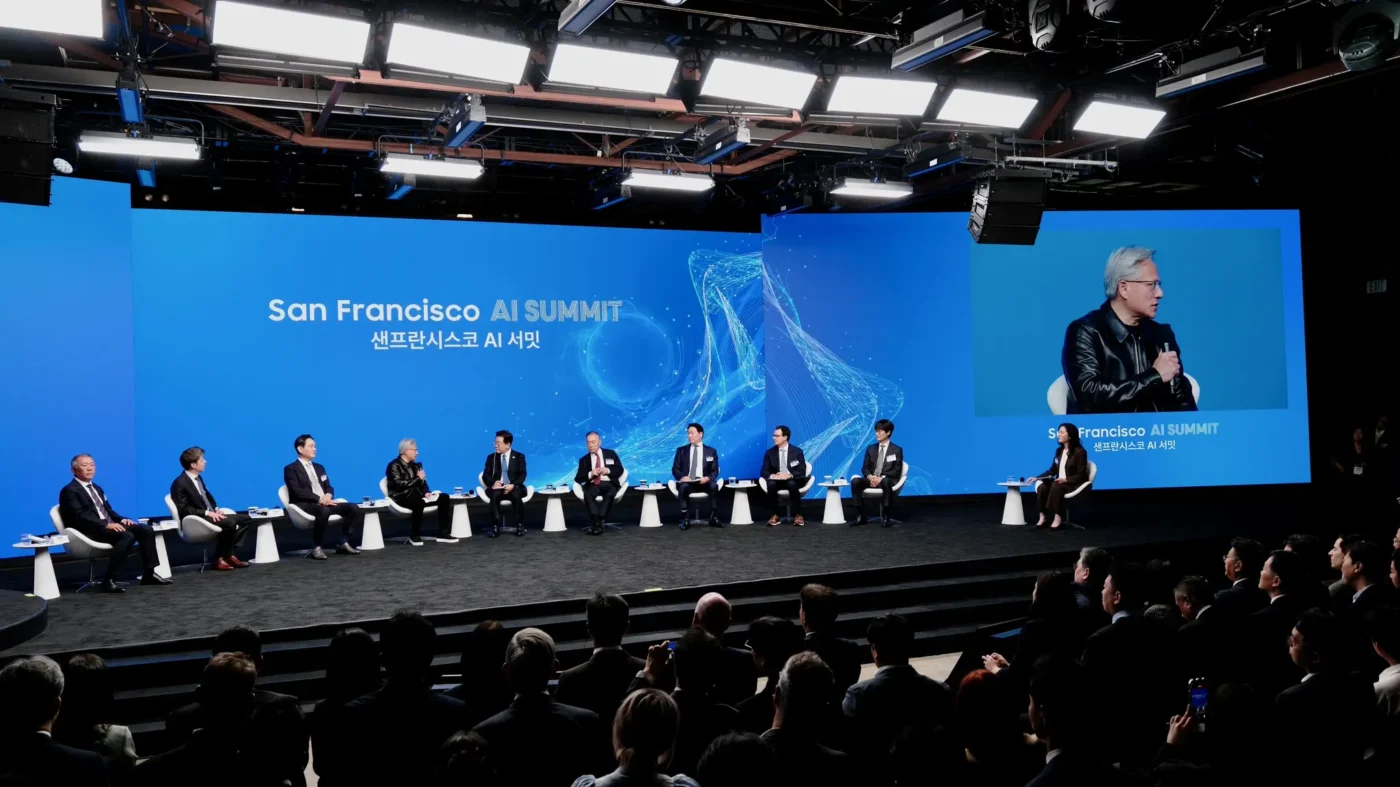
There, he brought together the chairpersons of South Korea’s four largest tech companies with the top executives who shape the global AI infrastructure. The meeting is being called a mega alliance by Korean business circles.
Samsung Electronics Chairman Jay Y. Lee, SK Group Chairman Chey Tae-won, Hyundai Motor Group Executive Chairman Euisun Chung, and NAVER founder Hae-jin Lee sat on one side of the table. On the other side were NVIDIA CEO Jensen Huang, OpenAI CEO Sam Altman, Anthropic CEO Dario Amodei, and Broadcom CEO Hock Tan.
The meeting was held at NVIDIA’s Endeavor building in Santa Clara. The agenda covered next-generation High Bandwidth Memory supply, AI factory construction, physical AI collaboration, and sovereign AI infrastructure. The number that emerged, SK Group and NVIDIA’s plans for a partnership worth approximately $500 billion, is among the largest single technology alliance announcements in the industry’s history.
The alliance
South Korean business and government leaders stated the summit’s goal. Companies from South Korea and other nations aim to create a large partnership to address China’s growing tech influence. The meeting included the heads of Korea’s four biggest technology companies and CEOs from four major global tech firms.
For the first time, leaders from critical areas of the global AI market like memory, GPUs, and generative AI services met together in one room, led by a sitting president.
The composition explains what the AI supply chain consists of. Generative AI systems need three main things to operate effectively: computational power from GPU clusters, sufficient memory to handle large volumes of data, and intelligent models that define what the systems can do.
The Santa Clara event highlighted three key points. NVIDIA is the market leader in AI GPUs, and its competitors have had little impact. Samsung Electronics and SK hynix are the two largest producers of High Bandwidth Memory, which is essential for NVIDIA’s AI chips, as it enables the fast data processing required for AI tasks.
NAVER, OpenAI, and Anthropic represent the model aspect of AI. Broadcom is also important as it supplies custom AI accelerator chips, which are alternatives to NVIDIA’s GPUs, for large tech companies known as hyperscalers.
China is making rapid progress in AI. Data from OpenRouter shows that eight of the top ten AI models used by developers worldwide are Chinese as of July 2026. Models such as DeepSeek, Kimi, and Baidu’s ERNIE series have become more popular among developers than Western models in the past year.
Chinese companies have created competitive AI models more quickly than many expected and at a much lower cost than American models needed. They have also shared these models in ways that have led to their fast adoption. The supply chain alliance being built in Santa Clara is a result of concerns that Chinese technological growth could continue to outpace Western expectations in areas such as hardware and infrastructure.
The specific commitments
The announcements accompanying the summit went beyond the kind of aspirational partnership declarations typically found in technology press releases.
NVIDIA and SK Group’s $500 billion partnership centres on two parallel tracks. SK hynix will deepen its collaboration on memory design with NVIDIA, co-developing the next-generation HBM architecture specifically optimised for NVIDIA’s upcoming platforms spanning AI infrastructure, personal AI, and physical AI.
SK Telecom will start a domestic AI factory with an initial capacity of 30 megawatts, aiming to scale it to gigawatts. A 30-megawatt AI factory is a computing centre, whereas a gigawatt-scale facility would be among the largest AI infrastructures in the world.
Samsung Electronics, which this week separately unveiled its next-generation HBM4 memory architecture specifically targeting AI accelerator applications, will deepen chip and memory design partnerships with NVIDIA.
HBM4 represents the next step beyond the HBM3E memory currently shipping inside NVIDIA’s Blackwell B200 accelerators, targeting higher bandwidth and lower power consumption per bit. These two performance dimensions determine how many AI inference operations a given hardware configuration can perform per unit of energy.
NAVER’s commitments centre on AI factory infrastructure. NVIDIA, NAVER, and Brookfield, the Canadian alternative asset manager that has been investing heavily in data centre infrastructure, announced an expansion of Korea’s National AI Factory infrastructure buildout, with NAVER’s GAK Sejong AI data centre targeted for expansion to 55 megawatts and then to gigawatt scale.
NAVER is also the first Korean company to participate in the NVIDIA Nemotron Coalition, contributing to open model development across pretraining, post-training, and reinforcement learning.
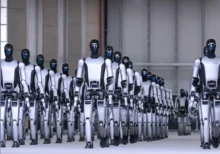
The Hyundai Motor Group dimension extends the partnership into physical AI. NVIDIA and Hyundai will jointly develop autonomous Genesis vehicles and robotics, with Hyundai’s robotics subsidiary, Boston Dynamics, providing the hardware platform on which NVIDIA’s physical AI software will run.
Boston Dynamics’ mechanical capabilities, Genesis’s vehicle architecture, and NVIDIA’s AI stack are direct physical AI competitors to the Chinese humanoid robot ecosystem and the Japanese Noetra consortium, to which Japan’s government committed $6.2 billion to build this year.
NVIDIA’s commitment to LG covers power generation systems, a recognition that the AI infrastructure buildout at gigawatt scale creates energy demands that semiconductor and software companies did not previously need to manage, and that power generation partnerships are now a component of AI infrastructure strategy.
The researcher relocation
NVIDIA also plans to launch an AI Frontier Lab in Korea and relocate leading AI researchers from California to the country.
Silicon Valley has a strong advantage because it has many skilled AI researchers. Instead of working with researchers from a distance or funding their projects through grants, some companies choose to move their researchers closer to South Korea’s hardware manufacturing and infrastructure.
Future AI development will benefit from having researchers close by. Although moving these skilled people may be difficult, it is worth it because they will have better access to important resources.
The AI Frontier Lab is a long-term commitment from the institution. Research labs have their own buildings, identities, and ways of working that continue even after the business agreements that created them. NVIDIA is not just investing in Korea; it is establishing a research institution there.
NVIDIA and KAIST simultaneously announced a joint AI research lab at KAIST’s Kim Jaechul Graduate School of AI in Seoul, dedicated to advancing agentic AI in South Korea.
It is the first joint AI lab between a Korean university and any global technology company. It will attract the kind of institutional attention from other universities and other companies that first-mover advantages in research infrastructure tend to generate.
The supply chain logic
The Korea-US AI alliance, which is being established in Santa Clara, is based on their shared supply chain. The partnership is now becoming more organised and structured.
Samsung and SK hynix provide the High Bandwidth Memory used in every NVIDIA AI accelerator. NVIDIA needs this Korean-made HBM to deliver its most important products. If NVIDIA did not use these GPUs, demand for HBM would drop, hurting Samsung and SK hynix, as they rely on NVIDIA for a large share of their advanced memory business.
Hyundai Motor Group’s acquisition of Boston Dynamics positioned South Korea within the physical AI hardware layer. Boston Dynamics’ Atlas and Spot platforms are the most mechanically capable commercially available robots in the world and represent exactly the deployment infrastructure that physical AI foundation models require to demonstrate real-world capability.
The NVIDIA partnership takes that hardware capability and adds the AI stack that makes it generalisable, a robot that can receive and execute natural language commands rather than executing pre-programmed routines.
NAVER’s approach is different from hardware companies. As Korea’s largest internet company, NAVER is building a large AI factory. It creates a local hyperscaler, keeping Korean AI computing independent of American or Chinese cloud providers.
Japan has raised concerns about relying on American or Chinese AI systems. Through its Noetra consortium, Japan has decided to create its own domestic AI foundation model. In Korea, NAVER is building similar infrastructure by processing data about Korean users on Korean infrastructure operated by a Korean company. The data remains under Korea’s control and differs from data processed on services like AWS, Google Cloud, or Alibaba Cloud, which are not under Korea’s jurisdiction.
The golden age
Jensen Huang called the past year under President Lee’s leadership a golden age for Korea. The statement was carefully worded but clear in what it meant. Under President Lee, South Korea has made rapid progress in developing AI infrastructure, creating AI industrial policies, and building AI partnerships with the US. The advancement was faster than what many people expected a year ago, considering the country’s political situation.
The $880 billion ten-year investment plan covering semiconductors, AI infrastructure, and robotics that South Korea announced in July, with Samsung and SK hynix alone committing $518 billion toward new chip fabrication sites, represents the domestic investment side of the same strategy the Santa Clara summit represents externally.
A golden age creates a sense of urgency to compete. The period will eventually come to an end. South Korea has limited time to strengthen its role in the AI supply chain before Chinese competitors close the technological and manufacturing gaps that currently give Korean companies their edge.
The summit’s discussion about China is serious. The South Korean government, NVIDIA, OpenAI, and Anthropic all share the belief that to maintain American and allied strength in the global AI market, it’s important to build partnerships now rather than just competing in business.
Huang visited Seoul in June for what the Korean media called the pork belly summit. He had dinners with Korean business leaders at local restaurants. These meetings were informal but serious. The Santa Clara summit a month later will have a sitting president and $500 billion in partnership commitments on the table. The current event formalises the same discussion.
South Korea and the United States are forming an alliance to build an AI supply chain. The partnership has both business and strategic goals. Both countries are clear about which competitor they want to counter. Eight of the top ten developers of AI models are from China. The alliance was signed in Santa Clara on Friday to help ensure that the next ten leading developers are not Chinese.