Key ideas
- •Project Zorawar is opening India’s tank industry to private manufacturers.
- •Tata, Mahindra and L&T are building a new defence ecosystem.
- •The bigger goal is a US-style industrial network for India.
In early September, India’s Ministry of Defence chose Tata Advanced Systems Ltd as the lowest bidder for the ₹20,000 crore Make-I part of Project Zorawar. The project aims to create a 25-tonne light tank for the Indian Army to use in areas like Ladakh, the Himalayas, and the Thar Desert.
Mahindra Defence Systems was the second-lowest bidder and will also create prototypes. Both companies will have their designs evaluated before production orders are divided between them. This selection marks the first time a private company in India will independently develop and build a battle tank for the armed forces.
The significance of this decision extends beyond just the tank. The F-35 Joint Strike Fighter program shares manufacturing tasks among more than 1,400 suppliers across 46 US states. Lockheed Martin leads the program. Northrop Grumman makes the centre fuselage, BAE Systems builds the aft fuselage, Pratt and Whitney builds the F135 engine, and Raytheon handles the weapons.
Many smaller companies contribute as well, creating not just an aircraft but a comprehensive political economy. Each senator and congressman whose state houses an F-35 supplier has a vested interest in the program’s success. The interconnected industrial system makes the program hard to cancel and difficult to replicate elsewhere. India is building a similar framework for the Zorawar tank.
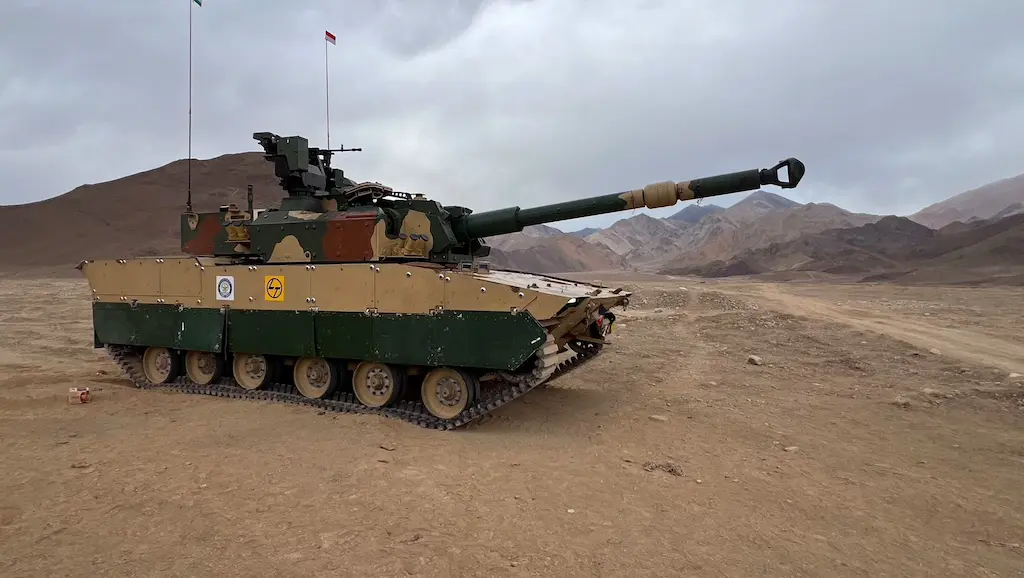
Larsen and Toubro created the original Zorawar prototype with the Defence Research and Development Organisation (DRDO) at its heavy engineering plant in Hazira, Gujarat. They completed this prototype in under 24 months, which is considered fast globally. It has passed track trials, desert trials at Pokhran, and user trials at high altitudes in Ladakh above 4,000 meters.
Tata Advanced Systems, chosen after a three-year evaluation from five bidders, will develop two operational prototypes within 130 weeks, while Mahindra Defence will work on competing prototypes at the same time. Once both designs are reviewed, the two companies will likely share large-scale production.
L&T, Tata, and Mahindra are India’s three largest private defence manufacturers. All three are now competing to build the same type of tank. The Ministry is funding the prototype development through the Make-I initiative, which covers up to 70% of development costs for qualifying Indian private companies. This encourages competition among these companies to build a strong, sustainable industrial capability.
The Zorawar tank supply chain adds to this ecosystem. Bharat Electronics Limited provides the fire control system and remote weapon station. DRDO’s Combat Vehicles Research and Development Establishment supplies anti-tank guided missile integration and counter-drone systems. Various small and medium enterprises in India supply essential components such as turbine blade castings, machined parts, and armour elements.
Tata’s design, which draws on its WhAP wheeled armoured vehicle program, includes an indigenous turret system and self-developed loitering munitions. These capabilities did not exist in India’s defence industry five years ago.
Analysts have observed that the processes of making turbine blades, machining them, and creating power packs are now connected within the same system. By having both Tata and Mahindra manufacture tanks, this strategy reduces risk and encourages competition, rather than relying on a single supplier.
The Zorawar’s specifications confirm that the Army is not just seeking a temporary solution. The Zorawar is equipped with a Cockerill 105-millimetre high-pressure rifled gun with an autoloader, a remote weapon station, and space for Nag Mk-2 anti-tank guided missiles or loitering munitions. Its modular armour provides strong front protection and can be upgraded.
The tank also has an active protection system and can operate in water. It weighs 25 tonnes, allowing two vehicles to fit inside a single Indian Air Force C-17 Globemaster III. This airlift capability directly to a Ladakh airstrip changes the deployment strategy for an army that realised its heavier T-72 and T-90 tanks faced altitude and terrain limitations against lighter forces positioned by China.
The Zorawar program has changed India’s tank manufacturing industry. Before this program, India had a state monopoly on tank production. The Heavy Vehicles Factory in Chennai produced the Arjun main battle tank, and the Ordnance Factory Board provided armoured vehicles and parts.
Private firms made subsystems but did not design, integrate, or lead armoured-vehicle production. A recent Forbes India analysis called this shift a turning point, showing that private companies can handle system engineering, configuration management, testing, quality assurance, and integration of weapons and sensors. These tasks were thought to require state institutions.
The F-35 program supports 220,000 direct jobs and will eventually produce over 3,000 aircraft. In comparison, Project Zorawar involves only 354 tanks with a ₹20,000 crore (about $2.3 billion) contract, which is small compared to the F-35’s total cost of over $400 billion. Even though the scale differs, both projects share the same core idea.
The program is being built step by step. India is doing things with Zorawar that have not been done before in armoured vehicle production, like awarding a program to a primary integrator, selecting subcontractors through competition, and funding orders through government procurement that guarantees real demand. L&T has designed the concept, Tata won the competitive Make-I bid, and Mahindra is also involved. Other companies like BEL, DRDO, and the MSME network provide various systems. Production will be shared to avoid a monopoly.
India’s defence industry has spent years making parts for foreign vehicles and assembling their designs under license. It has not yet developed the capability to fully design and produce an armoured fighting vehicle entirely in India. Zorawar is the first attempt of this scale with private companies leading.
The US F-35 project took decades and cost hundreds of billions. In contrast, India’s Zorawar project is smaller, faster, and is starting with a lower industrial base. If Zorawar develops a similar distribution network with L&T in Gujarat, Tata in different states, Mahindra in Pune, and BEL and DRDO labs from Chennai to Pune, the same success will happen.