Key ideas
- •The US Army is evaluating South Korea's K9MH wheeled howitzer to replace the aging M109 Paladin after three decades of failed replacement programs.
- •The K9MH offers the mobility the Army wants, combining a 155mm gun with faster shoot-and-scoot capability and compatibility with existing US ammunition.
- •South Korea once learned from American artillery technology, while the US Army is now turning to a Korean system for its next-generation artillery capability.
The M109 Paladin self-propelled howitzer has been in service with the US Army since 1963. It has been updated over the years with several variants, including A1, A2, A3, A4, A5, A6, and A7, but the basic vehicle design has remained unchanged since Lyndon Johnson was president. The US Army has been looking to replace it since 1994. Now, the service has chosen a South Korean howitzer to start this process.
On August 18, Hanwha Defense USA announced that it won a contract from the US Army to supply six prototype K9 Mobile Howitzers for the Mobile Tactical Cannon program. There is an option to provide twelve more, which has become Hanwha’s first major contract with the US Army. The company will set up production in a new facility in Opelika, Alabama, as part of its plan to boost American manufacturing.
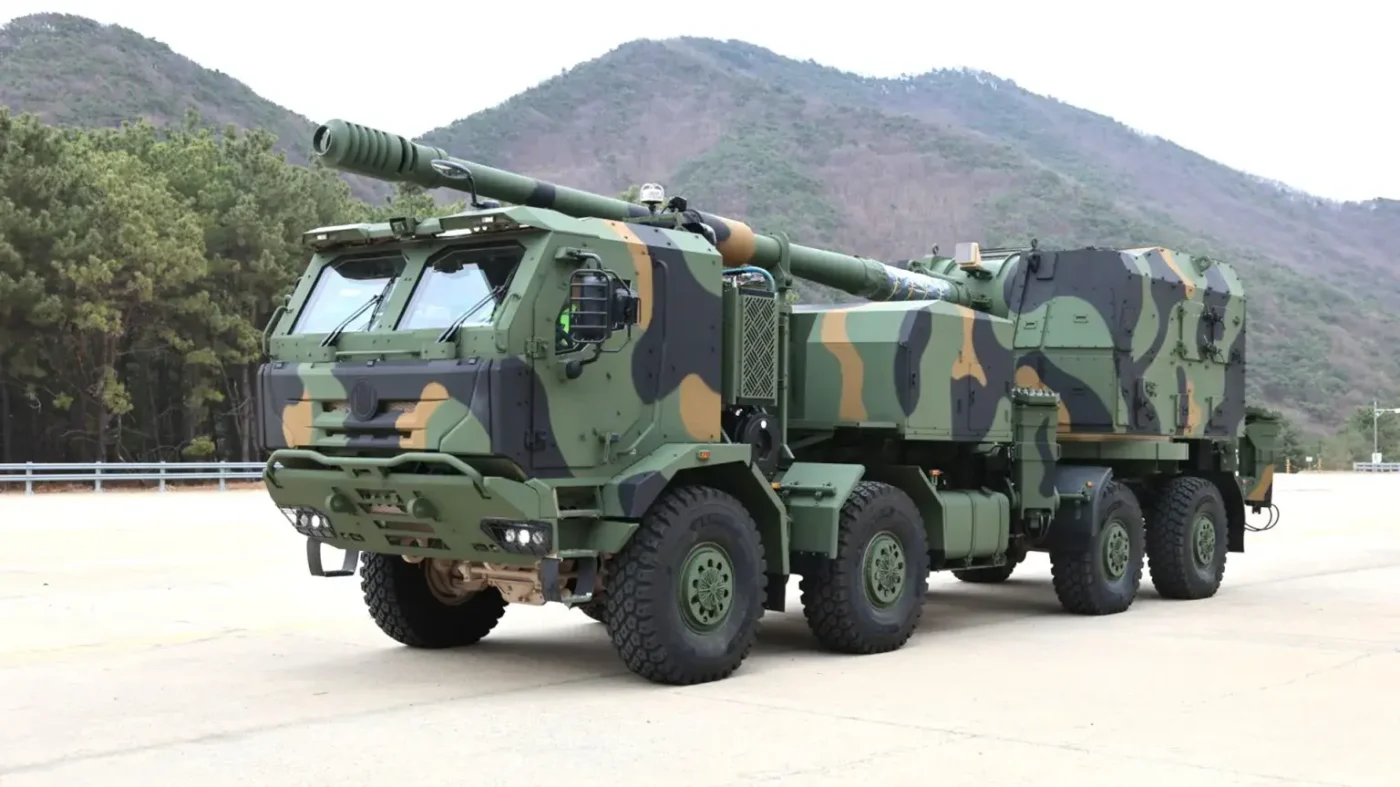
The chosen vehicle, the K9MH, is a wheeled version of the K9 Thunder. The Army will test it to see if it meets its need for a 155mm system that can quickly shoot, move, and shoot again, faster than any tracked artillery in modern battles.
The cancelled programmes
The US Army’s story of modernising its artillery is unique. The Army, known as a top military force, has failed to replace its main howitzer three times in thirty years.
The XM2001 Crusader was a promising tracked howitzer that could fire ten rounds per minute and move quickly after firing. However, in May 2002, Defense Secretary Donald Rumsfeld cancelled it, saying it was too expensive and that new threats didn’t require it.
The Non-Line-of-Sight Cannon was cancelled in 2009 as part of ending the Future Combat Systems project. The Extended Range Cannon Artillery (XM1299), based on the M109A7 and capable of firing beyond 60 kilometres (37 miles), was cancelled in 2024 because the Army faced too many technical challenges related to its long barrel.
After three failed attempts and thirty years, the Army has stopped trying to create a new howitzer from scratch. Instead, it is looking at existing systems that can be used quickly. The MTC program is now evaluating ready-to-use platforms that can fill the gap faster than a lengthy development project.
Army Secretary Dan Driscoll explained to the House Appropriations Committee that the Army’s approach has changed. He pointed out that during the fight in Ukraine, moving artillery quickly is important. The current M109A7 Paladin weighs about 36 tonnes.
It struggles to move in and out of position quickly enough to avoid enemy fire. In contrast, Ukraine’s artillery operators have had success with lighter wheeled systems that can be relocated more quickly. The Paladin is not designed for this fast pace. The MTC program aims to find a solution that meets this need.
The K9MH
The K9MH is a wheeled version of a family of vehicles that includes the K9 Thunder, the most widely used self-propelled howitzer outside of the Paladin. South Korea developed the K9 Thunder in the 1990s, taking early design inspiration from the US, and has since made improvements that make it better than its original influences.
The wheeled K9MH solves the mobility issue described by Secretary Driscoll. Wheeled artillery can move faster and deploy more quickly than tracked systems. It can travel at higher speeds on roads and be transported by C-17 or C-130 aircraft without the special preparations needed for tracked vehicles. The wheeled design is important to the Army’s goal of combining artillery with lighter, more mobile combat teams, including airborne divisions that currently rely on the towed M777. The K9MH is intended to replace that system.
The K9MH uses standard 155mm NATO ammunition, making it compatible with the US Army’s existing munitions, including precision-guided rounds like Excalibur and newer extended-range shells.
The K9 family’s development also includes a unique partnership. In December 2025, Hanwha Aerospace and the Army Combat Capabilities Development Command’s Armaments Centre signed an agreement to test a 58-calibre gun tube initially designed for the cancelled XM1299 on the K9A1 Thunder. The American gun tube may eventually be used in a Korean vehicle, even though it outlasted the vehicle it was meant for.
The system’s credentials
The US Army is evaluating the K9 howitzers before making a purchase. Over 2,500 K9 howitzers are in use worldwide in more than a dozen countries, including Poland, Finland, Norway, Estonia, Australia, Egypt, and Romania. These are nations with which the US Army collaborates through NATO and other security agreements.
Each country that has tested the K9 under real conditions and made follow-up orders has provided valuable information on its performance, which is far more useful than any prototype testing. Poland’s experience is particularly important for the US Army’s plans. After Russia invaded Ukraine in 2022, Poland signed agreements for K9 howitzers as part of a larger package costing around $22 billion.
Polish artillery crews are now using K9s, and Polish engineers are producing K9 parts at Hanwha’s facility in Poznań as part of localisation agreements. The K9’s performance in the same European security environment is essential for the US Army’s modernisation efforts and is available for review.
Hanwha’s CEO, Michael Coulter, described the Alabama facility as part of its localisation strategy. He explained, “Localisation is key to Hanwha’s global business model. We use our industry-leading technology from Korea to build a strong manufacturing base in the US, whether for shipbuilding, munitions, or combat vehicles.” The Opelika facility is just the first step in creating a manufacturing network in the US. Hanwha is considering more sites and phases as it grows its presence in America.
The reversal
South Korea’s artillery is mostly based on American equipment. The K1 main battle tank was developed with US assistance and shares similarities with the M1 Abrams tank. South Korea bought its first self-propelled howitzers from the United States, the M109 Paladin, manufactured by BAE Systems. The K9 Thunder howitzer uses American 155mm artillery technology, which was shared through defence agreements in the 1980s and 1990s.
South Korea learned from American designs, improved them, tested them against real threats from the north, and sold them to over a dozen countries worldwide. The US Army’s M109A7 program will not buy any more units as part of its FY2027 budget. Instead, the Army is investing in the MTC program, which has picked a Korean system for testing prototypes. The final choice is expected by late 2027, with plans for over 400 units if the program moves forward.