Key ideas
- •Singapore is moving beyond buying autonomous systems, giving its engineers the tools to develop and control their own military AI.
- •Its Horizon Tech Office is diversifying defence technology sourcing toward startups and emerging markets in Japan, South Korea, the Nordics and Eastern Europe.
- •Singapore is also working with South Korea to develop a framework for testing and certifying AI used in autonomous military vessels, tackling a major gap in current standards.
Singapore has one of the strongest militaries in Southeast Asia for its size. It uses F-15SG and F-16 fighter planes, Leopard 2 tanks, frigates with Aster missiles, and submarines. Each year, it spends about 3 per cent of its GDP on defence. However, Singapore cannot maintain a large military force. With a population of 5.9 million and a land area of 734 square kilometres, its mandatory national service does not provide enough personnel to meet the region’s traditional deterrence needs.
The Defence Science and Technology Agency (DSTA) believes that autonomous systems can help with this limitation, as drones and autonomous technologies can boost military strength without relying on a large number of personnel. However, DSTA has also decided that buying finished autonomous systems does not fully solve the problem. It moves the dependency from manpower to suppliers. Hence, Singapore is now focusing on more than just buying the unmanned systems.
The SDK model
In February at the Singapore Airshow, the DSTA and the Republic of Singapore Air Force announced plans to expand their partnership with Shield AI. The US company provides Hivemind AI technology, which enables aircraft to operate autonomously.
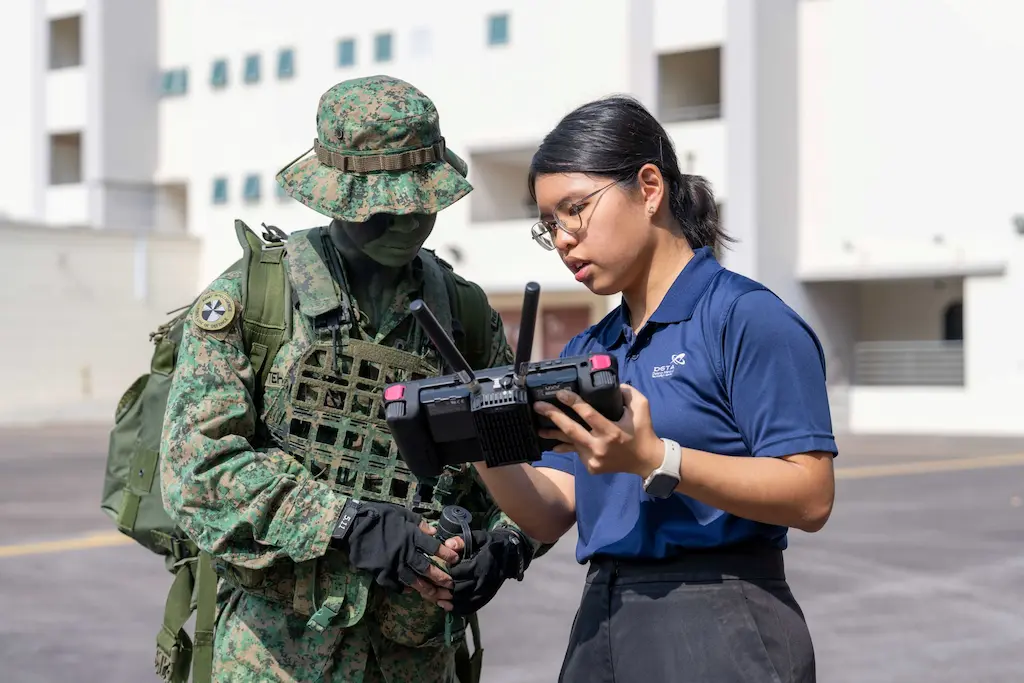
Shield AI’s Hivemind software development kit (SDK) allows DSTA engineers and RSAF aircrew to create, test, and deploy their own autonomous mission AI. It means they won’t have to depend on pre-built autonomous capabilities that come with existing platforms.
The difference between buying a drone that can operate on its own and getting the tools to create one is that buying means using a capability, while building means you own it. Within six months of gaining access to the SDK, engineers from RSAF and DSTA shared feedback that improved it. Singapore has shifted from being a customer to a co-developer in just one program cycle.
DSTA’s chief executive Ng Chad-Son stated, “This collaboration goes beyond technology adoption. It allows our defence engineers and aircrew to develop hands-on experience that will grow a sustainable pipeline of AI specialists with good operational understanding.”
Singapore is not building autonomous drones. Instead, it is developing the workforce needed to create autonomous AI. It includes training engineers who know how mission autonomy works. These engineers write the code and train aircrew who understand the system’s decision-making because they helped design it.
A country whose engineers develop mission AI from a software development kit (SDK) knows what that AI can do and why it works that way. In contrast, a country that purchases a complete autonomous system may understand how to use it, but this knowledge is more limited.
The way autonomous systems operate is important for how they will develop in the future. Military drones use mission AI that improves with each mission. Every operation collects data, which helps improve the software for the next time.
The Horizon Tech Office
The DSTA has partnered with Shield AI to establish a Horizon Tech Office, led by William Peh. The office aims to buy more technology from new defence markets, specifically Japan, South Korea, the Nordics, and Eastern Europe.
The focus on new markets comes from lessons learned during the conflict in Ukraine. The most impactful technologies, such as drones and AI targeting, have mostly come from startups and new suppliers, not from traditional defence companies in the US, UK, and France. DSTA believes the next wave of important autonomous systems will likely come from a Korean startup, a Japanese sensor company, or a Scandinavian autonomy firm rather than from the old established Western suppliers.
The countries targeted by the Horizon Tech Office are chosen for good reasons. South Korea’s defence industry is producing military technology faster and cheaper than Western suppliers. Japan has lifted its ban on defence exports as of April 2026, and its drone manufacturing is growing. Recent partnerships in Japan, including those with Tekever, Rheinmetall, Anduril, and Airbus-Kawasaki, demonstrate this growth. These are the markets that DSTA is focusing on now.
In March, DSTA’s chief executive explained that the main change in Singapore’s defence needs is the rise of drones. The shift means DSTA must look for innovations wherever they are occurring, rather than relying on traditional suppliers.
The certification problem
In January, the DSTA and the Korean Register signed an agreement to collaborate on a system to verify AI-based perception algorithms used in autonomous surface vessels.
The project addresses a specific problem that currently has no international solution. An autonomous ship navigates, avoids collisions, and makes other decisions based on what its AI perception system detects in its environment. The system processes data from sensors like radar, cameras, and sonar to identify objects.
It raises questions about how confident we can be in these classifications, what happens when the system encounters unfamiliar objects, and how it performs when sensor data is affected by weather, electronic interference, or deliberate spoofing.
Right now, there are no international safety standards that provide clear technical guidance for certifying the operation of autonomous surface vessels for military use. While the International Maritime Organisation has groups looking into autonomous shipping, they are not addressing specific defence needs such as electronic warfare resistance, adversarial environments, and rules of engagement.
DSTA and the Korean Register are developing a framework to allow for the assessment, testing, and certification of AI in autonomous surface vessels against specific performance standards. The Korean Register has expertise in global maritime certification standards.
At the same time, DSTA contributes systems engineering and military requirements expertise from the Singapore Navy’s autonomous vessel program, including work with the local startup BeeX on autonomous underwater vehicle technologies.
The partnership is important beyond just Singapore and South Korea. The framework they create will serve as a reference point for others. It will be the first serious technical effort by two advanced maritime countries to define what it means to certify AI for autonomous military vessels. Smaller navies in Southeast Asia and the Gulf, with their own plans for autonomous vessels, are closely watching this development.
The specific constraint
Singapore’s DSTA is working on an SDK model with Shield AI, the Horizon Tech Office’s new purchasing approach, and on certifying autonomous vessels with Korea. The strategy helps Singapore manage a critical challenge.
Unlike larger defence powers that can buy finished autonomous systems from various suppliers and deal with risks from any one supplier, Singapore has different needs. Each program must be reliable, well understood, and capable of operating independently without becoming overly dependent on foreign suppliers.
The SDK approach directly addresses these dependency issues by ensuring DSTA engineers have a deep understanding of the mission AI. The Horizon Tech Office diversifies suppliers by engaging with markets less affected by export-control issues that could disrupt supply from primary Western partners. The certification work with Korea creates a framework for defining the performance standards for autonomous systems, rather than simply accepting suppliers’ claims.
Ng Chad-Son describes the collaboration with Shield AI as a way to develop a lasting group of AI experts who understand operations. It reflects a deeper strategy than just buying equipment. Singapore aims for AI literacy. The goal is to have engineers and operators who understand these systems well enough to adapt and operate them independently, without relying on external explanations.
In a region where larger powers have more resources and capabilities, this deep technical understanding provides Singapore with a form of strategic independence that procurement alone cannot achieve.