Key ideas
- •Tokyo has moved from a purely defensive posture toward counterstrike capabilities, including long-range missiles.
- •Record defence budgets are funding new fighters, warships, missiles, drones, space capabilities, cyber warfare and electronic warfare.
- •China, North Korea and Russia are driving Japan toward a more integrated force, with a permanent joint command and deeper cooperation with allies.
In the winter of 1945, the United States dismantled the military that had fought it across the Pacific for four years. Japan was left without armed forces or weapons, and it adopted a new constitution that included Article 9, stating that Japan would renounce the right to wage war and not maintain a military. When Japan established its Self-Defense Forces in 1954, including Ground, Maritime, and Air, it focused on basic defence, limited spending to 1% of GDP, and relied on the United States for tasks Japan could not handle.
The arrangement lasted for 70 years but changed in 2022. Japan’s 2022 National Security Strategy approved a counterstrike capability. It means Japan can target an enemy’s military sites before or after an attack. For the first time since 1945, Japan’s government officially allowed planning and purchase of offensive military equipment. The new strategy also planned to double defence spending to 2% of GDP within five years, adding about $30 billion each year and committing ¥43 trillion ($275 billion) from 2023 to 2027.
In December 2025, Japan’s Cabinet approved a record defence budget of ¥9.04 trillion ($58 billion) for fiscal year 2026. It was the 12th consecutive year in which the budget set a record, and the fourth year of the current five-year program. By the end of this program in FY2027, Japan will be the world’s third-largest military spender, after the United States and China. The 21% increase in 2024 from the previous year is the fastest military buildup in Japan since World War II.
Defence Minister Shinjiro Koizumi said in December 2025 that Japan is facing its toughest and most complicated security situation since World War II. Japan shares borders with three countries that have nuclear weapons, including China, North Korea, and Russia.
In June 2025, two Chinese aircraft carrier groups were seen near Iwo Jima island in Japan. North Korea is continuously testing hypersonic systems and nuclear-capable rocket launchers, while Russia sent strategic bombers into Japanese airspace, often flying with Chinese planes.
Japan also shares a maritime border with China in the East China Sea and faces territorial disputes over the Senkaku/Diaoyu Islands. As a result, Japan’s military buildup across seven areas aims to tackle these challenges.
The missiles
Japan has upgraded its military capabilities by acquiring long-range strike missiles that can hit targets in China and North Korea. Japan bought 400 Tomahawk cruise missiles from the United States, each capable of reaching a range of about 1,600 kilometres. Deliveries of these missiles finished in fiscal year 2025.
On March 27, 2026, the Japan Times reported that the JS Chokai, a guided-missile destroyer, became the first ship in Japan to be equipped with Tomahawks after completing modifications and training in the US. It means that Tomahawks launched from Japan can target deep inside China and throughout North Korea.
In Japan’s fiscal year 2026 budget, funds were set aside to upgrade two additional Aegis destroyers, Myoko (DDG-175) and Atago (DDG-177), also to launch Tomahawks. Three other ships, Chokai, Haguro, and Kirishima, have already been modified. The plan is for all eight of Japan’s Aegis destroyers to carry Tomahawks in the future.
At the same time, Japan is producing the upgraded Type 12 surface-to-ship missile. The missile is an improvement over the original Type 12, with a range of about 1,000 kilometres compared to approximately 200 kilometres for the old version. It can target both ships and land.
The ground-launched version is being deployed to the 5th Surface-to-Ship Missile Regiment at Camp Kengun in Kumamoto Prefecture during fiscal years 2025-2026. The ship-launched version will be ready on the destroyer JS Teruzuki in fiscal year 2027, and the air-launched version will be used with upgraded F-2 fighters starting in fiscal year 2027.
Japan also received the Joint Strike Missile, developed in Norway, in fiscal year 2025. This missile is compatible with both the F-35A and F-35B aircraft and can strike surface vessels from a safe distance. Japan is also adding the JASSM-ER, an extended-range air-launched cruise missile from Lockheed Martin, to its strike capability.
In April 2026, an analysis by the International Institute for Strategic Studies stated that Japan’s new missiles would give it a strong naval capability for precise deep strikes, while the upgraded Type 12 would greatly expand Japan’s maritime strike range.
A report from the Center for Strategic and International Studies (CSIS) in April 2026 pointed out that Japan’s growing missile reach is faster than the necessary targeting networks, stockpiles, alliance agreements, and legal frameworks to use these weapons effectively. There are still unresolved issues about command authority for counterstrikes and coordination with US Indo-Pacific Command.
Mitsubishi Heavy Industries is working on the Hyper Velocity Gliding Projectile for island defence, a fast and stealthy weapon that aims to protect Japan’s southwestern islands from attacks. The first deployment is expected in 2026.
The navy
In March 2026, the Japan Maritime Self-Defense Force (JMSDF) made major changes to its organisation, the largest since its creation in 1954. It dissolved the Fleet Escort Force, which had been the core of Japan’s surface fleet since 1961, and replaced it with a new Fleet Surface Force.
At the same time, the JMSDF established an Information Warfare/Operations Command to consolidate intelligence, cyber, and oceanographic functions into a single centre. It also reduced the number of flotilla formations from four to three.
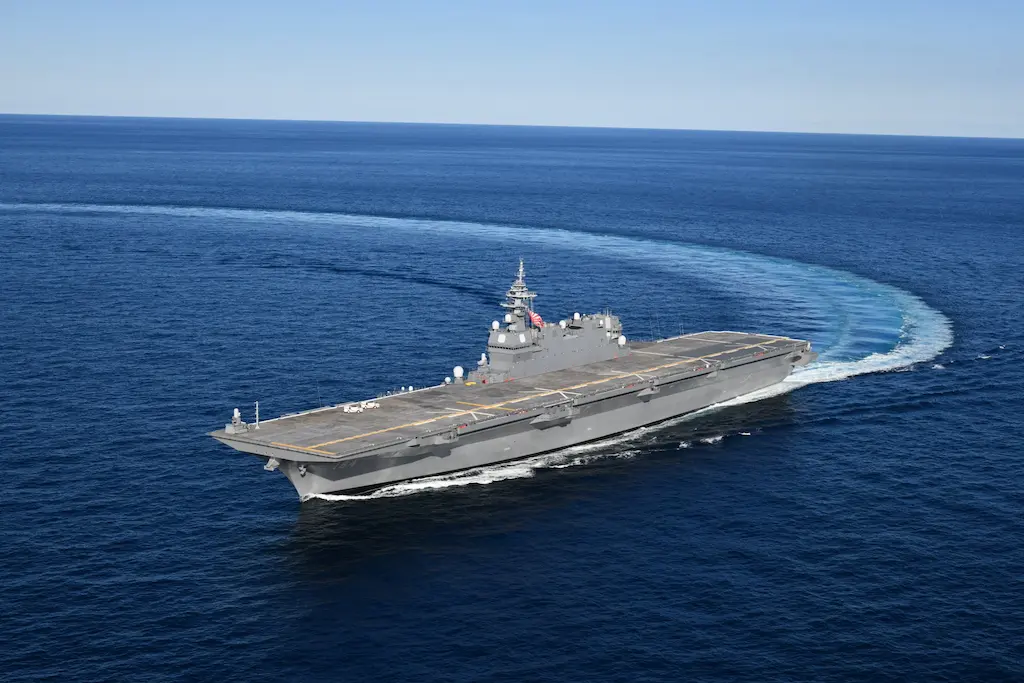
One of the most prominent changes in Japan’s navy is the conversion of its two largest ships, JS Izumo and JS Kaga, from helicopter carriers to platforms capable of operating fixed-wing combat aircraft. In April 2026, the JMSDF released new photos showing JS Izumo’s redesigned rectangular bow, which better supports fixed-wing aircraft.
The second phase of this modification began in November 2024 and is expected to be completed by the end of fiscal year 2027, or by March 2028. The modification for JS Kaga will begin in fiscal year 2026 and is expected to be completed by March 2029.
Japan’s government calls these ships “multi-purpose operation destroyers” rather than aircraft carriers for legal and political reasons. However, they are effectively aircraft carriers.
In August 2025, Japan sent its first F-35B fighters to Nyutabaru Air Base. The F-35B can take off and land vertically and will operate from the converted Izumo and Kaga ships. Japan plans to expand its fleet of F-35s to 105 F-35As and 42 F-35Bs, making it the largest F-35 operator outside the United States.
Japan is also building new Aegis System-equipped vessels designed for missile defence. Construction of the first vessel began in July 2025, and it will carry Tomahawk cruise missiles and an upgraded Type 12 missile that can be launched from ships. Land-based testing of the SPY-7 radar for this vessel started in September 2025.
JMSDF also took part in a July 2025 AUKUS Pillar II exercise focused on maritime autonomous systems. It marked Japan’s first involvement in a technology cooperation framework with Australia, the United Kingdom, and the United States, even though Japan is not a formal AUKUS member.
Additionally, Japan is starting to export warships. Australia chose Mitsubishi Heavy Industries to build a new class of frigates to replace its 11 ANZAC-class ships. The first three ships will be built in Japan, with the first expected to be delivered to the Royal Australian Navy in 2029 and enter service in 2030. It is Japan’s first major naval export since World War II.
The air force
The Japan Air Self-Defense Force will be renamed the Japan Air and Space Self-Defense Force in 2027. It will officially include space in its duties for the first time.
The Japan Air Self-Defense Force operates about 1,400 aircraft. It is expanding its fleet of F-35 jets. The remaining F-15Js are being upgraded to the Japan Super Interceptor standard. The upgrade includes a new AESA radar, better electronic warfare systems, and the ability to use standoff missiles.
The F-2 fleet, which is a joint development with the US, is also being modified. Starting in September 2026, F-2s will fly to India for the first time and will soon be able to carry an upgraded version of the air-launched Type 12 SSM before being replaced by the Global Combat Air Programme.
The Global Combat Air Programme is Japan’s biggest aerospace project. In July 2026, a partnership called Edgewing, which includes BAE Systems, Leonardo, JAXA, and Mitsubishi Heavy Industries, won a £4.6 billion contract to develop the aircraft.
Japan also set aside over ¥160 billion (about $1 billion) in its FY2026 budget for this program. The new aircraft is expected to be ready by around 2035. The program is also developing drones called Collaborative Combat Aircraft to work alongside the main aircraft.
Additionally, Japan’s FY2026 budget has initial funding for a standoff electronic warfare aircraft. This aircraft will disrupt enemy radar and communications from a safe distance. Japan is also working on acquiring radio-wave information-gathering aircraft and ground-based signals intelligence sensors.
The drones
Japan’s fiscal year 2026 budget includes ¥100.1 billion ($640.6 million) to develop SHIELD, a new coastal defence system that will primarily rely on unmanned systems. The goal is to have it ready for use by the end of fiscal year 2027.
SHIELD will acquire various unmanned platforms, including small attack drones for the Ground, Maritime, and Air Self-Defense Forces. It will also include UAVs launched from ships, small drones used on ships, unmanned boats for coastal patrols, and unmanned underwater vehicles for underwater surveillance. The Ministry of Defense plans to use existing platforms from foreign suppliers to speed up deployment, rather than developing new ones domestically.
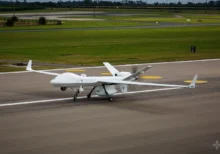
In fiscal year 2026, Japan’s ATLA ordered four more MQ-9B SkyGuardian drones for ¥76.5 billion. These drones will enhance the Maritime Self-Defense Force’s maritime surveillance fleet, which monitors Japan’s vast ocean areas.
One development this year is the Interceptor Drone Early Acquisition Program. ATLA started this program in early June, held demonstrations with four companies from July 15 to August 6, and signed a contract with TerraDrone Corporation for the TerraB1 drone on August 25. The process took just 80 days, resulting in a contract for 300 units, with delivery set for September 30, 2026. ATLA described this rapid pace as unprecedented in Japan’s defence procurement.
Japan has also requested its first Bayraktar TB2 combat drones from Turkey, with a budget of ¥30.5 billion for fiscal year 2026. These drones, which have seen success in conflict zones like Ukraine and Libya, would be Japan’s first armed commercial drone.
Lastly, ATLA is developing a Long-Term Operational UUV for longer underwater surveillance missions in Japan’s southwestern waters, where Chinese submarine activity has been rising.
The space
Japan is taking important steps in space defence. By FY2026, Japan will create a special space unit within the Air Self-Defense Force (ASDF). The unit will build a system to track objects in orbit, including space-based optical telescopes for intelligence gathering. It will also use laser devices to measure distances in space and develop training to handle threats to Japanese satellites, such as electronic interference.
In August 2026, the US Space Force launched a new system to monitor space using Japan’s QZS-7 navigation satellite. The agreement allows American military space surveillance to work with Japanese systems. The Quasi-Zenith Satellite System, which improves GPS coverage in the Asia-Pacific region, now includes American space-defence sensors.
The Space Operations Center at Fuchu Air Base in Japan is increasing its ability to monitor space. In the 2022 National Security Strategy, the Self-Defense Forces officially recognised space as a military area, alongside land, sea, and air.
The invisible wars
Japan established its Electronic Warfare Operations Unit in 2021. The unit, part of the Ground Component Command, has been growing in personnel and equipment since then. The Ground Self-Defense Force has gained extensive experience in electronic warfare since the 1960s. The Network Electronic Warfare System is now in use at Camp Yonago and other sites.
The Japan Air Self-Defense Force (JASDF) is buying ground-based signals intelligence sensors and aircraft to gather radio-frequency information. They are also developing standoff electronic warfare aircraft. Additionally, the JASDF is upgrading its Aerospace Defense Ground Environment, the system that connects air defence radars, missile sites, and control centres. This upgrade will help Japan better handle multiple air threats at once.
Starting in October 2026, the Japanese Self-Defense Forces (JSDF) will be allowed to defend against cyberattacks for the first time actively. It means that if a cyberattack targets important systems, Japanese forces can remotely access and disable the affected devices. Until now, Japan could only monitor, block, and defend against cyber threats.
In March 2026, the Maritime Self-Defense Force established the Information Warfare/Operations Command, which combines intelligence, cyber, and oceanographic functions into a single operational headquarters for maritime activities.
The JJOC
For most of its history after World War II, the JSDF operated without a permanent joint command structure. The Ground, Maritime, and Air forces each worked independently and reported separately. This made it difficult to coordinate a military response in an emergency since there was no pre-organised structure in place.
On March 24, 2025, Japan established the Joint Operations Command at the Defence Ministry in Ichigaya, Tokyo. Lieutenant General Kenichiro Nagumo is the first commander, and the command has 240 staff members. It leads operations for the Ground, Maritime, and Air forces. The Joint Operations Command coordinates responses to emergencies and natural disasters and works with foreign militaries.
It is Japan’s first permanent joint command. In fiscal year 2026, Japan increased the number of State Defence Ministers from 1 to 2. The change aims to improve civilian oversight as the military’s roles and capabilities expand.
The fiscal year 2026 budget includes funding to enhance intelligence, surveillance, and reconnaissance (ISR). Japan is developing its satellite-based ISR capabilities to support long-range targeting with its new standoff missiles. Tomahawk missiles and upgraded Type 12 missiles need this targeting data from space-based and aerial ISR systems to be effective. Japan is building both aspects of its strike capabilities simultaneously.
The defence industry
Japan’s defence industry includes companies like Mitsubishi Heavy Industries, Kawasaki Heavy Industries, IHI, Fujitsu, Mitsubishi Electric, and Toshiba. For 70 years, these companies could only sell to the Japanese government.
In April 2026, Japan lifted its ban on exporting weapons and allowed international sales and five foreign defence manufacturers started operations in Japan within six weeks, including Tekever from Portugal, Rheinmetall from Germany, Anduril from the United States, a partnership between Airbus and Kawasaki, and Terra Drone, which expanded its work with Ukraine.
Japanese companies also began exporting. Mitsubishi Heavy Industries won a contract to build frigates for Australia. The Global Combat Air Programme (GCAP) involves Japan developing a fighter jet alongside allies, potentially enabling global sales. The FY2026 budget allocated ¥10 billion to support the defence industry and promote arms sales.
Japan purchased the TerraDrone interceptor drone from a local company through a fast-tracked domestic program that reduced the procurement time to 80 days. This change indicates that Japan is reforming its defence acquisition system, which had been a significant obstacle in the past.
The blank budget
On August 31, Japan’s Ministry of Defense requested a budget of ¥8.9 trillion ($55.5 billion) for FY2027. It marks the 15th consecutive annual increase and the 13th record high. Senior officials noted that the final budget could reach ¥10 trillion (around $62.5 billion) after year-end negotiations. Japan has never exceeded this amount before, but it is expected to do so in 2027.
The FY2027 budget request includes a feature that The Diplomat described as an initial offer rather than a final amount. About 160 items in the request, such as missiles, drones, digital systems, and programs essential to Japan’s future defence plans, do not have specific funding listed.
This is because Prime Minister Takaichi Sanae’s government intends to update Japan’s three main national security documents, the National Security Strategy, the National Defense Strategy, and the Defense Buildup Program, by the end of 2026. These updates will determine how much funding the 160 unnamed programs will receive. The review might also change procurement quantities for some major equipment.
New items requested this year that are not in the current program include submarine-launched hypersonic missiles, mass-producible attack drones, a new cognitive warfare unit, and an AI system to help coordinate decisions for the Ground Self-Defense Force (GSDF), Maritime Self-Defense Force (MSDF), and Air Self-Defense Force (ASDF) at the same time. These new additions will enhance Japan’s military capabilities, building on existing equipment such as Tomahawks, SHIELD drones, and Type 12 missiles.