Key ideas
- •India is launching its first hydrogen train with a business model built around low-cost industrial byproduct hydrogen rather than expensive commercial fuel.
- •Germany is moving away from hydrogen trains as battery-electric alternatives prove cheaper for regional rail services.
- •India, Japan, South Korea, and China are pursuing hydrogen rail with different strategies, backed by strong manufacturing bases and expanding hydrogen infrastructure.
Pushpesh Raman Tripathi has been considering a problem for some time. As the Divisional Railway Manager for the Delhi Division, he is in charge of India’s first hydrogen train project. He has observed hydrogen-powered trains in four countries, noting what worked well and what didn’t. He believes that the countries that led in this technology made one key mistake that Asia can avoid.
“With this [India’s first hydrogen train] project, we have proved that we can not only build hydrogen trains, but also use the byproduct from several industries, which is hydrogen, which is currently getting wasted,” he told Tecrow. “So we are using that byproduct, resulting in low operating costs.”
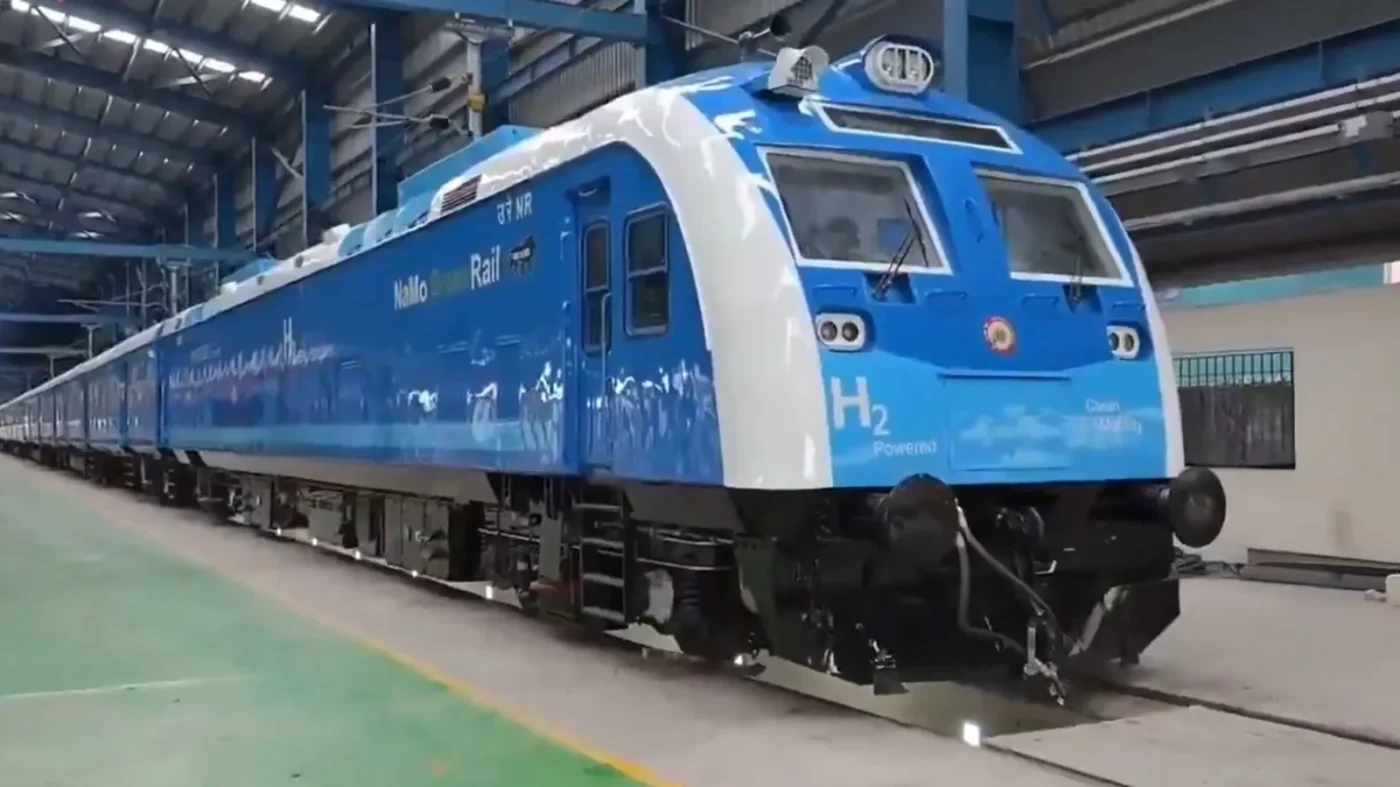
Germany could not follow the same economic argument for its hydrogen train project. On July 17, India’s Prime Minister Narendra Modi will launch India’s first hydrogen-powered train in Jind, Haryana. This train runs on the 89-kilometre (55-mile) Jind-Sonipat route. It has ten coaches and is the longest hydrogen train in the world on broad gauge, producing 2,400 kilowatts of power.
The train is designed by the Research, Designs and Standards Organisation and built at the Integral Coach Factory in Chennai. However, Tripathi’s comment hints at something more. It shows that Asia understands how hydrogen rail economics differ here from those in Europe, and signals that other parts of the continent are paying attention.
“Only four countries in the world have this technology,” Tripathi told Tecrow. “No country in the world has a hydrogen-powered train that has ten coaches.”
What went wrong in Germany
The world’s first commercial hydrogen passenger train, the Coradia iLint, began service in Lower Saxony, Germany, in September 2018. It ran on the Elbe-Weser network and replaced diesel trains on routes where installing overhead lines was too expensive. At its peak, the fleet had 14 railcars. The trains worked well, and passengers used them. However, they are now being taken out of service.
German regional train operators have indicated they will prefer battery-electric trains over hydrogen options for future orders. The number of operational railcars has now decreased from 14 to about 5. The leading supporter of hydrogen trains in Europe has concluded that the costs are not worth it. The main reason for this decision is feedstock.
Germany’s Coradia iLint trains run on hydrogen bought from a nearby chemical plant. This hydrogen is grey, meaning it is produced from natural gas via a process that emits carbon dioxide as a byproduct. While the trains emit only water vapour, the production process does release carbon dioxide.
Also, the hydrogen is expensive. Even when sourced locally, large-scale commercial hydrogen makes the per-kilometre operating cost of a hydrogen train much higher than that of a battery-electric train on the same route.
When battery technology improved, battery-electric trains became a better option for short regional routes previously served by hydrogen trains. As a result, the economic reasons for using hydrogen trains in Europe mostly disappeared. The technology worked, but the business model around it did not.
The industrial byproduct advantage
Asia has a different industrial structure, and Tripathi pointed this out. In India, fertiliser plants, petrochemical refineries, chlor-alkali facilities, and chemical manufacturers produce hydrogen as a byproduct of their main processes.
For example, a chlor-alkali plant that produces caustic soda produces about 28 kilograms of hydrogen per tonne of caustic soda. In petroleum refineries, hydrotreating units continuously produce hydrogen as a byproduct. Steel plants that use coke oven gas generate hydrogen-rich streams as a byproduct of industrial processes.
In many facilities, hydrogen, which is a byproduct, is often burned as low-quality fuel or released into the air. This happens because there is no nearby infrastructure to capture, compress, and use it efficiently.
A hydrogen train parked at the end of an industrial corridor completely changes the economic situation. The cost of hydrogen, which is made from industrial byproducts that would otherwise go to waste, is essentially zero. The operator pays only for the necessary equipment to compress, store, and refuel hydrogen, not for the fuel itself.
The cost structure makes the economic comparison very different when comparing battery-electric trains to the situation in Germany. The hydrogen plant at Jind produces hydrogen from water using electrolysis, which requires electricity. It is a green way to make hydrogen, but it can be expensive due to electricity costs.
Tripathi mentioned using hydrogen produced as a byproduct of industry. As the Hydrogen for Heritage program expands to include 35 hydrogen trains, the Indian Railways will likely choose routes near industrial areas where this byproduct hydrogen is currently being wasted.
The plan is economically sound, but Germany could not adopt this approach because it lacks sufficient hydrogen-producing industries along its rail corridors. China produces more hydrogen from byproducts than any other country. South Korea’s petrochemical area near Ulsan and its steel and semiconductor manufacturing create ongoing hydrogen streams.
Japan’s oil and chemical industries also generate byproduct hydrogen, which the country is working to capture for other uses. The way Asia’s major economies are structured not only allows for this byproduct hydrogen model but also needs a place for hydrogen that is currently being wasted on a large scale.
The Asian pipeline
India’s launch of a hydrogen train on July 17 highlights a growing trend in the region. Japan’s HYBARI is a train that uses both hydrogen fuel cells and batteries. It was developed by JR East, Hitachi, and Toyota and has been operating as a paid test service on the Tsurumi Line between Yokohama and Kawasaki since 2022.
Although it is not yet used for regular commercial routes, the data it collects will support Japan’s plans for hydrogen mobility. Japan aims to create a hydrogen-based society by 2030, producing three million tonnes of hydrogen each year.
South Korea is taking a different approach to public transport. Hyundai Rotem won a contract in July 2024 to provide 38 hydrogen trams for Daejeon Metro Line 2. Deliveries will start this year, and commercial service is expected to begin in 2028.
South Korea plans to invest over $40 billion (₩55 trillion) in hydrogen technology by 2040, with a focus on transportation. The Daejeon trams will be the first hydrogen rail system in South Korea to carry passengers on a regular schedule.
China is taking a large-scale approach to hydrogen technology. CRRC, the world’s largest train manufacturer, has developed hydrogen passenger trains that have been tested for several years. The Chinese government aims to have 50,000 hydrogen fuel cell vehicles, including trains and buses, by 2025 and 1,000,000 by 2030.
CRRC is also looking into hydrogen freight locomotives, which no other country has seriously considered for its rail system. This is important for covering the vast distances within China, where using battery-electric trains for heavy freight is not practical.
The pattern in India, Japan, South Korea, and China is important. Each of these countries has a major state-owned or state-controlled rail operator that can invest in hydrogen refuelling infrastructure. They can also manufacture trains locally rather than buy them from companies like Alstom.
Additionally, they can produce hydrogen as a byproduct on a scale that makes fuel economics more feasible than for German regional rail operators, who buy commercial hydrogen for shorter routes.
Passengers have to wait
Tripathi was clear about the time between tomorrow’s ceremony and the start of passenger service. “Though the inauguration by PM Modi is tomorrow, passengers can avail the train services only after the speed trials, which may take up to one month or one and a half months,” he told Tecrow.
The train has finished tests at 75 km/h (47 mph) and reached 120 km/h (75 mph) during high-speed trials. Indian Railways has approval to operate at 75 km/h on the Jind-Sonipat section. Before passengers can board, it will run more speed and performance tests.
The tests will also evaluate how the hydrogen train performs under real-world conditions, especially during the hot summer in Haryana, where temperatures often exceed 45 degrees Celsius (113 degrees Fahrenheit). Testing under these conditions is crucial for properly assessing fuel cell systems, since lab tests cannot fully replicate their operating conditions.
The 35-train Hydrogen for Heritage program aims to test an economic model with each train costing about ₹80 crore ($9.5 million). Each route will need around ₹70 crore ($8.3 million) for hydrogen production infrastructure. The focus is on heritage and hill routes such as Darjeeling, the Nilgiris, and Kalka-Shimla. These areas are ecologically sensitive, where diesel trains cause noise and pollution. Full electrification could harm the local environment.
These routes have low speeds and short distances, making the benefits of hydrogen more important than battery-electric options. Hydrogen is zero-emission and does not require overhead wires. If we can use byproduct hydrogen from local industries, it makes the economic case much stronger than the model used in Germany.’
“Hydrogen is the cleanest energy available,” Tripathi said. “It emits nothing but water, so no pollution. Firstly, there were coal trains, then diesel trains, some CNG trials, then electrification, and now it is hydrogen. The technology is to react hydrogen with oxygen, and water vapour forms as a byproduct. The energy generated in this process is used to propel the train.”
The changes he talks about, from coal to diesel, then CNG, electrification, and hydrogen, show the history of Indian Railways. Each switch took a long time. Hydrogen might progress faster because the support system is already in place, unlike when diesel replaced steam. The necessary byproducts and manufacturing capabilities for building trains exist. Authorities are also working on regulations for a new ten-coach train that will start its ceremonial journey tomorrow morning in Jind.