Key ideas
- •China's J-16 fighters have trained one-on-one against Egyptian Rafales for the first time, giving Chinese pilots direct experience against a Western fighter also operated by India.
- •The drills could help China study the Rafale's tactics, AESA radar and electronic warfare capabilities, although Egypt's Rafales do not have all the India-specific weapons and upgrades.
- •The exercise reflects China's broader effort to train against Western aircraft by conducting exercises with countries operating Rafales, F-16s, Gripens and other foreign fighters.
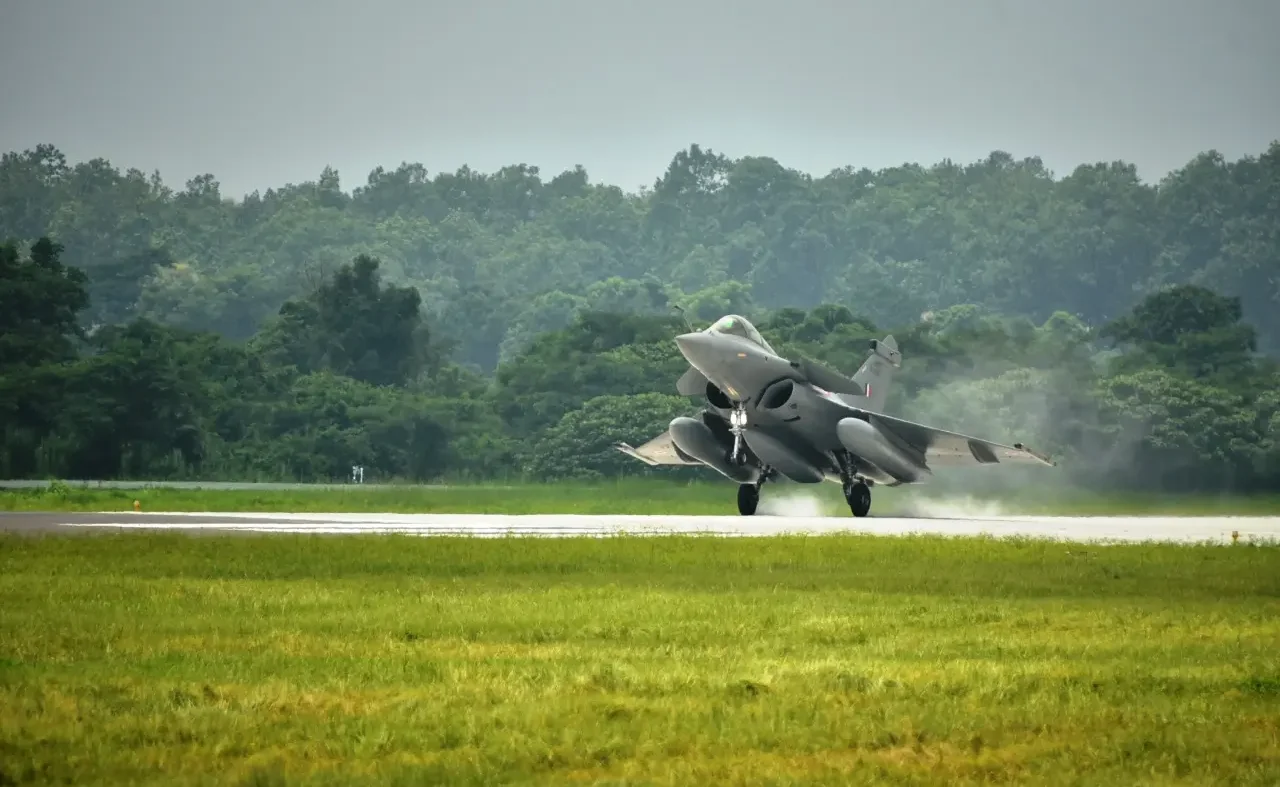
On Sunday, Chinese J-16 pilots and Egyptian Air Force Rafale pilots practised one-on-one combat drills at an air base in Egypt. The People’s Liberation Army Air Force (PLAAF) said these drills took place under realistic combat conditions. Footage released by the PLA on Monday showed a Rafale performing manoeuvres close to a J-16. It was the first time a Chinese fighter trained in direct aerial combat against a Rafale.
Egypt operates French Rafales alongside American F-16s and Russian MiG-29s, making it one of the few air forces in the world to train with all three major fighter aircraft families simultaneously. The exercise, called Eagles of Civilisation 2026, is the second joint training event between China and Egypt. Last year, they used J-10C fighters. This year, they upgraded to the heavier J-16, which has been deployed to Africa for the first time. Until now, it had only been used in Russia and Pakistan.
The PLA did not explain why Egypt chose to use Rafales instead of its F-16s or MiG-29s for these drills. However, the choice is important for Indian military planners. Among Egypt’s combat aircraft, the Rafale is the one China needs to understand the most. It is not because Egypt poses a security threat to China, but because India does.
Operation Sindoor
On May 7, 2025, India launched Operation Sindoor, during which the Indian Air Force carried out strikes in Pakistan. In response, Pakistan deployed its own aircraft, leading to one of the first real air battles between advanced fighter jets in the 21st century.
Pakistan used J-10C fighters, single-engine, multirole jets built in China, to achieve air superiority. India flew the Rafale, a versatile French fighter central to its air defence and attack capabilities, alongside other fighters. India has 36 Rafales, all operational, making them the most advanced in its fleet.
Pakistan claimed its J-10Cs shot down several Indian aircraft, including at least one Rafale. India did not confirm any losses. However, US officials told American media outlets that at least two Indian aircraft were lost, including one Rafale. The exact details of the engagement are disputed. What is clear is that Pakistan used Chinese fighters against India’s Rafales in combat for the first time.
Data collected from these engagements will likely benefit China’s aerospace and military sectors. The J-10C and J-16 share similar radar technology, missile systems, and data infrastructure. Information from the combat involving Pakistani J-10Cs and Indian Rafales will expand the knowledge base of the J-16’s designers and operators.
The leaning
The May engagement provided real combat data but didn’t allow for the in-depth observation that a dedicated exercise would. In Egypt, Chinese pilots are performing repeated one-on-one drills against the same type of aircraft, with both sides reviewing their performance together afterwards.
Egypt offers valuable data that China can’t obtain elsewhere, involving real performance details of the Rafale aircraft, observed by Chinese sensors in a controlled exercise setting.
One of the Rafale’s major advantages is its SPECTRA electronic warfare system, which is also one of its most secretive features. SPECTRA detects threats all around the aircraft using radar and infrared and can jam multiple frequencies simultaneously.
It can identify, classify, and respond to threats faster than current air-to-air or surface-to-air attack timelines. However, details about its frequencies, jamming signatures, and detection levels are classified. When a SPECTRA-equipped Rafale engages with a J-16 in an exercise, the J-16’s electronic support systems record what SPECTRA is sending out and how it reacts to the J-16’s radar.
Another important system is the Rafale’s Thales RBE2-AA AESA radar. In a one-on-one engagement, the J-16 pilot can see how fast the Rafale identifies him, whether the Rafale’s radar detects the J-16 before the J-16’s radar sets up the engagement and at what range the Rafale begins to track. The radar’s specific detection range and locking characteristics against a J-16-class radar are details that no simulation can accurately replicate.
Finally, there are the tactics that Rafale pilots use. The Rafale can travel at Mach 1.4 without afterburners, giving its pilots an advantage when preparing for a long-range missile shot. An Egyptian Rafale pilot can use this ability quickly in one-on-one drills. He starts by fighting at a distance, carefully looking at the situation.
When the enemy comes closer, he switches to close-range combat and is ready to change his strategy as needed. These tactics, which pilots learn in training, can be used by Egyptian, Indian, and French Rafale pilots, as they all train on the same aircraft and follow the same approaches.
The difference
India’s Rafale fleet operates in a specific context that influences what China can learn from the Egypt exercise. India’s Rafales, upgraded to the F3-R standard, carry the Meteor missile. It is a powerful weapon that can hit targets more than 150 kilometres away and has a much larger no-escape zone than older missiles.
On the other hand, Egypt’s Rafales don’t have the Meteor missile. Some Indian Rafales can also use the SCALP cruise missile for deep strikes. India’s operations in mountainous areas have led to improvements in performance at high altitudes.
These India-specific upgrades mean that China’s data from Egypt may not fully apply to encounters with Indian Rafales. However, the basic principles- how the plane moves, how the SPECTRA system works, how the RBE2-AA radar operates, and how trained pilots engage in combat- are similar. Indian pilots train in France alongside French, Egyptian, and Greek Rafale pilots, and they all use the same aircraft.
The pattern
The Eagles of Civilisation 2026 is part of a larger trend. China is increasingly joining forces with countries that use Western military equipment.
For example, the Shaheen exercises with Pakistan occur every year and have been running for over ten years. These exercises help Chinese pilots gain experience working with pilots who fly both Chinese and Western planes, including those with combat experience against India’s fleet.
Another example is the Falcon Strike series with Thailand, which ended the same week the Eagles of Civilisation began. This series involves the Thai Air Force, which operates F-16s and Saab Gripen fighters. The Falcon Shield exercise with the UAE took place in Xinjiang and focuses on F-16E/F Block 60 aircraft from the UAE Air Force, the most advanced F-16s available.
In August alone, the PLA Air Force announced joint training exercises with four countries, including Belarus, Thailand, Egypt, and the UAE. Each of these countries flies different Western or Russian aircraft. The training program shows a strong effort to learn from each other, rather than just following a diplomatic schedule.
Egypt is important because it uses a mix of American F-16s, French Rafales, Russian MiG-29s, and older aircraft. The variety creates challenges for integration but also offers unique opportunities for learning tactics. By using Chinese aircraft, Egyptian personnel can better understand and compare different combat strategies. Chinese pilots learn how Egyptian Rafale and MiG-29 pilots operate, while Egyptian pilots learn from J-16 pilots.
The J-16
The J-16 aircraft that flew against Egypt’s Rafale is different from the aircraft China would have sent five years ago. Previously, J-16s were only deployed to the Russian Far East and Pakistan. It marks the first time China have been sent to Africa and the first time they have flown intercontinental distances, requiring mid-air refuelling from a YY-20A tanker for a trip of about 6,000 kilometres over nine hours.
China can send heavy combat aircraft and their support systems, such as tankers, AWACS, helicopters, and combat support aircraft, 6,000 kilometres from China and conduct exercises there for weeks. The capability is important beyond just the drills. Gathering tactical data about the Rafale is useful for China’s understanding of the Indian Air Force (IAF). Operational data on deploying the J-16 to remote locations is important in various contexts.
India’s 36 Rafales are important to the IAF’s air superiority and strike capability. They are located at Ambala and Hasimara, strategically placed to cover the borders with Pakistan and China in Ladakh. The J-16 is a primary aircraft of the PLA Air Force along the Ladakh border. The one-on-one drills that took place in Egypt brought these two aircraft into direct contact for the first time in controlled conditions, with Chinese sensors capturing every detail.