Key ideas
- •LandSpace has become the second company after SpaceX to recover an orbital rocket booster.
- •Its ZhuQue-3 succeeded after the first flight crashed just 40 meters from the landing zone.
- •Reusable methane rockets could help China launch thousands of satellites at much lower cost.
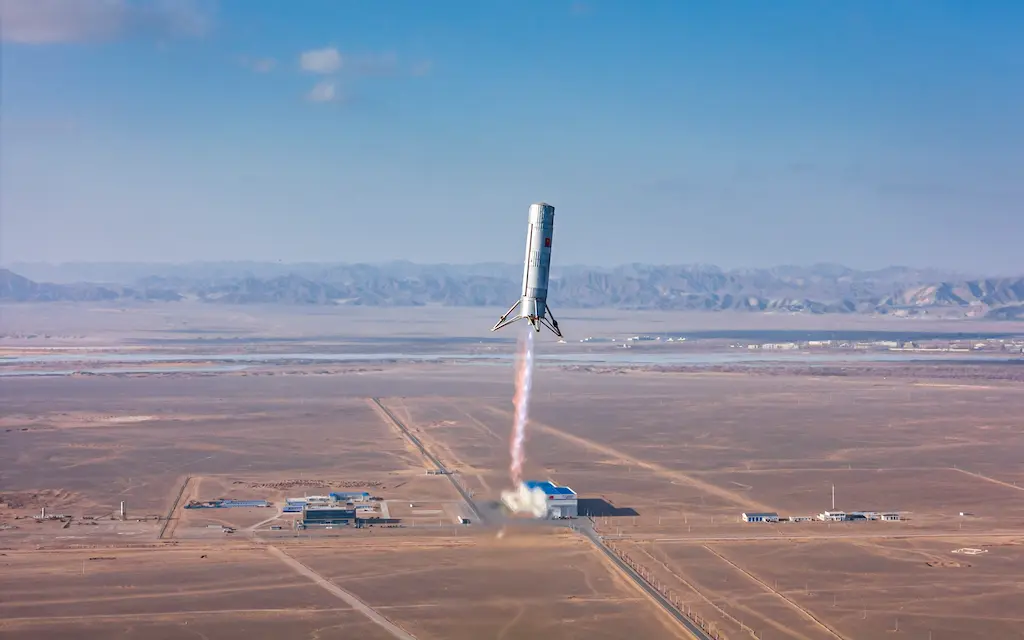
At 07:35 on Tuesday morning, a 66-metre stainless steel rocket lifted off from the Dongfeng Commercial Space Innovation Pilot Zone in the Gobi Desert. The first and second stages separated 137 seconds after liftoff. The second stage continued upward with a commercial satellite called Honghu-03. The first stage returned to Earth.
Six minutes after launch, it landed safely at a landing pad in Minqin County, Gansu Province, following its planned path. Before today, only SpaceX could consistently achieve this.
LandSpace, a private Chinese rocket company founded in 2015 by Tsinghua University graduates and based in Beijing, has become the second company in history to launch a rocket into orbit and recover its first stage in the same mission. The ZhuQue-3 Y2 successfully placed a real satellite into orbit and returned the booster that launched it.
The change
It was not LandSpace’s first attempt. The Y1, which was the first flight of ZhuQue-3 on December 3, 2025, came very close to success. Nine TQ-12A methane engines powered the rocket upward without any issues. The stages separated smoothly, and the second stage reached orbit with a mass simulator. The first stage returned through the atmosphere and headed toward the landing site.
However, it crashed 40 meters from the centre of the landing area. The ignition sequence for the engines during the final landing burn failed. An engine restart during descent caused the booster to crash to the ground in a fireball rather than land on the pad. The engineering team at LandSpace watched their rocket nearly succeed before it exploded just at the finish line.
NASASpaceFlight reported that LandSpace attributed the Y1 failure to the engine ignition sequence during landing. The company made adjustments based on the data from that flight before the Y2 launch. SpaceX has used the same approach with its rocket updates. When a failure occurs, it reveals what went wrong, and the next vehicle uses that insight to improve.
The SpaceX parallel
SpaceX launched the Falcon 9 for the first time on June 4, 2010. It made its first attempt to recover a rocket in September 2013. The first stage was guided over the ocean after a commercial launch to collect data. The booster survived reentry but ran out of fuel before landing. SpaceX tried three more times.
The first successful soft landing on solid ground took place on December 21, 2015, at Cape Canaveral Landing Zone 1. The mission also delivered eleven Orbcomm satellites to orbit. SpaceX achieved its first successful landing on a drone ship at sea on April 8, 2016. Falcon 9 flew eighteen times before achieving its first successful recovery. It took five and a half years from the first flight to reliable reuse.
LandSpace conducted its first vertical takeoff and vertical landing test in January 2024, reaching 350 meters. Its second test in September 2024 extended the hover time to 200 seconds. The first orbital flight occurred in December 2025. The full orbital launch and first stage recovery were successful on the second attempt in August 2026.
Though the comparison is not perfect, LandSpace learned from SpaceX’s methods in ways that SpaceX could not. The engineering challenge remains the same for both companies: returning a rocket that has experienced launch stress, guiding it back through the atmosphere at supersonic speeds, and landing it vertically on a small pad without damage for reuse. The challenge is difficult regardless of the year or the company’s experience, and LandSpace has now solved it.
The methane angle
Falcon 9 uses RP-1, which is refined kerosene, as its fuel. It was used in the Saturn V rocket and is still a key fuel for many rockets today. SpaceX selected it for the Falcon 9 because it is a reliable, mature technology.
On the other hand, ZhuQue-3 uses liquid methane mixed with liquid oxygen. SpaceX’s Starship also uses this combination. The choice for Starship was intentional, as it targets the next generation of space travel, unlike Falcon 9. Methane burns cleaner than kerosene, producing less carbon coking in the engines.
It reduces the need for engine repairs, allowing them to be reused more times. Methane also offers greater efficiency, delivering more thrust per kilogram of fuel. Additionally, it can potentially be made from carbon dioxide and water found on Mars, which is important for SpaceX’s long-term goals, even if it doesn’t apply to LandSpace right now.
LandSpace has managed to create a more advanced vehicle than Falcon 9 with its first orbital recovery attempt. Its TQ-12A engines run on methane. When LandSpace moves on to the TQ-12B engine, it will be even more powerful.
The TQ-12B will have 70 per cent of its parts made by 3D printing, fewer total components, and over 25 per cent more thrust. It completed 550 seconds of ground testing by April 2025, but it has not flown yet. This transition will further outstrip Falcon 9’s kerosene engines.
The satellite constellations
LandSpace is building reusable rockets because China needs to launch many satellites into orbit and can’t afford to use rockets that are discarded after a single flight.
The Guowang program, run by China Satellite Network Group, has plans to launch 12,992 satellites into low Earth orbit. SpaceSail, operated by Shanghai Spacecom Satellite Technology, plans to launch thousands more.
Honghu, the constellation where LandSpace launched its first satellite today, is another project focused on providing internet from space. China has several companies and government agencies all working on different satellite internet systems that will need hundreds or thousands of launches.
Using expendable rockets makes this goal impossible. Discarding each rocket after one flight drives the cost of each launch too high to make large numbers of satellites economical. SpaceX overcame this problem with its Starlink service by reusing Falcon 9 rockets. It allows the company to reuse the same first stage many times, significantly lowering the cost per launch and making it feasible to launch 50 Starlink satellites at once every week.
China needs a similar economic strategy for its satellite projects. LandSpace’s successful rocket recovery today marks the start of that approach becoming possible in China’s commercial space sector.
The commercial market
A reusable rocket that can be refuelled and launched multiple times. Currently, military planners believe satellites are difficult to replace. Building a new satellite and launching it with a single-use rocket takes at least a few months. It means that damaging an enemy’s satellites has lasting effects.
However, cheap, reusable rockets shorten the time required to launch new satellites into space. A set of surveillance or communication satellites that can be replaced in weeks instead of months is a much more valuable asset. It is particularly important for planning around the Taiwan Strait and South China Sea.
In any military conflict, intelligence, surveillance, navigation systems, and communication satellites are often the first targets. China’s ability to restore those capabilities after an initial attack changes how any opponent plans their first strike and the results they can expect.
LandSpace is a private company, not a government defence contractor. However, China’s national security and commercial space sectors are closely linked. The technology that makes affordable, fast rocket launches has important uses in both areas. The rocket that landed in Minqin County today can fly again, and the next one can fly a third time. The costs decrease with each flight, while the strategic importance increases.
The race
LandSpace is part of a competitive group in China’s commercial launch sector. Other companies like CAS Space, Galactic Energy, Space Pioneer (with its Tianlong-3 vehicle), and Deep Blue Aerospace are also developing reusable rockets. Galactic Energy’s Pallas-1 and Space Pioneer’s Tianlong-2 have completed missions using expendable rockets, but neither has successfully recovered its rocket in orbit until now.
Outside China, competition is limited. Blue Origin launched its heavy rocket, New Glenn, in early 2025 and has been working on recovering the first stage. Rocket Lab’s Electron rocket is too small to compete in the same category. Europe’s Ariane Group plans to include reusable elements in Ariane Next, but nothing has launched yet. India’s ISRO and its partners are still in the early stages of development.
SpaceX is far ahead of any competitor in rocket reusability and the frequency with which it operates. The Falcon 9 has flown each of its boosters more than twenty times. The reliability gained from these thousands of flight hours on reused rockets sets SpaceX apart.
LandSpace’s successful recovery shows that their engineering can work. The Y2 flight proved that the company can insert a satellite into orbit and recover the first stage in a single mission. The upcoming Y3 and Y4 flights, and future flights, will show how quickly LandSpace can build reliability on this proof.