Key ideas
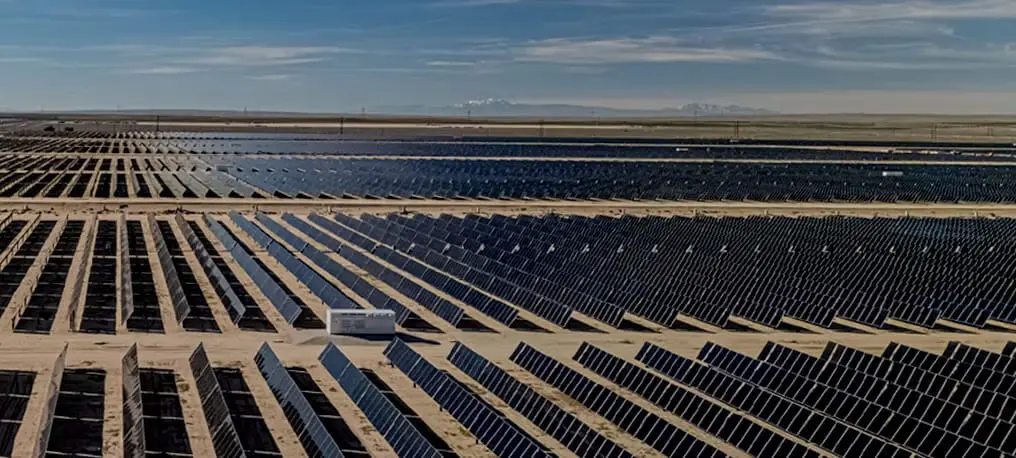
- •Abu Dhabi is building the world's largest round-the-clock solar project, combining 5.2 GW of solar capacity with 19 GWh of battery storage to deliver 1 GW of clean electricity 24 hours a day.
- •The $6.1 billion project marks a financial milestone, with 13 international banks backing a renewable energy model designed to provide continuous, dispatchable power at utility scale.
- •Designed to support AI data centers and advanced manufacturing, the project also underscores China's dominant role in the global clean energy supply chain, from batteries to solar modules.
Renewable energy has had a problem since the first solar panel was connected to a grid. The sun does not shine at night. While the storage technology has promised to solve this for decades, the economics have rarely made it work at scale. Batteries can store solar energy and release it at night. However, the cost of this process makes it difficult to produce electricity at a price that people are willing to pay without financial support.
On July 13, 2026, a consortium of 13 international and local banks provided the answer the renewable energy industry has been waiting for. They backed a $5.1 billion financing package, part of a total $6.1 billion capital investment, for a project being built in the Al Dhafra desert region of Abu Dhabi that combines 5.2 gigawatts of solar photovoltaic capacity with 19 gigawatt-hours of lithium iron phosphate battery storage.
Masdar, a United Arab Emirates state-owned renewable energy company, and Emirates Water and Electricity Company (EWEC) are developing this project to provide 1 gigawatt of clean electricity round the clock. Construction started in October 2025, and the project plans to begin operations in 2027.
Masdar’s chairman Sultan Al Jaber called it “a step towards redefining the role of renewable energy for the information age.” The world’s largest solar and storage project is beginning to take shape in the desert with support from 13 banks.
Round-the-clock solar project
The Round-the-clock project delivers 1 gigawatt of continuous power, not 5.2 gigawatts. It uses 5.2 gigawatts of solar energy to provide that 1 gigawatt. The geography is what makes Abu Dhabi suitable for this project.
Abu Dhabi is about 24 degrees north latitude and gets a lot of sunlight. On a typical summer day, solar energy can be generated for about 11 to 13 hours. During this time, the 5.2-gigawatt solar plant produces far more electricity than the required 1 gigawatt.
The plant can generate an extra 3 to 4 gigawatts of electricity, depending on the weather, which charges the battery. At night, when the solar plant does not produce electricity, the battery supplies 1 gigawatt to maintain a steady energy flow.
The main factor to consider is how long the plant needs to store energy. In winter, Abu Dhabi has its longest nights, lasting about 13 to 14 hours. Maintaining a continuous output of 1 gigawatt for those 14 hours requires 14 gigawatt-hours of stored energy.
The project provides 19 gigawatt-hours of storage, which is 5 gigawatt-hours more than needed. This extra storage is important because it helps cover periods of low generation at dawn and dusk, as well as the 25 to 30 cloudy days Abu Dhabi experiences each year.
The arithmetic adds up in Abu Dhabi because of its strong sunlight and few cloudy days. However, in Germany, where winter days are short and clouds are common, the same solar setup doesn’t work well.
To obtain a similar, consistent energy output, the solar plant would need to be three to four times larger, or the storage capacity would need to double. “Round-the-clock” solar only works in places where the sun consistently shines.
The battery
The battery technology used by the round-the-clock project is lithium iron phosphate (LFP), rather than the nickel-manganese-cobalt cells that dominated earlier utility-scale storage projects.
Abu Dhabi’s desert is surrounded by extreme heat and fine dust particles. In Al Dhafra, summer temperatures often go over 45 degrees Celsius (113 degrees Fahrenheit). Sandstorms can also bring fine particles into any open area.
LFP addresses both challenges more effectively than alternatives. Its electrochemical structure is more thermally stable at high temperatures, reducing the risk of thermal runaway. It tolerates a wider operating temperature range with less performance degradation. It also offers a significantly longer cycle life, more charge and discharge cycles before capacity fades, which matters for a system cycling daily for 25 to 30 years.
BYD Energy Storage, the Chinese battery manufacturer, won the majority of the storage contract, supplying 11.275 gigawatt-hours of the 19 gigawatt-hour total in one of the single largest energy storage procurements ever placed.
BYD’s specific product packs 10 megawatt-hours into a standard 20-foot shipping container, rated IP66 for dust and sand resistance, and rated to operate from negative 30 to positive 55 degrees Celsius. The company’s GC Master energy management system can manage up to 15 gigawatt-hours in a single station.
Another Chinese company, Contemporary Amperex Technology (CATL), the world’s largest battery manufacturer, supplies the remaining storage capacity. The choice of battery is linked to a common trend throughout this project’s supply chain. Both BYD and CATL are Chinese, and JA Solar, which is sending the first batch of solar panels under a 3-gigawatt supply contract, is also Chinese.
Jinko Solar, the second-largest panel supplier, is also Chinese. POWERCHINA, one of the two contractors handling engineering, procurement, and construction for the project, is a Chinese company. The only one that’s not Chinese is Larsen and Toubro from India.
The world’s most ambitious renewable energy project, built by a UAE sovereign energy developer and financed by 13 banks, including HSBC, BNP Paribas, Société Générale, KfW, and Standard Chartered, is being constructed primarily with Chinese industrial capacity.
The Chinese supply chain, which provides modules, batteries, and construction management, has made solar energy costs low and competitive worldwide. This supply chain is the key factor behind Masdar’s claim.
What it will power
Sultan Al Jaber did not use the language of carbon reduction when he described the project’s significance. He used the language of the information economy.
“This gigascale project is a step towards redefining the role of renewable energy for the information age,” he said. The project’s CFO, Mazin Khan, made the connection more explicit at financial close, citing electricity demand “driven by AI, data centres, and advanced manufacturing” as the context in which continuous, dispatchable clean power transitions from technical ambition to commercially bankable infrastructure.
Abu Dhabi’s ambition to become the AI compute hub of the Middle East is not new. With Masdar City, G42, partnerships with Microsoft and OpenAI, and NVIDIA compute agreements, Abu Dhabi has been systematically positioning itself as a data centre destination, with the sovereign capital, political stability, and regulatory flexibility that technology companies require. What it has lacked is the clean energy supply to power that compute at scale without relying on the oil and gas production that sits alongside it.
The RTC project’s 1-gigawatt continuous output is approximately the power consumption of 500,000 to 700,000 typical homes. It is also approximately the power consumption of three to five large hyperscale data centres. The connection Al Jaber is drawing between gigascale, round-the-clock solar and the data centre demand that AI infrastructure creates is the commercial logic on which the project is built.
Abu Dhabi is simultaneously building the compute infrastructure and the clean energy supply designed to power it. The $6.1 billion investment in the RTC project is a strategic bet that both halves of that equation succeed together.
The 13 banks
The round-the-clock project describes an important financial breakthrough rather than a technical one. Utility-scale solar energy has been reliable for years, and smaller battery storage projects have also been dependable.
However, a project that claims to provide continuous, round-the-clock clean power has been both appealing and commercially uncertain for a long time. Buyers and investors worry about performance risks, such as what happens if the batteries do not perform as expected, if cloudy weather lasts longer than design forecasts, or if the storage system wears out more quickly than planned.
The 13-bank consortium that backed the RTC project includes Abu Dhabi Commercial Bank, Abu Dhabi Islamic Bank, Bank of China, BNP Paribas, Crédit Agricole, Dubai Islamic Bank, First Abu Dhabi Bank, HSBC, KfW IPEX-Bank, Natixis, Sumitomo Mitsui Banking Corporation, Standard Chartered, and Société Générale.
The breadth and the scale of that consortium signal something the project’s technical specifications alone cannot. The banking community has accepted the performance risk, modelled the worst-case scenarios, and concluded that the project delivers on its continuous output claim with sufficient confidence to provide $5.1 billion of debt financing.
Mazin Khan, Chief Financial Officer at Masdar, said, “This significant financing commitment demonstrates the confidence of the international banking community not only in a landmark project but also in Masdar’s financial strength, disciplined execution and long-term growth strategy.”
“This milestone further demonstrates our ability to mobilise global capital at scale while delivering innovative renewable infrastructure that supports long-term economic growth and energy security. We now look forward to advancing the project to deliver reliable, affordable, clean energy around the clock,” he added.
The scale
The round-the-clock project is an important part of a much larger program. In May 2026, Masdar and EWEC signed an agreement to develop 30 gigawatts of solar power and 8 gigawatts of battery storage across the UAE.
The RTC project includes 5.2 gigawatts of solar power and 19 gigawatt-hours of storage. It is the first step in a national energy plan that, when fully built, will change how the UAE generates and distributes electricity.
The UAE’s current installed solar capacity is approximately 14 gigawatts. The Masdar-EWEC framework envisages adding 30 gigawatts of capacity. If executed at the cost and performance levels that the RTC project demonstrates are achievable, the UAE will, within a decade, have more solar generation capacity than Germany has today and substantially more battery storage to support it.
The project, expected to be online in 2027, will not be the world’s largest solar-plus-storage installation for long. Saudi Arabia’s NEOM project and several Chinese provincial installations are targeting comparable or larger configurations. The race to demonstrate gigascale round-the-clock renewable power is not over. Abu Dhabi has simply moved to the front of it.