Key ideas
- •The UAE's first commercial satellite factory can produce up to 50 satellites a year, shifting the country from buyer to manufacturer.
- •Altair satellites use onboard AI and Nvidia-powered edge computing to analyze data in orbit before sending insights to Earth.
- •FM1 is the first spacecraft built and tested at the new facility, marking a major step in the UAE's plan to build a domestic space industry.
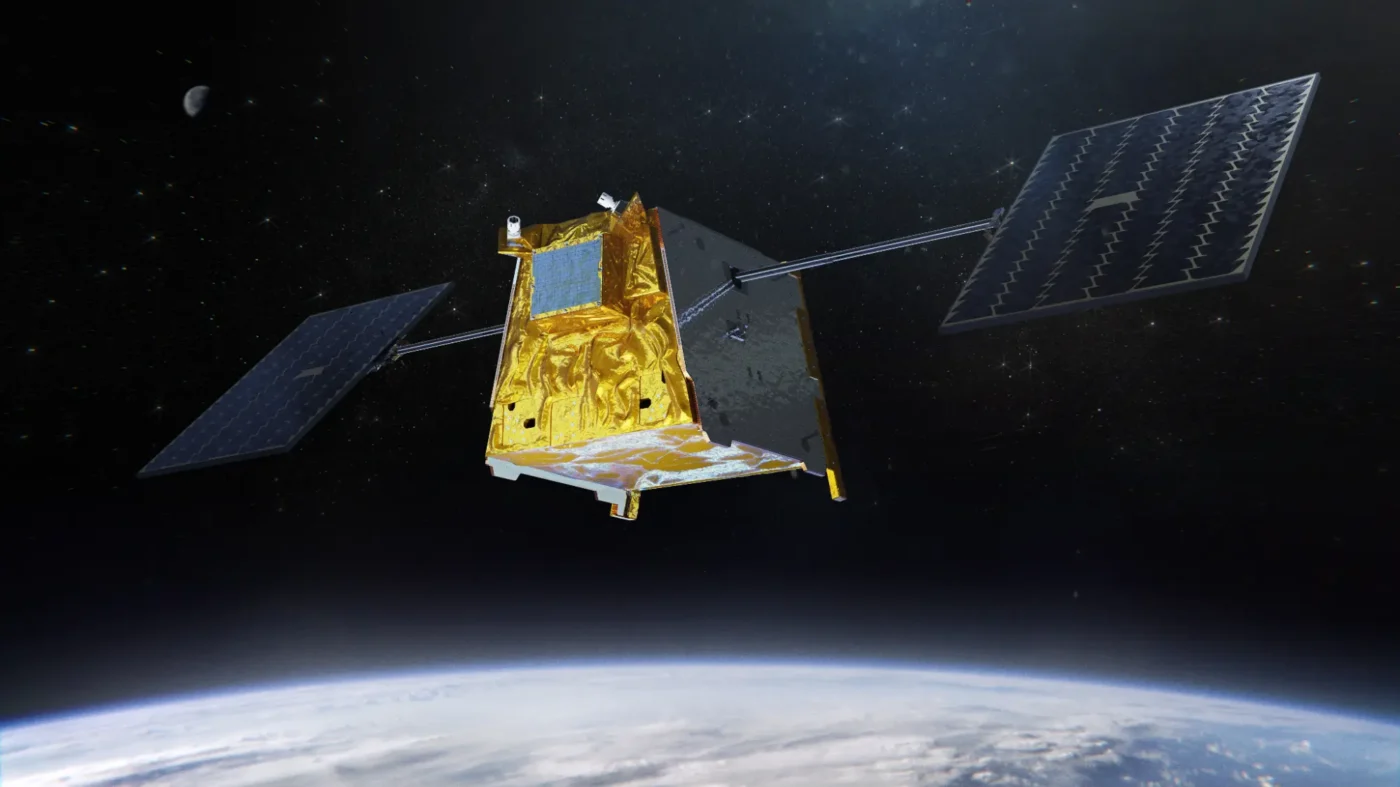
This week, FM1, the first physical spacecraft in the UAE’s Altair constellation, finished optical testing in a clean tent at Orbitworks’ facility in Abu Dhabi. Engineers tested every part of its multi-spectral payload to ensure they were aligned, focused, and ready to capture clear images once the satellite is in orbit.
While this is a standard step before launch, it marks an important moment for the UAE. The project has moved from a plan to an actual spacecraft built and tested in the UAE, and is now on its way to the launch pad.
A 50,000-square-foot facility in Abu Dhabi’s Khalifa Economic Zone features a cleanroom built to the same high standards used for assembling spacecraft worldwide. This cleanroom covers 15,000 square feet and is surrounded by thermal-vacuum chambers and vibration tables. It also has equipment that simulates the exact stresses a satellite will experience after leaving the atmosphere.
When it opened in November 2025, this facility became the first of its kind in the Middle East. It was specifically designed to manufacture satellites on a commercial scale rather than operate ones bought from elsewhere. Orbitworks is the company that created the FM1 satellite.
The company began in 2024 as a partnership between Marlan Space, based in Abu Dhabi, and Loft Orbital, a satellite operator based in California. FM1 is the first of 10 satellites planned for the Altair project. The project aims to create an Earth observation satellite system manufactured outside the UAE that offers features that many existing Earth observation satellites lack.
Satellites that think
The basic design of Earth observation satellites has remained the same for many years. A satellite flies overhead, takes pictures, and sends the raw data down to a ground station. There, different software and analysts interpret the data. The process takes time, which can be critical. Issues like a pipeline leak, a drifting vessel, or a spreading wildfire can lose value the longer they go undetected.
Altair’s satellites carry onboard edge computing, powered by Nvidia GPUs, that processes imagery in orbit before it’s ever sent to the ground. Each satellite combines optical, shortwave infrared, thermal, hyperspectral, and radio-frequency sensors into a single multisensor payload. Instead of just photographing a target, the onboard system analyzes what it sees and transmits a completed assessment within minutes.
Dr. Hamdullah Mohib, acting chief executive of Orbitworks, has described the practical application with a simple example. Instead of a satellite photographing an oil pipeline every hour and waiting for a human analyst to spot a problem, it can flag a leak or structural damage the moment its sensors detect it. The satellites, in his words, become information providers rather than image takers.
What makes Altair different is that it is not just “a satellite built somewhere new.” It is important to have local manufacturing, but creating something truly unique is even more vital. This week, FM1’s optical testing aimed to confirm that this unique feature works properly before the satellite is launched.
Building instead of buying
Orbitworks’ Abu Dhabi facility was completed in roughly twelve months, according to Loft Orbital chief executive Pierre-Damien Vaujour. It was designed from the outset for modular, parallel production rather than the bespoke, one-at-a-time approach that has traditionally made satellite manufacturing slow and expensive.
At full capacity, the site can produce up to 50 satellites a year, close to one a week, an output rate built specifically to support both the UAE’s own programs and satellites built to order for other countries and companies.
However, Altair’s satellites are not completely new. They use Loft Orbital’s Longbow platform, which is an improved version of the Airbus Arrow bus. This bus has been used in over six hundred missions, so it has a proven track record. What is new are the added features, such as the sensor suite, onboard processing, and importantly, the location and the team that builds it.
By late 2025, the company had thirty-five employees and planned to grow to about fifty. Engineers and technicians are being trained directly in cleanroom operations, payload integration, and systems testing. They work alongside experienced specialists to ensure that knowledge is passed on to the local workforce over time. The UAE hired the first Emirati employee at the facility. The company sees staffing as a long-term project focused on building skills rather than just hiring.
The applications
In May 2026, the Abu Dhabi Maritime Academy, which is part of AD Ports Group, signed an agreement to use Altair’s Earth observation data. They will use this data to manage ports, monitor vessel traffic, and conduct coastal surveillance once the satellite system is operational.
There is also a research component aimed at identifying mineral deposits and improving the movement of raw materials from extraction sites to processing facilities in the Khalifa Economic Zone. It shows the type of customer base Orbitworks is targeting: not just government space programs, but also ports, logistics operators, and industrial users who need quick, reliable information about physical assets across large areas.
Altair is part of two UAE government initiatives, including the Make it in the Emirates, which promotes the local manufacturing of over 1,000 key industrial products, and Operation 300bn, the country’s wider industrial strategy that includes aerospace, defense, and AI.
Since it started its space agency in 2014, the UAE has invested more than $5.5 billion in its space program. The program now includes 57 organizations. Between 2018 and 2023, investment in Middle Eastern space programs increased by 175 percent. The UAE is also sharing this ambition globally.
This month, Mohib participated in a discussion at Eurosatory 2026 in Paris, where leaders from government, defense, and industry discussed how investment and new technologies are transforming Earth observation, connectivity, and security worldwide. Orbitworks is one company entering a region that has been building this kind of capability for over a decade.
FM1 has completed its optical testing, and the steps left before launch are few. The first satellite in the constellation is expected to reach orbit in the second half of this year. When it does, the story of the UAE’s satellite industry will change. It will no longer be just about a facility capable of building 50 satellites a year. It will be about a country that is actually launching the satellites it built.