Key ideas
- •Taiwan is focusing on building military robots without Chinese parts to strengthen its defense independence.
- •China's PF-070 robot shows its advanced manufacturing skills compared to Taiwan's developing technology.
- •To reduce risks, Taiwan plans to get components from allied nations, ensuring it can rely on its own defense systems.
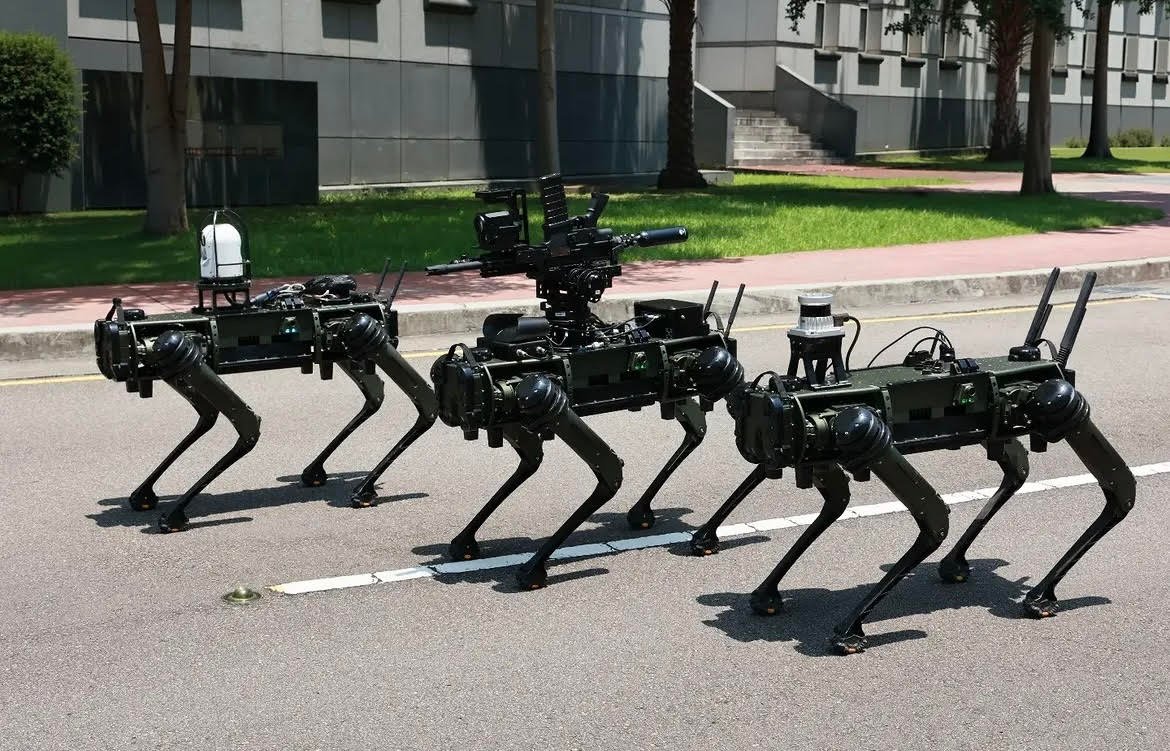
On June 2, Taiwan’s top defense research institute brought three armed robots onto a stage in Taipei and made a point of noting where each part came from, and none of it was Chinese.
The announcement from the National Chung-Shan Institute of Science and Technology (NCSIST) came four months after China displayed a missile-armed robot dog at a weapons show in Saudi Arabia and offered it to buyers. The machines on both sides look alike. They have four legs, sensors in the front, and weapons on top. What makes them different is not the technology but the factory that makes them and the supply chain that supplies that factory.
Armed ground robots have moved from demonstration to product. The contest to build, sell, and field them is now running on both sides of the Taiwan Strait.
Taiwan’s robot dogs
The NCSIST unveiled three variants of military robot dogs on Tuesday at the Ministry of National Defense in Taipei. The systems are built on the Vision 60 quadruped platform from the US firm Ghost Robotics and are modified with NCSIST-developed sensors, surveillance systems, and weapon integration.
The three types of robot dogs unveiled by NCSIST have different jobs. The first type uses LiDAR and thermal imaging for tasks such as patrolling, obstacle avoidance, and 3D mapping. The second type is intended for reconnaissance and target tracking. The third type is a combat robot designed for direct fire support.
Each robot weighs 52 kilograms (115 pounds), can move at up to 2.5 meters per second (8 feet per second), and has an endurance of 8 to 10 hours. They can operate in temperatures ranging from -40 to 55 degrees Celsius, making them suitable for both the cold winters on the Kinmen Islands and the hot summers in the South China Sea.
Taiwan is building robot dogs for two main reasons. First, for combat use against China; second, the island wants to show that it can create them without using any parts from China. Jen Kuo-kuang, the Deputy Director of NCSIST, reportedly said that the plan to use a US platform is meant to create a production line for autonomous ground systems that does not rely on China.
The demonstration followed a defense ministry report to Taiwan’s Legislative Yuan in April, in which the ministry said recent wars have shifted from traditional force-on-force battles toward asymmetric warfare built around large numbers, lower costs, high efficiency, unmanned systems, and artificial intelligence.
China’s Riyadh presentation
At the World Defense Show in Riyadh in February, a Chinese state-owned defense company introduced the PF-070, a four-legged combat robot dog capable of carrying four anti-tank guided missiles. At the time, the company representatives said that it was not just a concept, but a ready-to-produce platform that could be sold internationally.
The Chinese quadruped robot has a low-profile design that makes it quiet and agile on rough terrain. It has four missile tubes arranged in two pairs, based on existing Chinese portable anti-tank systems, and can hit targets at ranges of 2 to 4 kilometers. A sensor package at the front includes a day camera, thermal imager, and laser rangefinder.
The robot can navigate on its own, moving between waypoints, avoiding obstacles, and tracking targets, but a human operator must approve any weapons launch. Delegations from Middle Eastern and Asian countries carefully examined the system at the show. No export contracts were announced, but industry sources said that unarmed versions could be offered for border security and counter-terrorism. Armed variants would need government export approvals.
The PF-070 was developed as a part of China’s military-civil fusion strategy. The country first tested commercial robot dogs from companies such as Unitree during military exercises before deploying them as weapons. During the SCO’s Interaction-2024 counter-terrorism exercise in Xinjiang, robot dogs armed with rifles worked alongside soldiers from all ten member countries, including Pakistan.
The capability gap
China’s PF-070 has an advantage over Taiwan’s NCSIST, but the biggest challenge is production. China has a strong manufacturing base and aims to export. In 2024, China had over 2 million operating robots and installed about 295,000 new industrial robots. In comparison, the United States installed only 34,200. This manufacturing strength supports the PLA’s work on autonomous ground systems. The PF-070 is not just a small defense project. It shows that China has the experience to build quadruped robots at scale, as its factories have been doing so for years.
However, Taiwan is taking a different approach. Taiwan faces a specific threat and has supply chain limitations. Its robot dog program is not just about the technology but also about the origin of its parts. The Vision 60 is a reliable US military platform used by the US Air Force and Marine Corps. By using this, Taiwan can get functional hardware more quickly than if it started from scratch. Most importantly, it avoids using Chinese-made components in systems that might confront Chinese systems on Taiwan’s shores and outer islands.
Neither program has publicly addressed what these machines will do if communications fail, GPS is jammed, or the terrain differs from what they practiced on. China has been testing its quadrupeds in real exercises for years. In contrast, Taiwan has prototypes that haven’t been tested in battle conditions.
This gap between a system tested in the field and one shown only at press events is the real difference between the two programs right now. Taiwan’s robots are not yet in action, while China’s are available for sale. Both governments are working to close this gap, but they are heading in different directions across 180 kilometers of water.