Key ideas
- •Australia's Bushmaster survived a near-cancellation in the 1990s before its V-shaped hull proved its worth across conflicts in Afghanistan, Iraq, and Ukraine.
- •Battlefield performance transformed the Bushmaster into one of Australia's most successful defense exports, with Ukraine accelerating global demand after President Volodymyr Zelensky specifically requested the vehicle.
- •The new Bushmaster 5.6 (Mulga) builds on 25 years of combat lessons with modular systems, digital connectivity, and export-focused upgrades as Australia doubles down on sovereign defense manufacturing.
In April 2022, the president of Ukraine, Volodymyr Zelensky, addressed the Australian parliament. He specifically asked for a vehicle named the Bushmaster, which is built in Bendigo, Victoria. By that time, Zelensky had spoken to many legislatures during the war. Most of those speeches made general requests for weapons, ammunition, air defence, and financial support.
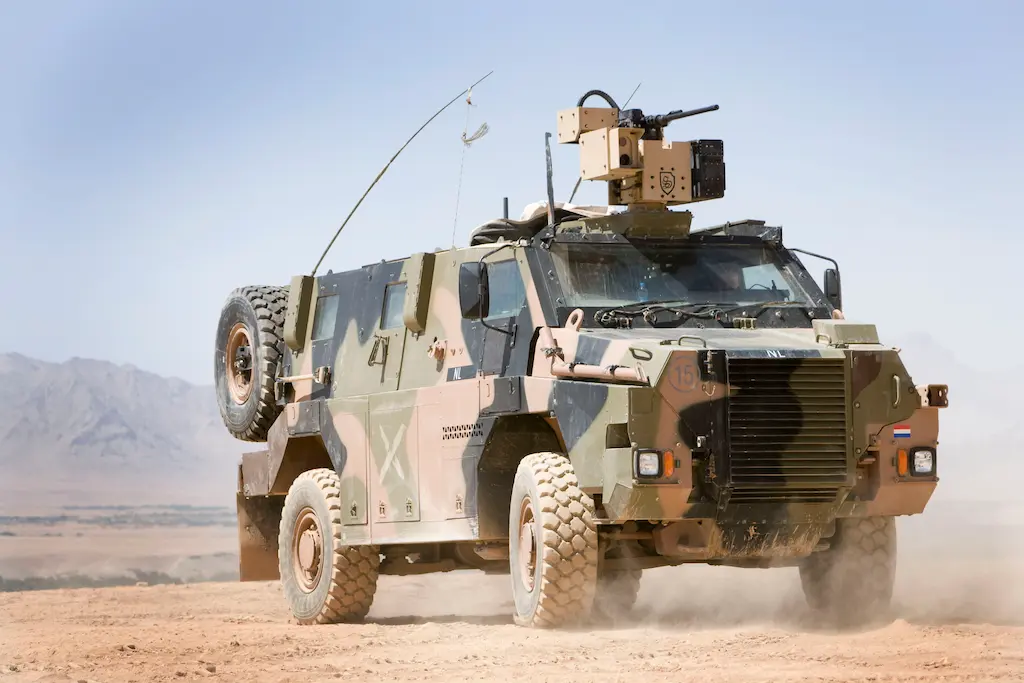
However, his request to Australia was different. He specifically named the Bushmaster, a protected mobility vehicle made by Thales Australia. The Australian Army had worked hard to keep this vehicle in production, and it had proven its worth in places like East Timor, Afghanistan, and Iraq long before many outside Australia knew about it.
Australia sent Bushmasters to Ukraine, and Ukrainian soldiers drove them through difficult terrain. Videos of the Bushmasters in action spread around the world. In the months that followed, this vehicle, which has proven itself in various conflicts over the past 25 years, became one of the most famous military vehicles globally.
Last month at the Eurosatory 2026 trade show in Paris, the world’s largest land defence exhibition, Thales Australia introduced the Bushmaster 5.6. The vehicle, known internally as the Mulga, is the next generation of the Bushmaster. It features a left-hand drive for export markets, a modular design for adding sensors and mission systems, upgraded armour, and advanced digital communications.
The design includes lessons learned from 25 years of actual warfare. Major General Jason Blain, Australia’s Head of Land Systems, announced the vehicle at the Team Defence Australia stand, alongside Julien Assoun, Thales’ vice-president for vehicles and tactical systems in France.
Three days ago, the Australian Department of Defence published a notice about it. And in April, Australia committed A$535 million (approximately US$350 million) to its own next-generation Bushmaster fleet, with the government buying more of the vehicle it already has 789 of, because 20 years of evidence has confirmed the original engineering decision was right.
The vehicle that almost died
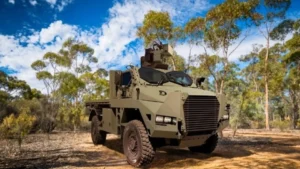
The original Bushmaster faced challenges right from the start. In February 1994, the Australian Army created a draft for an Infantry Mobility Vehicle. The vehicle needed to carry infantry troops across challenging terrain, especially in situations where they might encounter improvised explosive devices and mines. The army needed to be protected, mobile, reliable, and transportable by air.
Australian Defence Industries, later acquired by Thales, designed a vehicle with a V-shaped hull to meet these needs. A flat-bottomed vehicle directs blast energy upward into the floor, potentially harming the crew. However, a V-shaped hull deflects this energy outward and downward, keeping it away from the passenger area. The angle of the plates is what makes this effective, rather than just using thicker steel.
The procurement did not go smoothly. The original contract was for 370 vehicles at A$170 million. By the time the process concluded, Australia had 299 vehicles at A$329 million. The cost had nearly doubled, and the quantity had fallen by nearly a fifth. The political pressure to cancel was real, but the army bought them anyway, because the analysis showed that the only available alternative was twenty times less reliable under operational conditions.
It was the right call. The problem is that the right call was not obvious until the alternative proved itself by failing.
Afghanistan and the proof that matters
The Bushmaster entered full ADF service between 2004 and 2016. By the mid-2000s, the defining threat in both Afghanistan and Iraq was the IED, the improvised explosive device buried under roads and tracks, triggered remotely, designed to destroy or disable military vehicles and kill or maim the soldiers inside them.
American military planners spent years working toward what they eventually called the Mine-Resistant Ambush-Protected (MRAP) vehicle programme. The urgency was driven by casualty data from vehicles not designed for the threat environment in which they operated.
The V-shaped hull geometry that Australia had built into the Bushmaster in the mid-1990s was the same principle the MRAP programme eventually adopted at enormous cost and in emergency quantities. Australia’s version was already in service.
In Afghanistan, the Bushmaster’s protection record in contacts involving IED strikes saved Australian soldiers’ lives in circumstances where other vehicles in use by allied forces sustained fatal casualties. The vehicle’s combat record accumulated not in test centres but in operational deployments, and the data from those deployments became the commercial case that no brochure could replicate.
Countries watching Afghanistan saw a vehicle that performed. The Netherlands purchased a big fleet and deployed it in Uruzgan Province, where Dutch forces operated in the same threat environment as Australian forces and drew the same conclusions about the platform’s protection characteristics.
The UK’s Special Forces assessed multiple options for what became the Escapade programme and selected the Bushmaster. 24 vehicles were procured and deployed to the Middle East, where the requirements for a vehicle capable of operating in complex and contested environments were as demanding as any customer could specify.
By the time Afghanistan concluded, the Bushmaster had done something that defence export campaigns cannot manufacture. It had been used in genuine combat by multiple allied nations and come back with its crews alive.
Indonesia and the regional dimension
Indonesia makes the Bushmaster as the Sanca under a license from Thales. This is produced by PT Pindad, Indonesia’s state-owned defence manufacturer. The licensing agreement shares manufacturing knowledge and skills with an Indonesian company.
The Sanca is part of the Indonesian Army and uses Australian technology. The technology supports training and support systems, strengthening the relationship between Australia and Indonesia’s large military, and the partnership ensures a steady supply of parts and maintenance.
In this relationship, Thales Australia provides support for upgrades and repairs. Pindad, an Indonesian company, demonstrates that the Sanca design is mature enough to be built outside the Bendigo facility without compromising quality. Countries such as the Philippines, Papua New Guinea, New Zealand, Fiji, and Jamaica have adopted the platform in various configurations.
Ukraine and the moment everything changed
The Bushmaster had accumulated an impressive but niche combat record by early 2022. Defence professionals knew it, and allied procurement offices had evaluated it. But it was not a household name in the way that the Javelin anti-tank missile or the F-35 had become through years of public discussion. Then Zelensky asked for it in Canberra.
In April 2022, Australia donated Bushmaster vehicles to Ukraine for the first time. The decision was complicated because sending weapons to a country at war required careful consideration of the risks. Despite this, the government chose to proceed. When the vehicles arrived, Ukrainian soldiers who had been fighting for weeks used them and realised that armoured protection was essential to their survival in the conflict.
Ukrainian commanders praised the Bushmaster vehicle for its clear performance. They highlighted how well it protected the crew during incidents in which the vehicle took hits yet continued to operate. In the high-intensity battles in Ukraine, the Bushmaster’s protection is much stronger than its protection against IEDs in Afghanistan. These are two different types of threats, and both have proven the Bushmaster’s effectiveness. No other vehicle in its class offers such a strong combination of protection.
Major General Jason Blain, Australia’s Head of Land Systems, told the Eurosatory audience in Paris last month that interest from allies and partners had continued to grow. “The Bushmaster has been an integral part of the ADF for around 20 years, and it has saved the lives of many Australians who have deployed on operations using our vehicle,” he said. “There’s no wonder that there is strong interest in the Bushmaster and we want to ensure our allies and partners actually see this vehicle.”
The Mulga
The Bushmaster 5.6, the Mulga variant revealed at Eurosatory, is the vehicle that Thales Australia intends to sell to the world on the back of the record that Afghanistan, Iraq, and Ukraine have now collectively established.
The left-hand drive configuration is the most immediately visible change and the most commercially significant. The majority of the Bushmaster’s export customers operate in right-hand traffic environments, such as in Europe, the Middle East, Southeast Asia, and Africa.
The original Bushmaster’s right-hand drive, appropriate for Australia, New Zealand, and a limited number of Commonwealth export customers, was a point of friction in procurement discussions with markets where right-hand traffic is standard. The 5.6 eliminates that friction.
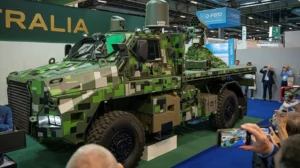
The modular architecture takes the platform’s adaptability to a new level. Andrew Downes, vice-president for land systems at Thales in Australia, described the 5.6 as allowing “customers to adapt the vehicle for different missions while retaining the protection, mobility and reliability that have made Bushmaster successful globally.”
It means that the same base vehicle can support different uses without needing changes to its structure. It can carry a remote weapon system, communication equipment, a medical setup, or equipment for detecting explosives. The vehicle, which the Australian Army values for its adaptability across nine versions, can now be purchased by smaller customers in a single configuration. They can then modify it to meet their specific needs without having to return to the manufacturer for a new vehicle.
The digital connectivity design shows the direction of modern land warfare. The Bushmaster 5.6 serves as an integral part of the digital battlefield. It shares sensor data, receives targeting information, and works with larger command-and-control systems in ways the original 1994 design did not consider, since those systems were not yet in place.
The Ukraine conflict has demonstrated that battlefield connectivity, the ability to share real-time information across a dispersed force, is as militarily significant as armour protection. A vehicle that cannot communicate effectively in a networked fight is as limited as a vehicle that cannot survive a mine strike.
The A$535 million signal
The Australian government’s commitment of A$535 million in April 2026 for the next-generation Bushmaster fleet is more than just a buying decision. It shows that Bendigo’s manufacturing capability has a future.
Making defence equipment in Australia is as much a political decision as it is an industrial one. It costs more to build vehicles in Bendigo than to buy the same ones from a European supplier with an established export line. This extra cost supports a local maintenance system, a parts supply chain, and a design authority. It keeps skilled workers in Australia instead of sending their expertise to a foreign company’s headquarters.
The AUKUS partnership and the 2026 Defence Industry Development Strategy both emphasise sovereign capability as a national security priority; the Bushmaster commitment is the most tangible expression of that priority in land systems.
Australia has a contract worth A$535 million for manufacturing that has been ongoing at the same site for over 20 years. This location in Bendigo holds valuable knowledge of the processes involved, such as how to weld hulls, validate protection levels, and integrate combat-feedback-driven design changes into production vehicles. This expertise is difficult to replace once lost, so Australia decided to retain it.
What the Bushmaster proves
The Bushmaster’s commercial success is instructive in ways that go beyond the vehicle itself. Australia is not a large defence industrial nation by the standards of the United States, France, Germany, the United Kingdom, or Russia.
It does not have the industrial base to compete across every capability category simultaneously. What it has done with the Bushmaster is identify a specific capability gap, protected mobility in environments where mines and IEDs are primary threats, build a solution to that gap before the gap became globally recognised as a priority, and then let successive combat deployments in progressively more demanding environments validate the solution in terms no marketing campaign could fabricate.
The journey from the 1994 draft specification to Zelensky’s speech to the Australian parliament in 2022 took 28 years of hard work, testing, and making improvements. From the outside, this process may seem like a sudden global success. The launch of the Mulga at Eurosatory 2026 continues this development into the next generation.
The 2026 Defence Industry Development Strategy’s relaunch of the Defence Export Facility signals that Australia intends to apply the Bushmaster model more broadly, using combat-validated platforms as the basis for an export programme that is credible precisely because the platforms have been proven rather than merely marketed.
The Bushmaster is not the only platform that model could apply to. But it is the clearest demonstration that the model works. Major General Blain’s comment at Eurosatory that Australia wants its allies and partners to “see this vehicle and the opportunity it provides for their own military and soldiers to utilise” is both a sales pitch and a statement of strategic approach.