Key ideas
- •Jensen Huang's Asia trip secured vital semiconductor partnerships and supply agreements for Nvidia.
- •TSMC's advanced CoWoS technology is essential for Nvidia’s AI chip packaging and production.
- •Collaborations with SK Hynix aim to enhance memory performance for AI data centers.
Jensen Huang landed at Taipei’s Songshan Airport on May 23 and told reporters he had “a lot to do.” He left after doing much more than just “a lot.”
Over the next sixteen days, Nvidia’s CEO traveled through Taiwan and South Korea. The trip appeared to be a celebration, but it had a clear purpose to check the supply chain and promote industrial development. By the time he left Seoul on June 8, he had signed six major partnerships, pledged $100 billion per year to support Taiwan’s semiconductor industry, and secured multi-year supply agreements crucial to Nvidia’s production.
Though Nvidia couldn’t provide comments to Tecrow for this story till the time of publication, Huang’s two stops were not random. Taiwan is where the company makes and packages its chips. South Korea produces the memory used in those chips and is now also building the machines that will use them.
The blockage Huang flew to Taiwan to fix
Most news coverage of Huang’s visit to Taiwan focused on his announcements, including the launch of Vera Rubin, a new AI supercomputer system, and RTX Spark, a personal computing chip made in partnership with MediaTek. However, they are not why he traveled to Taipei two weeks before Computex.
Huang’s main goal in Taiwan was to meet with Taiwan Semiconductor Manufacturing Co., Ltd. (TSMC) Chairman C.C. Wei to discuss a problem that went beyond chipmaking. TSMC has been producing chips for Nvidia for years, and it’s only the first step. Assembling everything into a format that a data center can use is another challenge, and that is where Nvidia is starting to face limitations.
To understand why this is important, it helps to know what packaging does. A modern AI accelerator is not just one chip. It is made up of several chips, including a GPU chip, a CPU chip, and high-speed memory, stacked together and combined into a single package that functions as a single unit. The technology that enables this combination is called CoWoS, which stands for Chip-on-Wafer-on-Substrate. TSMC developed CoWoS, and it is currently the only method capable of producing this at the scale Nvidia needs.
TSMC is making one of the largest expansions in semiconductor history. The company plans to increase its CoWoS production from about 35,000 wafers per month in late 2024 to between 120,000 and 140,000 wafers per month by the end of 2026. Nvidia has reportedly reserved more than half of TSMC’s CoWoS capacity through 2027.
Nvidia aims to secure a large amount of CoWoS capacity in advance. This move limits what competitors like AMD, Intel, Google’s custom chips, and Amazon’s Trainium can produce. By locking in this capacity for the next two years, Nvidia restricts rivals’ production while ensuring it has enough supply.
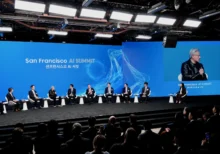
Vera Rubin was introduced at the GTC Taipei keynote on June 1. It uses seven chips made with TSMC’s 3nm process and features CoWoS-R and CoWoS-L packaging, along with HBM4 memory from SK Hynix, Samsung, and Micron. The system is designed to run AI agents that can reason, plan, and perform complex tasks without human assistance. Huang described it as a supercomputer for the age of AI agents and highlighted the complexity of its packaging as a key engineering success, rather than just the silicon itself.
“Vera Rubin was not just built for AI. Vera Rubin was built to run agents,” Huang said at the Taipei Music Center keynote. “We did this with Taiwan. Together, we reinvented computing for the age of AI.”
Huang also revealed that Nvidia has increased its annual spending in Taiwan to $100 billion. The amount includes not only the costs of making chips but also the entire network of suppliers, packaging companies, testing facilities, and system builders needed for Vera Rubin’s supply chain.
The second product introduced is RTX Spark. It is made using TSMC’s 3nm process in partnership with MediaTek. The chip features a Blackwell RTX GPU with 6,144 CUDA cores, a custom 20-core Grace CPU, 128 gigabytes of unified memory, and can deliver one petaflop of AI performance. Microsoft helped develop the Windows platform it runs on.
RTX Spark aims to bring AI processing from data centers to personal computers, a market where Nvidia has a weak presence. The partnership with MediaTek is important because it shows Nvidia’s deeper involvement in Taiwan’s chip design industry, beyond just using TSMC’s manufacturing services.
What Huang went to Korea to build
On June 4, Huang flew directly from Taipei to Seoul. The Korean part of the trip was different from the Taiwan part. In Taiwan, the focus is mainly on production. In Korea, the trip involved both production and relationships with industrial customers. The customer side is important because it helps Nvidia decide its future direction.
The first deal in South Korea involved SK Hynix. Nvidia and SK Hynix have signed a multi-year deal to collaborate on advanced memory for AI data centers. This memory, called high-bandwidth memory (HBM), is crucial for how quickly an AI accelerator can transfer data between memory and processing units.
In a regular computer, the memory and processor are separate components linked by slower connections. HBM improves on this by stacking multiple memory chips on top of one another using tiny copper pillars. This stack sits right next to the GPU chip in a special package. As a result, HBM delivers memory speeds that are ten to fifteen times faster than standard DRAM.
SK Hynix supplies most of the HBM used in Nvidia’s data center products. This long-term agreement shows that the companies want to secure their relationship at the engineering level, not just in business terms. Vera Rubin uses the latest generation of HBM, called HBM4, which is still being produced and in increasing quantities. “We already procure and buy from SK Hynix billions and billions of dollars each year, and it is going to grow substantially,” Huang said.
Young Ho Ryu, a senior industry analyst at NH Investment & Securities, noted the strategic significance of the arrangement. The partnership reinforces the view that memory chips are evolving from a commodity product into a more customer-specific business, meaning the HBM that goes into Nvidia’s next-generation accelerators will be co-designed by the two companies rather than simply ordered from a catalog.
During Huang’s trip, SK Telecom and Nvidia partnered to build a large AI cloud infrastructure in Korea. They plan to open their first AI factory in 2027. This factory will provide AI services to businesses in Korea, focusing on reliable and independent technology. They also plan to expand to other Asian countries.
The AI computing capacity they are building is massive, equivalent to the output of a large power plant dedicated to AI. No other country in Asia-Pacific, outside of the United States, has developed anything this big. The use of the word “sovereign” is important; it means Korea is creating its own AI infrastructure that it can control, rather than relying on US cloud services.”
“Our large-scale partnership with SK is our first cooperation model spanning multiple platforms and technologies,” Huang said after meeting SK Group Chairman Chey Tae-won.
Naver, South Korea’s leading internet company, will use Nvidia’s DSX platform to develop and expand its AI infrastructure. They will start with 55 megawatts and aim for a gigawatt-scale expansion. Nvidia’s CEO, Huang, said in a press statement, “Useful AI has arrived, and demand for AI factories is extraordinary.”
The industrial deployments
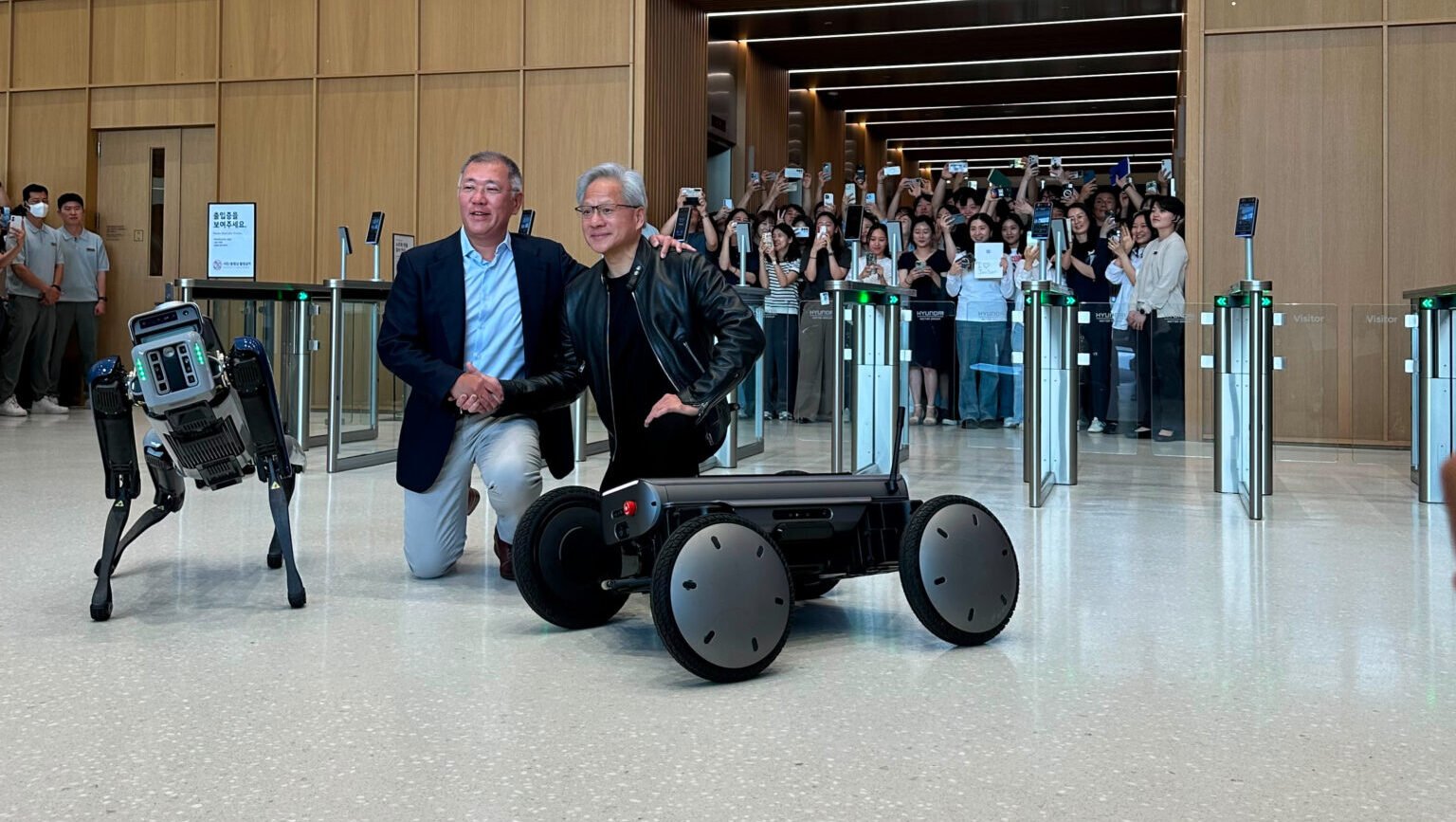
In Korea, Nvidia’s deals with Hyundai, LG, and Doosan were also important. Hyundai Motor Group and Nvidia will invest $3 billion to set up an Nvidia AI Technology Center in South Korea and a Hyundai Motor Group Physical AI Application Center. These centers will focus on AI systems that work in the physical world, such as self-driving cars, industrial robots, and logistics systems.
Hyundai is one of the largest makers of cars and industrial robots, and its Boston Dynamics subsidiary has been creating walking and running robots for many years. The $3 billion center will integrate Nvidia’s simulation and inference systems directly into Hyundai’s vehicle and robot development process.
After meeting LG Group Chairman Koo Kwang-mo, Huang said, “We are working with them on motor technologies and mechanical systems to integrate humanoid robotics with the future of robots. We are also partnering with LG to build the data centers of the future.”
LG makes electric motors, sensor components for robots, and semiconductor substrates through its LG Innotek subsidiary. These components are essential to robots’ physical components, not just their software. Nvidia is integrating its AI technology into LG’s manufacturing process, rather than just providing software for LG’s platforms.
Doosan Group, an industrial company involved in machinery, construction, and power generation, has agreed to build a robot platform for industrial sites using Nvidia’s AI and robotics technology. At the same time, Doosan’s electronics division is supplying Nvidia with high-quality copper-clad laminate, which is essential for producing AI hardware.
It means Doosan is both a customer of Nvidia’s AI products and a supplier of materials for the hardware on which Nvidia’s AI products run. This unique relationship shows how deeply Nvidia is integrated into Korea’s industrial supply chain at multiple levels.
On his last day in Seoul, Huang visited the AI Institute and Robotics Laboratory at Seoul National University. He then held a private meeting with the founders of Korean AI and robotics startups, including Upstage, Nota AI, RLWRLD, and Aei Robot, at The Shilla Seoul. This startup meeting is the least visible part of the tour, but it is likely the most important for the future. It helps Nvidia find the next generation of customers before they grow large enough to be noticed by big buyers.
What every other APAC government is now watching
Nvidia’s market value has exceeded $5 trillion, more than the combined economies of Japan and India. Its data center business grew by 92% from last year, underscoring that the tour in the Asia-Pacific region is part of a strategy, not just a formal event.
Huang is not traveling to Asia to sell chips. He is traveling to Asia to embed Nvidia’s infrastructure into the physical production systems of the region’s most industrially capable nations before the next wave of AI deployment, the physical wave, where AI runs not in data centers but in factories, ports, shipyards, and vehicle assembly lines, creates a procurement race that latecomers will lose.
Huang’s trip revealed how the company plans to operate in Asia. Taiwan will manage production and packaging, while Korea will focus on memory and industrial use. These two countries will work together to support Nvidia’s AI supply chain in the Asia-Pacific region, ensuring its future security.
Every government in the Indo-Pacific and Middle East that wants to develop industrial AI, including India, Japan, Singapore, the UAE, and Saudi Arabia, is now looking at what Korea accomplished last week. “Business is booming, and Korea is doing very well. My partners here in Korea are very important to me,” Huang told reporters before leaving Seoul.