Key ideas
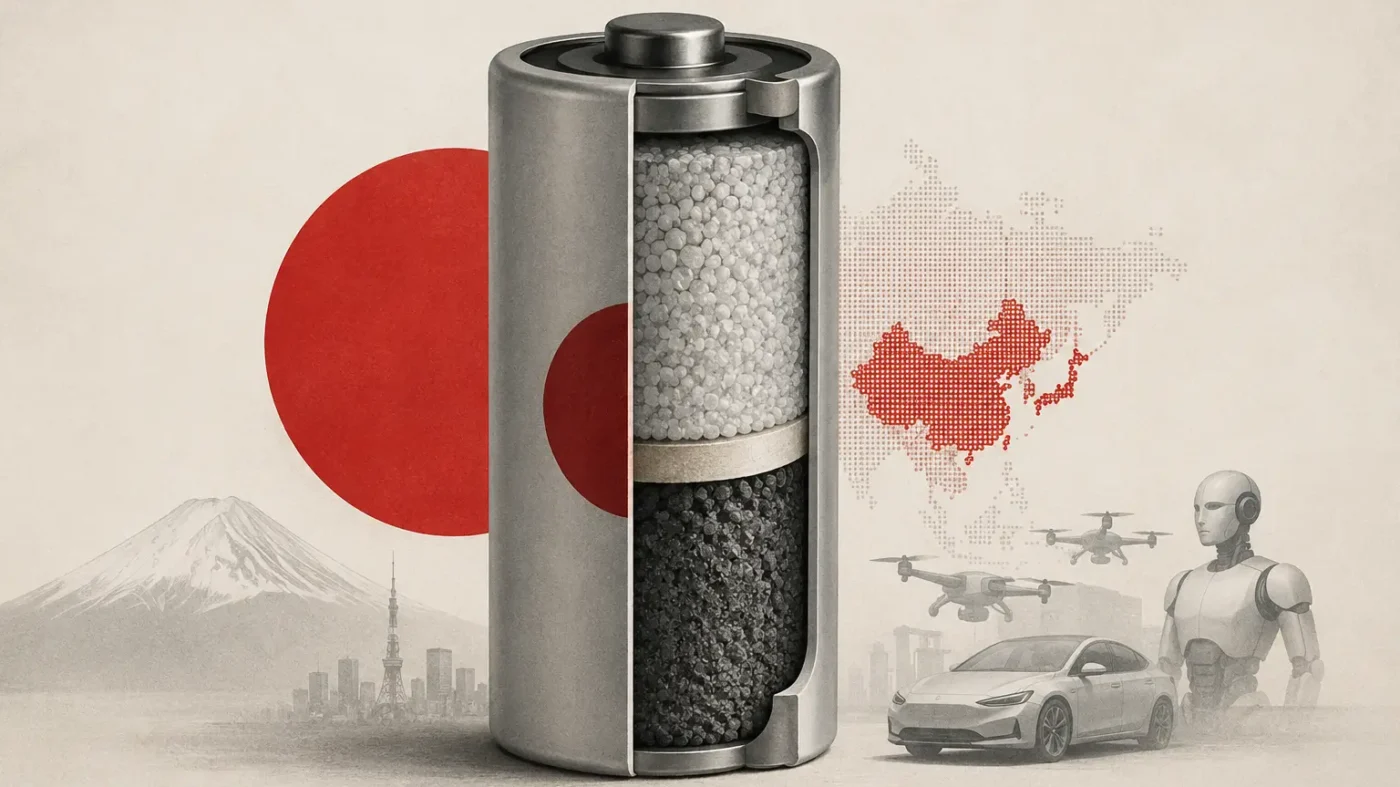
- •Japan pioneered lithium-ion batteries but lost its manufacturing dominance to China and South Korea; solid-state batteries are its attempt to regain that lead.
- •Toyota, Nissan, Honda and Samsung SDI are moving solid-state batteries from laboratory research to pilot production, with Japan currently ahead but China rapidly catching up.
- •The technology could go far beyond EVs, with higher energy density potentially giving drones longer endurance, eVTOLs greater range and humanoid robots longer operating times.
In 1991, Sony launched the first commercial lithium-ion battery for handheld video cameras. The technology originated in Japan, and for many years, Japanese companies dominated the battery market, as they did in consumer electronics. By 2015, Japanese manufacturers made up over 50 per cent of the global automotive battery market.
However, by 2023, their share had dropped below 6 per cent. China and South Korea took over Japan’s battery leadership through large government investments, high-volume production, and competitive pricing. Companies like CATL, BYD, LG Energy Solution, and Samsung SDI filled the market that Japanese firms had once led. Panasonic, which used to supply nearly all of Tesla’s battery cells, has become a minor player. The technology Japan created was now produced at a scale and at a cost that Japan could not match. Japan’s next effort is the all-solid-state battery.
The solid-state changes
A standard lithium-ion battery has a problem that engineers have not solved after decades of improvements. The electrolyte, which allows lithium ions to move between the battery’s positive and negative parts, is a liquid or gel. This liquid can catch fire, break down at high temperatures, and freeze at low temperatures. It limits how thin the battery can be and slows down charging speeds.
When charged too rapidly, lithium can form needle-like structures called dendrites on the anode, which can short-circuit by piercing the separator between the electrodes. Incidents such as laptop battery fires, recalled phones, and burning electric vehicles are examples of failures caused by dendrites in liquid electrolytes.
A solid-state battery replaces the liquid electrolyte with a solid material, usually ceramic, glass, or a polymer. A solid electrolyte is nonflammable and does not break down as the liquid does. It prevents the dendrite problem because lithium cannot penetrate a dense solid as it does with a liquid. This design allows for thinner batteries, faster charging, and more energy storage. Solid-state batteries are estimated to deliver 40 to 50 per cent more energy than traditional lithium-ion batteries, with even greater potential in the future.
The benefits of solid-state batteries vary depending on their use. For smartphones, safety and a thinner design are the main benefits. For electric vehicles, the focus is on longer range and faster charging. For military drones, a 40 per cent increase in energy density means greater endurance or a smaller, lighter battery for the same performance, thereby improving payload and radar stealth.
For humanoid robots that carry their power sources, this same improvement enhances their capabilities and extends their operating time before needing to recharge.
TrendForce recently reported that solid-state batteries are being used in applications beyond electric vehicles, including drones, eVTOL aircraft, and AI robots. The shift is not just for consumer electronics but also important for autonomous technologies in Japan, South Korea, and China, as well as for the defence industry in the Indo-Pacific region.
The race
TrendForce’s report for the first half of 2026 shows that Japan and South Korea have moved beyond lab testing to engineering-grade sample validation on pilot production lines. It means battery cells are now in early production and being tested for performance in vehicles.
Nissan has made progress with a 23-layer stacked onboard cell that has completed charge-discharge tests, demonstrating better capacity retention than traditional liquid lithium-ion batteries. Toyota, Honda, and Samsung SDI are also working on their samples in pilot production lines.
However, none of these companies has started mass production yet. They are still confirming that their manufacturing processes can produce cells that meet design standards, which is important before making decisions on large-scale production.
According to TrendForce’s Technology Readiness Level framework, the top developers from Japan and South Korea are at TRL5 to TRL6. It means their technology is being tested in real-world environments and is moving towards full-scale demonstration. On the other hand, Chinese companies like CATL, BYD, and FAW Group are at TRL 4 to TRL 5, which is slightly behind, but they are quickly progressing in pilot line development.
In terms of materials, the price of lithium sulfide, an important ingredient for solid-state batteries, has dropped by 50% over the last six months. The price decrease indicates that the production process is scaling up and that companies are investing in their supply chains ahead of demand. A halving of the price for a critical material suggests that the market is shifting from research to industrial production.
The subsidy architecture
Japan is currently leading in solid-state battery development due to government support. In 2024, the Ministry of Economy, Trade and Industry (METI) approved the Battery Supply Assurance Programme, which allocated about $660 million for solid-state battery research and development, supporting four major projects that span everything from materials to battery cell production and integration.
The programme aims to help Japan regain the market share that it lost in liquid lithium-ion batteries. Japan once held over 90 per cent of the global market when Sony first introduced lithium-ion technology. However, this strong position weakened because of several strategic decisions. Japanese companies focused on small improvements to existing technology instead of shifting to new battery chemistry.
As a result, Chinese companies like CATL and BYD were able to produce low-cost lithium-ion batteries, leaving Japanese manufacturers without a viable alternative. METI’s programme aims to prevent this situation from recurring with solid-state batteries. Japan has a strong foundation in materials science, including the development of sulphide electrolyte chemistry at the Tokyo Institute of Technology.
Additionally, companies like Toyota are leading in solid-state battery patents. The challenge now is for Japan to bring its patent innovations into mass production before Chinese firms advance their development and manufacturing techniques, as happened with liquid lithium-ion batteries.
The Korean fit
Samsung SDI is the South Korean company that is closest to Toyota and Honda in developing solid-state batteries. It has started producing automotive-grade samples on its pilot lines. Unlike Japan’s approach, Samsung SDI is also the second-largest maker of regular lithium-ion batteries. It gives the company a reason to handle the shift to solid-state batteries carefully rather than rushing it, since solid-state technology will eventually compete with its current products.
The situation creates a challenge for both Samsung SDI and LG Energy Solution. They rely on revenue from traditional batteries to fund research into solid-state batteries, but the new technology will eventually replace the older versions. Companies without traditional battery sales can move more quickly, like Toyota, which focuses solely on solid-state battery production rather than expanding liquid lithium-ion production.
Meanwhile, South Korea’s L&F Plus recently shipped the first samples from its first mass-production line for LFP (lithium iron phosphate) cathodes. The development helps diversify the current supply chain, which China has largely controlled. Companies like CATL and BYD produce most of the world’s LFP cells. South Korea’s move into LFP production runs alongside the longer-term shift to solid-state technology.