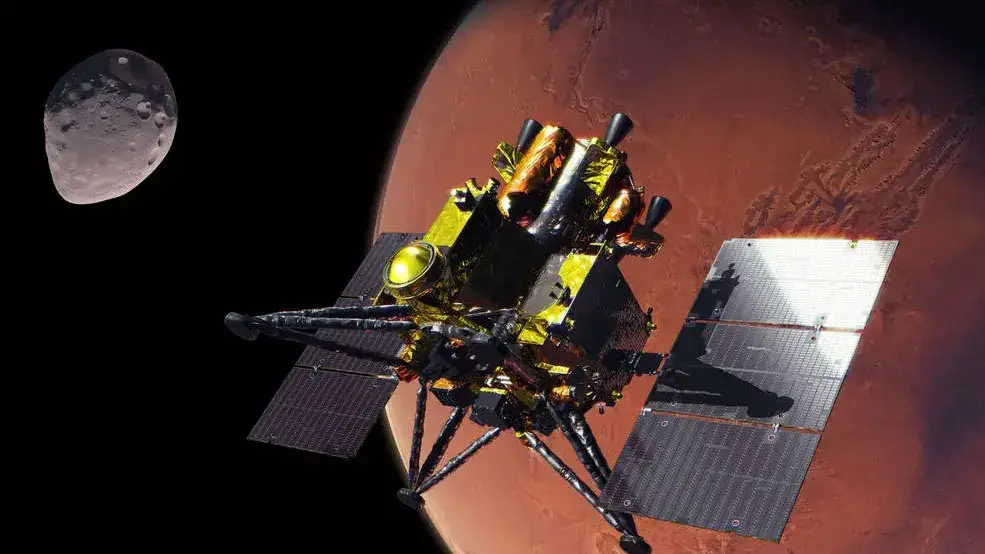
Key ideas
- •Japan's MMX mission aims to become the first in history to return samples from Phobos, Mars' largest and least understood moon.
- •Scientists hope the samples will finally reveal whether Phobos is a captured asteroid or debris from an ancient impact on Mars.
- •The mission will deploy a rover, collect subsurface material, and return it to Earth in 2031 after navigating one of the weakest gravity environments ever explored.
On June 12, a Japanese rocket called the H3 lifted off from the Tanegashima Space Center, carrying six satellites and, more importantly, proof that it still worked. The H3 had failed in December, losing a navigation satellite when a damaged payload adapter caused the spacecraft to separate prematurely and burn up in the atmosphere. Another failure for the young rocket program would have caused a two-year delay for one of Japan’s most ambitious missions.
However, the June 12 launch succeeded, and all six payloads reached orbit. And somewhere inside a preparation facility at Tanegashima, a spacecraft called Martian Moons eXploration (MMX), which arrived from its manufacturing site in April, took a major step closer to launch.
MMX launches in October or November this year. Its destination is Phobos, one of the two moons of Mars. It will collect at least ten grams of material from the surface, spend several years studying the Martian system, and return those samples to Earth in 2031, landing in the Australian outback. If it works, it will be the first mission in history to bring material back from the neighborhood of Mars.
Nobody has done this before. The reason Japan is attempting it now is that the answer to what Phobos actually is has been sitting just out of reach for six decades, and the samples are the only way to get it.
The moon that might not be a moon
Most people know Mars as the red planet. Fewer know it has moons at all. Phobos and Deimos were discovered in 1877 by the American astronomer Asaph Hall, who named them after the sons of the Greek god of war, Phobos (meaning fear) and Deimos (meaning dread). They are small and unglamorous compared to the moons of Jupiter or Saturn.
Phobos, the larger of Mars’ two moons, is only 22 kilometers wide. That’s smaller than many cities and even smaller than Mount Everest’s height. It orbits Mars every seven hours and thirty-nine minutes. Phobos gets so close to the planet that it rises in the west and sets in the east, moving quickly across the sky. The big question is not where Phobos is, but what it actually is.
Two competing hypotheses have divided planetary scientists since the discovery of the moons. The first says that Phobos and Deimos are captured asteroids, rocky bodies from the outer solar system that wandered too close to Mars billions of years ago and were captured by Mars’s gravity.
Asteroids of that type, called D-type asteroids, are known to contain water ice and carbon-rich organic compounds, exactly the kind of materials scientists believe may have seeded the inner solar system, including Earth, with the ingredients for life. A Phobos built from captured asteroid material would be a window into the chemistry of the early solar system.
The second hypothesis says the moons formed from debris thrown into Mars orbit after a large object struck the young planet, the same general mechanism by which Earth’s Moon is thought to have formed. A Phobos built from impact debris would be Mars material, ancient Martian rock in orbit, carrying chemical signatures of what the red planet was made of before any of the processes that may have once made it habitable had begun.
These two origins would produce completely different materials. Spectral observations from orbit have not been decisive. The surface of Phobos appears unusual, darker than most asteroids, and its spectrum does not cleanly match either hypothesis. The only way to settle it is to hold a piece of it and look at it.
Landing on something that barely knows you
Getting to Phobos is easy compared to what you face when you get there. The main engineering issue is gravity or the lack of it. Gravity on Phobos is approximately 1,800 times weaker than on Earth. A 70-kilogram person standing on its surface would weigh less than 40 grams.
The IDEFIX rover that France and Germany have built for the mission, a four-wheeled robot about the size of a large shoebox, named after the dog in the Asterix comics, weighs roughly 25 kilograms on Earth. On Phobos, it effectively weighs nothing. Drive too aggressively, and the wheels push off the surface rather than rolling along it.
Apply too much force, and the rover could launch itself into space. Every design decision for a surface vehicle operating in that environment has to account for a physics regime that no rover has ever navigated before.
MMX itself does not orbit Phobos in the conventional sense. Phobos is too small and its gravity too weak to hold a spacecraft in a stable orbit around it. Instead, the mission uses a quasi-stationary orbit, as the Japan Aerospace Exploration Agency (JAXA) calls it. The spacecraft orbits Mars along a carefully calculated path that keeps it hovering near Phobos without being gravitationally bound to it.
Maintaining that position while preparing to land requires continuous calculation and adjustment against the competing gravitational pulls of Mars, Phobos, the Sun, and Deimos. The landing itself comes in two phases. Before the main spacecraft touches down, IDEFIX separates and lands first, rolling across the surface to take measurements at ground level, mineral composition, surface temperature, texture at 100-micron resolution, while MMX watches from above.
Then MMX itself descends to collect samples using two different mechanisms. First is a drill that bores ten centimeters below the surface, and second is a pneumatic system that fires a burst of pressurized gas to kick up surface material and channel it into a collection tube. The goal is at least ten grams total. Those ten grams, if the mission succeeds, will answer questions that spectroscopes and orbital cameras have been failing to answer since 1877.
Five countries, one mystery
MMX is a JAXA mission, but it is not a Japanese mission alone. NASA is contributing an instrument called MEGANE, which means eyeglasses in Japanese, a gamma-ray and neutron spectrometer that measures the elemental composition of Phobos’s surface from orbit.
France’s CNES contributed IDEFIX and a near-infrared spectrometer. Germany’s DLR co-built the rover. ESA is providing deep-space communication transponder and ground-station support through its Estrack network. Japan’s national broadcaster NHK is partnering with JAXA to install an 8K camera on the spacecraft, making Mars the first planet imaged at that resolution.
The collaboration reflects a real aspect of this mission. Phobos is not a strategic asset. It lacks rare-earth minerals, military significance, or geopolitical stakes. It is a lumpy, dark, poorly understood object roughly 400 million kilometers away, and the question of how it formed is interesting for the same reason any fundamental question is. We do not know the answer, and the answer will teach us something about where everything came from.
Japan has a strong history of space missions. In 2010, the Hayabusa mission returned samples from the asteroid Itokawa. Then, in 2020, Hayabusa2 brought back samples from the asteroid Ryugu. Both missions provided important insights that changed our understanding of these asteroids. The latest mission, MMX, aims to explore Phobos, one of Mars’ moons. Phobos is more challenging and unusual than the missions Hayabusa undertook.
Phobos is located deep within another planet’s gravity. Its surface may be solid or might consist of loose rubble held together weakly. We do not know for sure because no one has been close enough to investigate. The spacecraft is currently at Tanegashima. The rocket that will launch it proved successful two weeks ago. The launch window starts in October. No matter what Phobos is like, Japan will set off to explore it in four months.