Key ideas
- •Abu Dhabi's A2RL has reduced the gap between autonomous race cars and a professional Formula One driver from minutes to just 1.58 seconds in under two years.
- •The racing league is evolving from a speed competition into a test bed for AI capable of navigating dynamic obstacles, complex environments, and autonomous decision-making.
- •The same autonomy technologies being proven on the racetrack are already being adapted for the UAE's next generation of military and autonomous ground vehicles.
In November 2025, former Formula 1 driver Daniil Kvyat climbed into a racing car at Yas Marina Circuit and was told he had ten laps to catch an autonomous machine. He caught it. His best lap around a short version of the circuit came in at 57.569 seconds. The AI car, operated by the Technical University of Munich (TUM), set its fastest lap at 58.183 seconds, a gap of 1.585 seconds. Then, on the final lap of the six-car autonomous race that followed, TUM’s car ran a 58.183, and the gap to Kvyat’s benchmark narrowed to half a second.
The number is important because A2RL held its first race at this venue in April 2024. During testing, the autonomous cars were 3.5 minutes slower than the human benchmark. By race day, that gap had narrowed to just 10 seconds. Eighteen months later, the gap was only 1.585 seconds. The difference fell by more than 99% in less than two years.
In March 2004, the US Defense Advanced Research Projects Agency (DARPA) sent 15 vehicles into the California desert near Barstow. Their task was to drive 142 miles to Primm, Nevada, on their own. The best vehicle only traveled 7.4 miles before getting stuck on a rock. No vehicle finished the course, and no one won the $1 million prize. Congress established this challenge to develop military technology to make one-third of ground military forces autonomous by 2015. The desert race was aimed at achieving that military goal.
By October 2005, five vehicles completed a 132-mile course. By 2007, autonomous vehicles were navigating mock city environments, obeying traffic laws, and competing against each other in moving traffic. Many of Stanford’s creators went on to form the core of Google’s self-driving car project. The chain of consequences that runs from a failed desert race in 2004 to Waymo taxis in San Francisco today passes directly through a DARPA competition designed to solve a military logistics problem. Abu Dhabi has been watching.
What is A2RL
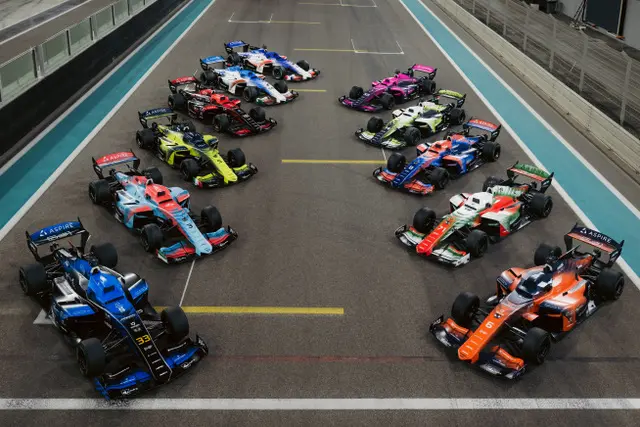
The Abu Dhabi Autonomous Racing League (A2RL) is run by ASPIRE, part of Abu Dhabi’s Advanced Technology Research Council. It uses artificial intelligence, fast vehicle technology, innovative sensors, and edge computing to create high-performance cars. These cars can understand their surroundings, make decisions, and race without any human help.
The car is a Dallara Super Formula SF23, the same chassis that professionals race in Japan’s Super Formula championship. The autonomous system uses AI stacks, including combinations of sensors such as LiDAR and cameras, along with machine learning software, to navigate the track. The 2025 car included a completely overhauled autonomous system with new LiDAR technology, new radars, multiple camera arrays, and navigation sensors, allowing more accurate positioning, obstacle recognition, and situational awareness, including bespoke technology designed to handle the G-forces, heat, and vibrations generated on track.
Teams cannot touch the car during official sessions. The software must control everything on its own, including how the car behaves while the tires warm up. This is not about remote control or following a fixed route. The AI needs to observe the changing environment in real time, understand what other cars and drivers are doing, make quick decisions under pressure, and adjust them as conditions change.
At 250 kilometers per hour, the closing speed between two autonomous cars approaching each other in a corner exceeds 500 kilometers per hour. The sensor and decision stack must process that faster than any human nervous system can.
Why racing is the right stress test
DARPA’s original desert challenges aimed to advance self-driving systems to navigate tricky terrain quickly and without human assistance. The main innovation of the prize system was not just the prize itself. It was the competitive public setting, where many independent teams worked on the same problem in different ways at the same time. In this environment, everyone could see and record each failure.
A2RL takes on a more difficult challenge. In a desert, the terrain is unpredictable. On a race circuit, the challenge comes from other cars. These autonomous vehicles are moving obstacles. They have their own decision-making processes, which can lead to unexpected behavior that can’t be anticipated from a map.
When an autonomous car tries to overtake another at 200 kilometers per hour, it must do several things. It needs to predict where the other car will go, evaluate the size of the gap as conditions change, decide on a course of action with limited information, and execute it with very precise movements. This all happens while both vehicles face strong lateral forces.
For the 2026 season, the focus has changed. Instead of just going fast, teams will now work on being quick and careful. They will race on a tougher track with obstacles and tasks. These challenges will help them practice planning and moving well under pressure.
Obstacles, tasks, and finding the right path aren’t just for racing; they also show how military robots operate in tough situations. The change in A2RL’s competition from going fast to completing missions in different ways is important.
The Imola test
On September 5, the series will race in Imola for its first international event. This circuit is important because it presents challenges such as elevation changes, narrow racing lines, and limited space for mistakes. The difficult corners and tight margins will test how well the autonomous systems can handle grip, traffic, positioning, and overtaking under pressure.
Each of these characteristics relates to important skills needed in situations beyond motorsport. Elevation changes require an autonomous system to understand three-dimensional terrain, not just a flat track surface. Narrow paths with little room for error create situations where a wrong decision can have serious and immediate consequences. Challenging overtaking spots need careful planning.
It’s important to evaluate not only the current gap but also the sequence of moves needed to create the right gap at the right time. Tight corners require precise control of speed, direction, and weight transfer, and cannot be reduced to simple rules.
The five teams competing at Imola will have prepared through A2RL’s Sim Sprint series, which delivered more than 5,000 hours of collective simulation testing and racing across 11 teams in the prior season, running across high-fidelity digital twins of Yas Marina, Suzuka, and Imola before concluding on the Yas Marina North Circuit. The scale of simulation investment, 5,000 hours across a single season, reflects how seriously the competing institutions are treating the engineering problem, not the racing result.
In addition, Imola is not just a challenging racing circuit; it is where the sport learned about its own limits. On May 1, 1994, Ayrton Senna, a three-time Formula 1 world champion and widely regarded as the fastest driver ever, died at the Tamburello corner. His car, the Williams FW16, lost control and went off the track at about 310 kilometers per hour.
The accident led to the biggest safety changes in motorsport history. For thirty years, it showed the dangers when human skill and mechanical problems come together in extreme situations. Since then, no driver has died at a Formula 1 circuit. The sport focused on enhancing driver safety. In September 2026, there will be no person in the car at Imola.
The partner in the pit lane
The final page of A2RL’s 2026 press release, released today, lists the series partners. Among the partners, between AD Ports and AWS, is a company called SteerAI. This company deserves more attention in motorsport coverage than it usually gets.
SteerAI is a defense technology company based in Abu Dhabi, not a racing company. Its main product, CoreX, is a kit that adds autonomous features to existing military vehicles. This allows these vehicles to operate independently without requiring new hardware.
In February 2025, at the International Defence Exhibition in Abu Dhabi, SteerAI signed a contract to equip 20 THeMIS unmanned ground vehicles for the UAE Land Forces with its autonomy system. The production units are expected to be ready by the end of 2026.
SteerAI, like A2RL, was built within Abu Dhabi’s Advanced Technology Research Council ecosystem, the same institutional parent, the same technology development mandate, the same strategic objective of building sovereign AI capability. Its presence as a named partner of A2RL is not a sponsorship arrangement between unrelated entities. It signals what A2RL’s autonomous racing technology is ultimately for.
SteerAI’s CoreX system faces challenges in military deployment that are similar to those faced by A2RL’s self-driving cars on the road. Both systems need to observe their surroundings without human help. They must understand how other agents will behave. They have to make quick navigation decisions in unplanned situations. Finally, they must implement these decisions accurately in environments with significant sensor noise. While the speeds and stakes may differ, the underlying technology is the same.
DARPA’s explicit original goal was military autonomy. The desert challenge was the instrument. Similarly, ATRC’s explicit goal is building Abu Dhabi into a global AI hub. A2RL is the instrument. The difference is that where DARPA ran its challenges and its military autonomous vehicle programs as separate efforts that eventually converged, Abu Dhabi has built the convergence into the structure from the beginning. The racing league and the military autonomy company share an institutional home, a technology research mandate, and, now, a formal partnership in the same racing series.
1.58 seconds
TUM’s team said after the 2025 race that Kvyat’s 57.5-second lap is the benchmark they are targeting for 2026. If the gap continues to close at a rate approaching that of the past few years, AI systems will be at or near parity with a professional driver before the end of the decade.
After DARPA’s 2005 desert race, a lot happened. The engineers who figured out how to navigate the desert went on to develop the self-driving technology we see in commercial vehicles, logistics systems, and military equipment worldwide today. It took about ten years to go from the competition to real-world use.
Abu Dhabi is not being subtle about what it is doing, or why. The secretary-general of the Advanced Technology Research Council said the Imola race demonstrates how the UAE is “translating bold R&D ambition into globally relevant technology platforms.” The CEO of ASPIRE described A2RL as both a technology platform and an emerging sporting format, in that order.
The gap between an autonomous racing car and a professional driver is now 1.58 seconds. The company, with its logo in A2RL’s pit lane, is simultaneously retrofitting UAE Land Forces vehicles with the same type of AI. The series travels to Imola in September and returns to Abu Dhabi in the season finale. The technology, as it always does, will travel further than the cars.