Key ideas
- •Toyota has formed a manufacturing joint venture with Joby to apply its production system to electric aircraft before FAA certification.
- •The partnership aims to solve eVTOL's biggest challenge: building aircraft profitably at commercial scale.
- •Joby has proven the aircraft can fly; Toyota will now test whether it can be manufactured like a car.
On April 27, 2026, a Joby Aviation electric aircraft lifted off from John F. Kennedy International Airport, flew fifteen minutes across New York City, and landed at the West 30th Street Heliport. It was the first point-to-point flight by an eVTOL aircraft in New York City’s history.
Joby has now demonstrated its aircraft can fly safely at 200 miles per hour (322 kilometers per hour), operate in some of the world’s most complex urban airspace, conduct sustained demonstration campaigns in Japan in collaboration with Toyota, and work through the FAA’s certification process toward commercial approval in its final stretch.
The flying issue is mostly fixed. The world’s largest car maker will now determine Joby’s future. This week, Joby Aviation and Toyota Motor Corporation formally established a joint venture, named the Joby Toyota Aero Manufacturing Preparation Company, or JTAMPC, to determine whether an eVTOL aircraft can be manufactured at a sufficient quality and at a cost that supports the business model.
Toyota has announced a significant change in its partnership, which has been developing for nearly ten years and involves an investment of $590 million. This marks Toyota, the world’s largest automaker, shifting from being a financial partner to becoming a co-owner of an aviation manufacturing project. This change shows what Toyota is focusing on for the future. The real question is whether they will succeed.
The manufacturing question
The eVTOL industry has seen many companies that solved engineering issues but still failed. Lilium filed for bankruptcy in 2023; Volocopter followed suit, and Wisk, which had backing from Boeing and Kitty Hawk, shut down its operations. Archer Aviation is still around but is quickly running out of funds. In most cases, the aircraft worked well, but the business side did not. The challenge lies in moving from a successful prototype to a product that can be manufactured and sold profitably, and this is where the industry continues to face problems.
Joby has survived longer than nearly all of them because it has Toyota’s capital, US Air Force contracts through the Agility Prime program, Delta Air Lines as a launch operator, and more than $1 billion in disclosed potential aircraft and service sales. But survival is not the same as solving the cost problem, and the cost problem is what determines whether Joby becomes a commercial airline-class operation or remains a well-funded demonstrator.
Joby currently plans to reach four aircraft per month by 2027, supported by this JV and by facilities in California and Ohio, the latter of which is a 700,000-square-foot facility acquired earlier this year. Whether four aircraft per month produces a commercially viable cost structure is the specific question the JTAMPC is tasked with answering and the specific reason Toyota’s involvement matters far more than any additional capital injection.
What is the Toyota production system?
The Toyota Production System (TPS) is a leading method for manufacturing worldwide. Any process that does not add value to the product is considered waste, and this waste should be eliminated. Activities that do not add value, such as waiting, redoing work, making too much of a product, and unnecessary movements, should be identified and removed. Production should flow continuously instead of in batches.
Problems stop the entire production line immediately instead of being fixed later down the line. Improvement happens continuously and comes from the people doing the work, not just from management orders.
The system has created the most efficient large-scale manufacturing operation in automotive history. Major automakers, electronics companies, and industrial firms have all adopted it. Toyota employs nearly 64,000 people at 14 manufacturing plants in North America. In 2025, Toyota started assembling automotive batteries in North Carolina, showing that its production methods are effective for products beyond traditional combustion-engine vehicles.
TPS has not entered the aerospace industry because of specific challenges. Aerospace manufacturing relies on assumptions that differ greatly from TPS. Production volumes are low, and processes are complex. In addition, manual skills and inspections are more important than systematic flow.
Most importantly, any process change, as TPS practitioners call it, kaizen, might require revalidation by the FAA. It makes continuous improvement very expensive after a product is certified. Once a process is certified, you cannot easily change it, unlike improvements made on an automotive assembly line. The certification locks the process in place.
This is the problem JTAMPC is built to solve before certification, not after it. Establishing TPS-informed manufacturing processes now, while Joby is still in the certification phase, means the process that gets certified is the TPS process. There is no legacy method to fight, no previously certified process to deviate from. The improvement runway exists precisely because it has not yet been closed off by regulatory approval.
The aircraft being manufactured
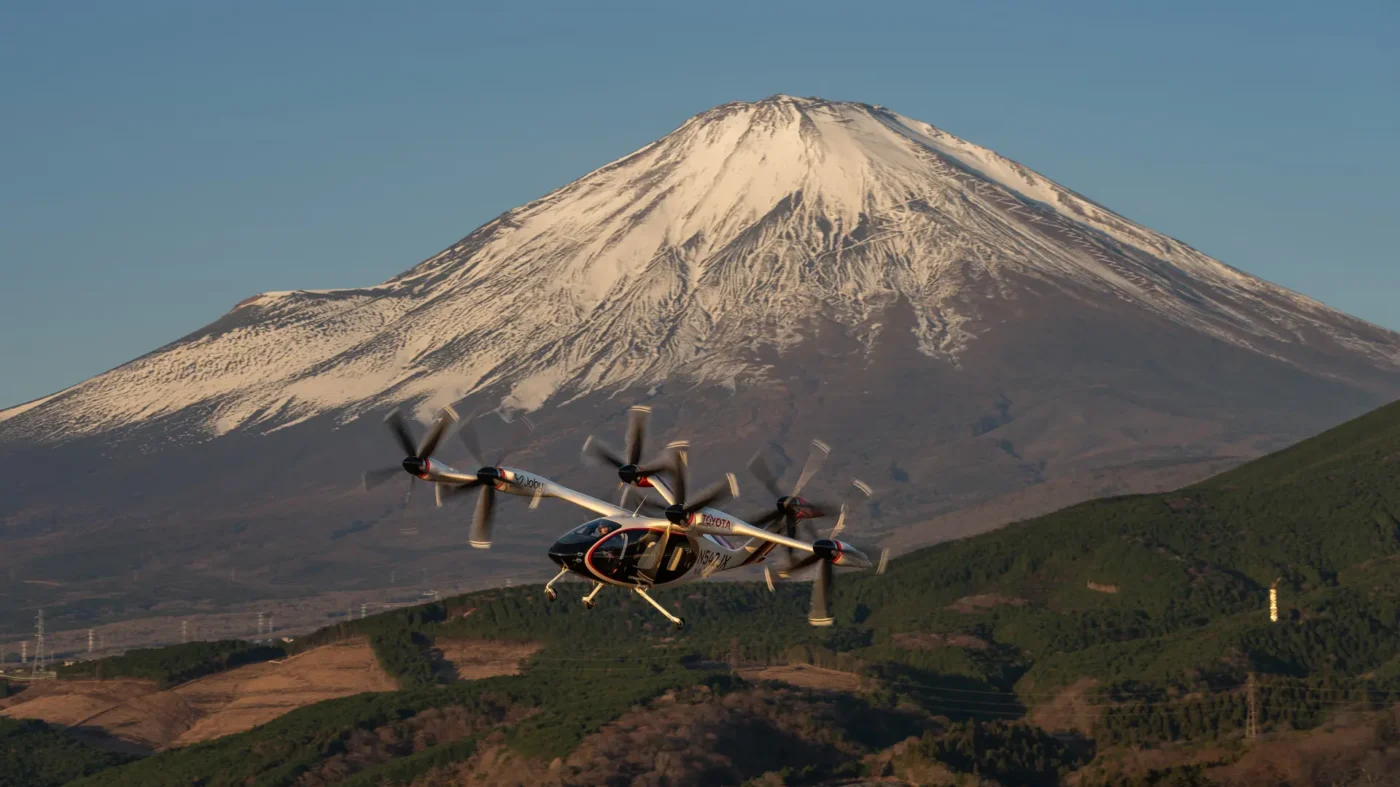
Joby’s production vehicle is a six-motor, six-propeller eVTOL with four battery packs and a triple-redundant flight computer; the third computer is specifically designed to take over if the first two fail simultaneously. The aircraft is made from titanium, aluminum, and carbon fiber. Its parts are created using robotic 3D printing. It can reach a top speed of 200 miles per hour and fly at altitudes up to 10,000 feet. It has successfully operated in both US and Japanese airspace.
Joby’s facilities in California and Ohio currently use a production process that combines hand-laying of composite materials, precision machining of metal parts, and the integration of electrical and propulsion systems. This process operates at much lower volumes than what Toyota’s production system is designed to handle. JTAMPC needs to develop, test, and certify the specific application of the Toyota Production System (TPS) for this process alongside the aircraft itself.
Akio Toyoda, the chairman of Toyota, is actively involved in the partnership with Joby, showing more than just financial support. In 2024, he met with Joby’s CEO at Toyota’s Higashi-Fuji Technical Center to discuss their shared goals.
In December 2025, Toyota and Joby held a week-long flight demonstration at Fuji Speedway in Japan. They announced their collaboration today from Santa Cruz, California, and Toyota City, Japan. Toyoda highlighted that air mobility fits with Toyota’s core belief, “Since our founding, we’ve been guided by the philosophy of providing mobility for all.”
Toyota is beginning to produce aircraft through JTAMPC. This is an important development for Japan’s aerospace industry in the last ten years. The most significant previous attempt to build commercial airplanes in Japan was the Mitsubishi SpaceJet regional jet. This project cost $4 billion but did not get certified, leading to its cancellation in 2023.
The failure occurred in the well-known aerospace industry, which has strict certification requirements and strong competition. However, eVTOL offers new certification options and fewer legacy issues. This better aligns with Toyota’s production capabilities, making this venture unique.
In December, Japan tested Joby’s aircraft at Fuji Speedway, signaling its intention to enter the future market for this technology. Today, Toyota announced a manufacturing joint venture, indicating that it aims to build the industrial infrastructure for this market rather than just investing in the winning company.
The future
The joint venture announced that it is starting a strategic manufacturing partnership called JTAMPC. This phase will focus on setting up the basics and improving manufacturing quality before expanding production capacity. Certification timelines in the eVTOL industry have often been pushed back, with most manufacturers now aiming for certification between 2026 and 2027 rather than earlier. Joby is close to finishing its certification process, but this phase has been ongoing for some time.
The main uncertainty is whether Joby can make money at the production level it aims to achieve. Producing four aircraft per month at their current facilities is just the beginning, not a stable production rate. McKinsey has projected that passenger advanced air mobility operators could rival today’s largest airlines in flights per day and fleet size by 2030, but that projection rests on a cost structure that does not yet exist at production scale.
Getting from four aircraft per month to the volumes at which TPS principles drive meaningful cost reduction is the work JTAMPC is designed to do, and it has no direct precedent because no one has applied Toyota’s production philosophy to this specific category of aircraft manufacturing.
Whether the system that transformed automotive production can be successfully translated into an entirely new manufacturing domain, before certification, in time to make the commercial timeline work, is the industrial experiment Joby and Toyota have just formally agreed to run together. The flight demonstrations proved the aircraft. The joint venture proves the manufacturing hypothesis, or it doesn’t.