Key ideas
- •China staged the world's first autonomous humanoid robot fight night, using identical robots to turn every match into a test of AI algorithms rather than hardware.
- •The tournament is designed to generate real-world data that improves embodied AI, echoing how DARPA's autonomous vehicle challenges accelerated self-driving technology.
- •Backed by China's expanding humanoid robotics industry, the competition creates a pipeline that turns combat-tested AI into robots for factories, logistics, and potentially defense applications.
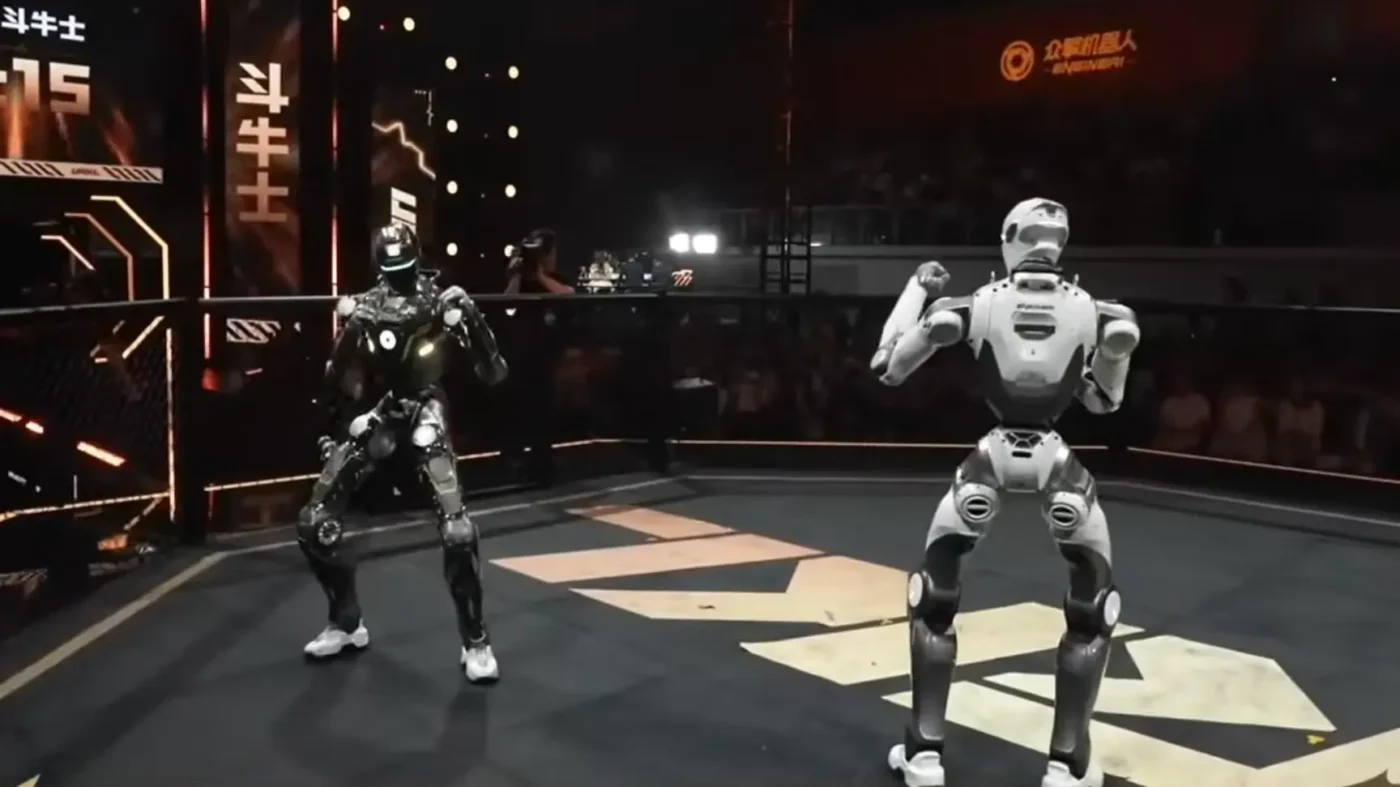
Thursday night in Shenzhen, a 1.73-metre robot nicknamed White Eagle landed a precise high kick to the head of its opponent, a black-clad machine called Matador, and the crowd at the Nanshan Cultural and Sports Centre went to pieces. Action actor Donnie Yen, sitting ringside, said it was more impressive than anything he had seen made for film. “The weight of the machines, the precision of their movements,” he told the audience. “It was incredible.”
In late 2025, Abu Dhabi’s A2RL, an autonomous racing league, used driverless Formula-class cars. These cars race around circuits at speeds of 250 kilometres per hour (155 mph), which is not just a motorsport but Abu Dhabi’s way of addressing DARPA’s Grand Challenge. It creates a competitive environment that accelerates AI development beyond what any laboratory can. China’s Ultimate Robot Knock-out Legend is built on the same logic.
Autonomous humanoid robot fight night
EngineAI, a robotics company based in Shenzhen, started the competition in February 2026. The event began at the Longgang FRL Robot Club and grew to a larger event at a major sports venue on Thursday.
The company started global registration in April and chose 32 teams for the first season. Each team uses the same robot, EngineAI’s T800 full-size humanoid, which is provided free of charge. Teams cannot make any hardware changes. The rules clearly state that teams cannot make structural changes, unlike traditional robot combat sports where teams add armour or spinning blades to any chassis they build.
The competition follows a “standardised hardware plus differentiated algorithms” model. Teams are encouraged to innovate in motion control and balance algorithms to ensure the robot remains upright and agile under impact, and in perception and decision-making, as well as in autonomous or semi-autonomous navigation and tactical choices during a match.
When White Eagle’s AI decided to perform a high kick at just the right moment, it was not the robot that succeeded. Instead, it was the software running on a system similar to Matador’s. The competition serves as a pure test of algorithms, with equal hardware conditions, producing real combat data under pressures that no lab test can ethically or practically recreate.
EngineAI’s own CEO, Zhao Tongyang, said at the event, “We want to use competition to drive research and industry development. Let the event feed back into technology, and let technology drive the industry.” The tournament, he said, would help validate key frontier technologies including mechanical structural balance, millisecond-level intelligent decision-making, and multimodal sensor coordination.
The machine
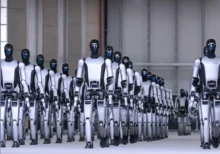
The T800 is a serious piece of engineering presented inside marketing language that makes it easy to dismiss. Weighing 75 kilograms (165 pounds), the humanoid has a magnesium-aluminium alloy exoskeleton, 29 degrees of freedom throughout its body, and three-fingered hands with seven movable joints each.
It features an integrated joint module capable of 450 Newton-metres of peak torque and 14,000 watts of instantaneous joint power. For reference, the average male athlete in peak condition generates roughly 200 to 250 Newton-metres of peak torque at the knee joint during a maximum effort kick. The T800 generates nearly twice that figure across its joint architecture.
The T800 humanoid has an advanced sensing system that uses 360-degree LiDAR, stereo cameras, and fast environmental processing. This system helps it stay aware of its surroundings and avoid obstacles in real time. The T800 also features a special solid-state power battery designed for humanoid robots, which gives it a runtime of four to five hours. This is about double the runtime of other similar robots.
The T800 debuted globally at CES 2026 in Las Vegas and carries a starting price of $25,000. Zhao Tongyang, EngineAI’s founder, previously led XPeng Motors’ humanoid robotics programme, the same XPeng that has been building autonomous electric vehicles, before founding EngineAI in October 2023.
The company is less than three years old. In April 2026, it raised about $200 million in a Series B funding round, bringing its total funding to at least $350 million. This funding has increased its value to $1.5 billion. EngineAI has also filed to go public on the Hong Kong Stock Exchange.
However, political endorsement arrived early. In an inspection tour of Guangdong Province from January 3 to 5 of this year, Premier Li Qiang visited the company’s Shenzhen headquarters and observed live demonstrations. For a company less than two and a half years old at the time, a personal visit from China’s second-ranking leader is an unambiguous signal of where this programme sits in national industrial priorities.
Robot losing its head
The most technically significant moment of Thursday’s event was not the winning kick. It was what happened when a robot’s head was knocked off.
The machine continued fighting. After losing the head-mounted sensor cluster, it kept throwing punches and absorbing strikes, operating on its torso-based core systems until the match concluded. Organisers described it as a demonstration of durability and impact resistance. That description is accurate but undersells the engineering implication.
A system that can still work after losing its main sensors has built-in features such as distributed sensing, extra processing, and a design that allows it to continue operating at reduced capacity. This ability is what distinguishes a lab prototype from a practical system used in real-life situations, such as a factory floor where a robot arm may hit an object and lose a sensor. In this medical setting, something partially blocks a sensor; in a military context, damage occurs, but the system still survives.
Designing and testing graceful degradation under real-world impact conditions is almost impossible in a controlled laboratory setting: you cannot repeatedly destroy your own prototype to discover its failure modes. In a fighting competition, your opponents do it for you.
The URKL scoring system evaluates how well teams perform in four main areas, including effective strikes, body stability, defensive skills, and overall durability. These areas demonstrate how a general-purpose humanoid robot can work reliably in real-world situations.
Effective strikes assess decision-making under pressure. Body stability checks how well a robot maintains balance and recovers from impacts. Defensive and evasive ability assesses how well a robot understands its opponent and responds. Durability tests how the hardware holds up and how the software responds to wear over time. A robot that performs well in all four areas has a strong design suitable for many uses beyond just fighting.
The algorithm
The competition’s standardised hardware model means that every difference in performance is, by construction, attributable to software. This is the structural insight that makes URKL more than entertainment.
By providing a standardised hardware platform, EngineAI is shifting the focus from mechanical destruction to the “embodied intelligence” software that will define the next generation of automation.
“Embodied intelligence” refers to AI that works through a physical body. This type of AI learns not just from text or images but from how it interacts with its environment using sensors and actuators. Developing this kind of AI in labs is challenging because real-world physical interactions are diverse and cannot be fully recreated in simulations.
A humanoid robot in a combat match faces situations that simulations cannot fully mimic. Its opponent might make unexpected moves that were not part of any training. The exact way a punch strikes a joint at a certain angle and speed is not something the engineers prepared for.
The milliseconds available to decide whether to block, absorb, or counter are shorter than any human reaction time. The AI that wins these decisions, across a full season of matches against 31 different algorithmic opponents on identical hardware, is an AI that has generalised to real physical interaction in a way that laboratory training cannot produce.
In 2004, DARPA recognised an important issue. The Grand Challenge’s desert course saw many failures. These failures occurred not because the vehicles were poorly made, but because the environment posed challenges the algorithms had not encountered before. By the time of the 2007 Urban Challenge, the algorithms had learned from these failures. They had experienced enough real-world conditions to navigate a mock city successfully.
The engineers who built Stanley, the Stanford vehicle that won the 2005 challenge, went on to found what became Google’s self-driving car programme. The physical competition produced AI capabilities that translated directly into commercial and industrial applications.
EngineAI’s $1.4 million gold championship belt is the prize money equivalent. Every team reaching the Top 16 receives a full T800 humanoid robot to support further R&D. Members of Top 8 teams each receive a limited-edition T800 plus priority recruitment fast-tracks directly to EngineAI’s talent pipeline.
The competition recruits the best algorithm developers in the world, gives them expensive hardware for free, runs them through a year-long adversarial training programme against each other, and then offers the most promising ones jobs.
What is China building?
EngineAI is one of many companies developing humanoid robots in China. Tecrow has identified several competitors, including Agibot, which plans to produce 20,000 humanoid robots by 2026. Galbot focuses on retail operations without human staff. Pudu Robotics is a leading manufacturer of service robots and is expanding into humanoids. ROKAE Robotics specialises in industrial and collaborative robots.
The URKL competition features 32 teams from different companies across China’s robotics industry. Each team uses a unique algorithm to work with the same mechanical platform.
We wrote last week that China now ships approximately 90 per cent of the world’s humanoid robot units. That dominance was built on a manufacturing cost structure, a domestic component supply chain, and a government industrial policy that treated humanoid robotics as a strategic sector rather than a commercial bet.
The URKL competition adds an accelerated research layer to that manufacturing base. Companies that win in the competition refine algorithms that are then deployed on production robots. Production robots are then deployed at scale in factories, logistics operations, and potentially in military applications. The feedback loop runs from the fighting cage to the factory floor.
Zhao Tongyang said Thursday that he wants to build a globally influential commercial humanoid-robot fighting IP that also accelerates research and industrialisation. The two goals are not in tension. They are the same goal, expressed from different angles.
On Thursday night in Shenzhen, White Eagle kicked Matador in the head, and the crowd erupted with excitement. Donnie Yen was impressed, and that kick was partly AI-driven.