日上午特別來到本院航空研究所,視導無人機發展成果,實地了解反輻射無-5.webp)
Key ideas
- •Taiwan's president urged parliament to fund homegrown ship-sinking drones.
- •The Kratos-backed Mighty Hornet IV is built to hunt warships at low cost.
- •Taiwan says its drone strategy draws lessons from the war in Ukraine.
Taiwan President Lai Ching-te flew to Taichung on July 17 and walked through a hangar at the National Chung-Shan Institute of Science and Technology (NCSIST). He stood at a podium in front of a medium-altitude long-endurance surveillance drone called the Teng Yun.
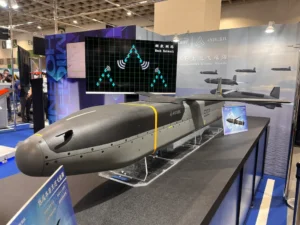
He also received a personal briefing on an attack drone called the Mighty Hornet IV, built in partnership with the American firm Kratos Defense and Security Solutions. He inspected anti-radiation unmanned aerial vehicles stored in launch canisters designed to hunt and destroy enemy radar installations. Then he walked outside and said that Taiwan’s parliament needs to fund what he had just been shown.
“Taiwan must heed international calls to share the responsibility for collective defence,” Lai told reporters after the visit. The statement was directed at the opposition-controlled legislature, which in May cut the entire domestic drone procurement component from Taiwan’s T$1.25 trillion (approximately $38.7 billion) special defence budget.
The systems shown at NCSIST were the same ones that parliament decided not to fund. Lai wants lawmakers to understand the gap between what Taiwan is creating and what it is purchasing, and to fix that gap. The budget cut was followed by the Executive Yuan’s introduction of a new plan on June 18, titled the Draft Special Act on Procurement of National Defense Self-Reliance Uncrewed Systems.
The plan aims to spend $6.65 billion to buy over 200,000 one-way attack drones and 1,320 unmanned surface vessels by 2031. This act still needs parliament’s approval. During his visit to NCSIST, Lai made a strong public case for its approval.
The Mighty Hornet IV briefing
The Mighty Hornet IV is the most powerful system Lai saw on Friday. The aircraft is derived from Kratos’ MQM-178 Firejet target drone, a platform that has served for over 15 years in surface-to-air and air-to-air missile training exercises, giving Kratos’s engineers unusually deep data on its airframe performance under high-stress conditions.
NCSIST took that existing aircraft design and changed it into something entirely new. The modified MQM-178 demonstrated it could reach Mach 0.8 speeds, perform sharp turns, and fly above 35,000 feet (10,500 meters) during tests.
NCSIST developed and integrated the payload and mission system, the guidance, sensors, and warhead architecture, while Kratos provided the airframe and propulsion. The joint team completed integrated system testing on February 5 this year, Kratos confirmed at the time, describing the objective as “a high quantity fleet of Mighty Hornet IV systems ready in Taiwan — affordable mass.”
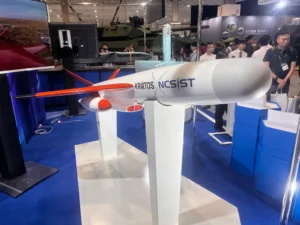
Affordable mass is the operational concept. Each Mighty Hornet IV is designed to cost well under $300,000 per unit. At that price point, Taiwan can field hundreds of them against a single high-value maritime target. Its primary mission, as Kratos president of unmanned systems Steve Fendley confirmed publicly, is ship-hunting, designed specifically to engage vessels crossing the Taiwan Strait in an amphibious or blockade scenario.
“Ship-hunting, ship-attacking, ground force-hunting, ground-force attacking,” Fendley described to The War Zone in September 2025. NCSIST focuses on the anti-ship mission, which is important for Taiwan. The aircraft can also serve as a decoy, drawing defensive fire from Chinese vessels while more precise weapons target the enemy.
“Both Barracuda-500 and Mighty Hornet IV are low-cost and will be used as ship-shinking capabilities in the event of Chinese aggression in the Taiwan Strait,” Major Jacky Chao from Taiwan’s Ministry of National Defense (MND) recently told Tecrow.
At under $300,000 per aircraft, Taiwan can lose fifty of them and still have changed the calculus of any naval commander in the strait. The Barracuda-500, jointly developed with Anduril Industries, was also featured in Friday’s inspection.
With a range exceeding 800 kilometres (500 miles), a payload of more than 45 kilograms (99 lbs), and a unit cost of approximately NT$6.5 million (around $216,000), it sits in the same affordable-mass architecture as the Mighty Hornet IV. According to Chao, the estimated cost for the Barracuda-500 is less than USD 200,000 per unit.
An “M” variant is configured for direct strikes against warships and land targets. The same airframe can carry electronic warfare payloads for jamming. Anduril has also been supplying Taiwan with Dive-LD autonomous underwater vehicles and Copperhead maritime systems, building out a multi-domain unmanned architecture that extends from the subsurface through the surface and into the air.
The system in the photographs
The large aircraft dominating Friday’s photographs published by the NCSIST, the drone Lai stood in front of while addressing the media, is the Teng Yun, NCSIST’s domestically developed medium-altitude long-endurance UAV.
Where the Mighty Hornet IV and Barracuda-500 are expendable one-way weapons, the Teng Yun is a persistent intelligence, surveillance, and reconnaissance platform, a reusable aircraft capable of extended patrols over the Taiwan Strait, the Luzon Strait, and Taiwan’s eastern Pacific approaches.
Its presence at the president’s inspection, alongside the Mighty Hornet IV, is deliberate. The combination of persistent surveillance and an affordable mass strike is the operational concept Taiwan is building its asymmetric defence around.
Also displayed were anti-radiation UAVs in launch canisters, systems specifically designed to home in on the electromagnetic emissions of enemy radar and destroy them. These are the same category of weapon that has proven decisive in modern air campaigns, stripping an adversary’s early warning network before conventional strikes begin.
Taiwan’s domestic anti-radiation drone programme has received less international attention than the Mighty Hornet IV. Still, it serves an equally important function in the sequence of events in a potential cross-strait engagement.
The market that built these systems
Taiwan’s drone industrial base did not emerge overnight. Gene Su, general manager of Thunder Tiger Corporation, one of Taiwan’s largest drone manufacturers, which has supplied UAV platforms across the civil and defence sectors for decades, told Tecrow earlier that Taiwan’s government has been moving toward a procurement target of nearly 50,000 military-grade drones worth approximately $2 billion.
That ambition was what the May budget cut severed. The June 18 emergency act was the attempt to restore it. Lai’s visit to NCSIST was the attempt to make parliament understand what it cut.
On July 17 at NCSIST, along with its partners Kratos and Anduril, it showcased its projects. These include the Teng Yun MALE platform and an anti-radiation drone program. They represent Taiwan’s industrial response to a question about military procurement. This question has become important since Russia invaded Ukraine, which showed what is needed for a war of attrition against a larger military force.
Ukraine responded by using a large number of drones that are inexpensive to lose and accurate enough to be effective. Taiwan’s defence planners reached the same conclusion. The systems that Lai looked at in Taichung are Taiwan’s version of this lesson.
Lieutenant Junior Grade Wu of Taiwan’s MND told Tecrow recently that Taipei is investing in and developing these drones, drawing lessons from the Russia-Ukraine conflict. “We [Armed forces of Taiwan] have learned from Russia and Ukraine that drones play an important role in the fighting. So we are trying to improve ourselves to have the capability to deter our enemies.”
The parliamentary battle
The opposition Kuomintang and Taiwan People’s Party, which together hold a majority in the legislature, have opposed Lai’s defence spending expansion on fiscal grounds and through scepticism about the scope of the emergency procurement act.
Some members of parliament believe that current defence channels are enough and that the emergency act skips normal budget checks. This view reflects their genuine concerns about parliament and highlights the complex politics surrounding Taiwan’s relationship with Beijing. Some opposition members support a friendlier approach to China.
Lai’s use of NCSIST as a stage for his public appeal reflects the political calculation that showing the hardware is more persuasive than discussing the budget line. A parliamentary vote on the emergency drone procurement act has not yet been scheduled.
Lai’s administration has been clear that the Trump administration’s calls for allied defence burden-sharing make passage urgent, the same argument Lai made Friday morning in Taichung, standing between the Teng Yun and the briefing slides for the Mighty Hornet IV.
The three companies whose systems featured most prominently in the inspection, NCSIST, Kratos, and Anduril, have a combined industrial relationship with Taiwan that has been developing since 2022, when Taipei’s $8 billion Sea-Air Combat Power Improvement Plan first directed significant capital toward expendable precision-strike systems.
The Mighty Hornet IV’s completion of integrated testing in February and Anduril’s continued deliveries to Taiwan through the first half of this year suggest neither company has been waiting for parliamentary approval to continue development.