Key ideas
- •India's flagship Panipat 2G ethanol plant produced just 5.7% of its annual design capacity in its first full year of operation.
- •The refinery was built to turn rice straw into ethanol, but technical issues and low straw processing have limited its performance.
- •Despite the Panipat plant's struggles, India is moving ahead with multiple new 2G ethanol projects across the country.
Every winter, reports of high air pollution in New Delhi, the capital of India, dominate newspapers, TV news, and social media. The elevated pollution is attributed to many factors, a primary one being the burning of stubble (rice straw) by farmers in the neighbouring states of Haryana and Punjab after the harvest in October.
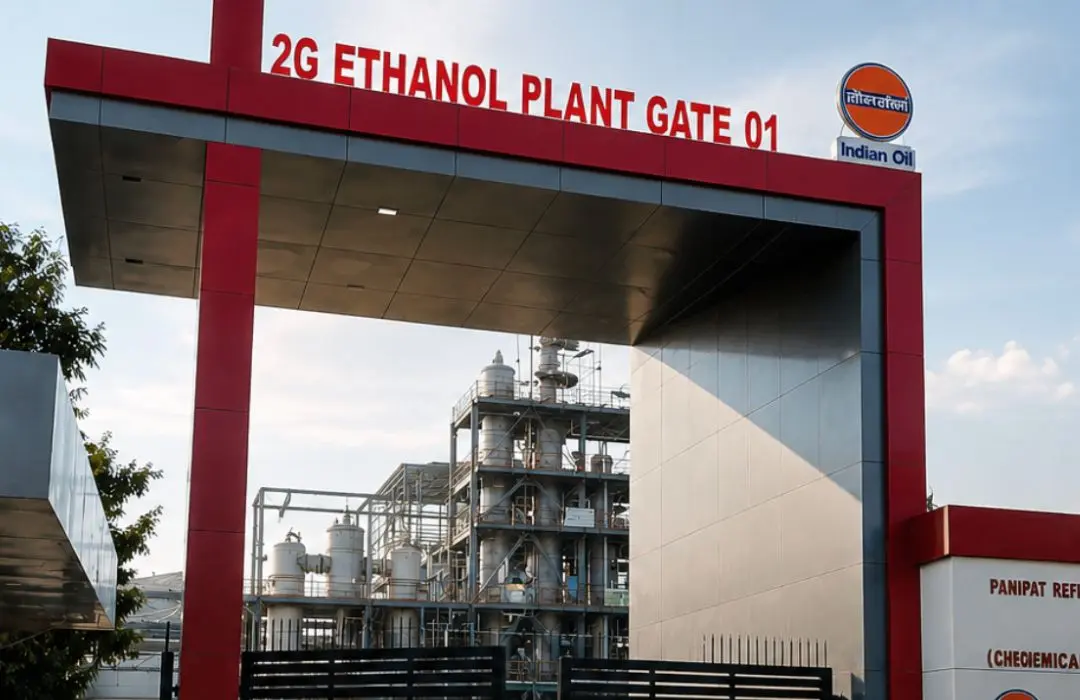
To address this, Indian Prime Minister Narendra Modi inaugurated the country’s first second-generation (2G) ethanol biorefinery in Panipat, Haryana, on August 10, 2023. Built at an estimated cost of Rs 984 crore, it was designed to convert the rice straw (agricultural waste) from farmers into 100,000 litres of ethanol every day. However, the plant produced only 5.7 per cent of that amount. It was revealed by the Minister of State (Petroleum and Natural Gas), Suresh Gopi, in Parliament on February 5, 2026, in response to Lok Sabha Unstarred Question No. 1075.
When being commissioned, the plant was envisaged to help India rely more on locally produced clean energy rather than imported crude oil. The promises were strong, including clean air, local fuel development, helping farmers earn extra income, and indigenous technology, but the reality has turned out to be something opposite. Two and a half years later, the government’s own quarterly production data tells a different story.
The numbers
The initial budget to develop the Panipat 2G ethanol plant was Rs. 909 crore. It finally cost Rs. 984 crore to develop it, and the plant began commercial production on November 11, 2023.
The plant was designed to produce 100,000 litres of ethanol per day and 36.5 million litres in a full year. However, total production for financial year 2024-25, its first complete operating year, was 2,076,600 litres, which was just 5.7 per cent of the annual design capacity.
The worst quarter on record was July to September 2025, which was less than 2 per cent of what the plant was built to produce in those three months.
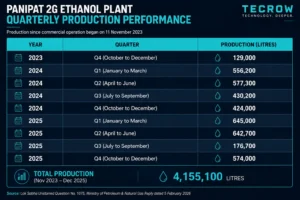
In the same period, the plant spent approximately Rs. 80 crore on annual maintenance, according to a Dainik Bhaskar report in its April 29, 2026 edition, meaning Rs. 80 crore was spent on a plant yielding just 5.7 per cent.
However, the minister describes it as a technical challenge being actively addressed. “The variability of straw quality in terms of moisture and silica content affects the downstream treatment section and creates associated mechanical issues,” he said.
In December 2025, after modifications carried out in November and December, the plant operated at 62 per cent of design capacity, its best performance since commissioning. “As experience of ongoing and executed projects is gained,” the minister told Parliament, “these plants will stabilise.”
The minister’s answer does not address whether 62 per cent of capacity after two years of operation and two rounds of repairs indicates the technology is stabilised, or whether that is the maximum it can achieve.
The technology provider and a Danish link
In the parliamentary reply, an important detail beyond the production numbers was revealed. The Indian Oil Corporation Limited has withheld Rs. 5.25 crore of the total Rs. 10.5 crore license fee owed to Praj Industries, the technology provider. The reason was “successful completion of Performance Guarantee Test Run of the plant has not been met as per the terms of Agreement.”
The Performance Guarantee Test Run is the standard contractual mechanism by which a technology licensor demonstrates that the plant built using its technology achieves the production specifications it promised. IOCL held back half of the license fee because the plant did not meet those production standards, as the government’s official record shows that the technology used in India’s main 2G ethanol plant did not work as expected.
Moreover, IOCL deducted Rs. 2.84 crore from contractors and equipment suppliers under the Price Reduction Schedule for delays. And Praj Industries carried out modifications costing Rs. 9.44 crore at no additional charge, with the licensor acknowledging through that remedial expenditure that the original installation was deficient enough to require fixing.
Praj Industries licenses its process technology from Novozymes, the Danish biotechnology firm. The enzymes that break down cellulose in rice straw into fermentable sugars at the Panipat plant are the Danish company’s CellicCTec3 product. India’s flagship 2G ethanol facility depends on enzymes manufactured in Denmark.
According to research published by CSIR’s National Institute for Interdisciplinary Science and Technology, most of India’s proposed 2G biorefineries rely on imported enzymes.
Dr Ramesh Sonthi, Director of the International Centre for Genetic Engineering and Biotechnology (ICGEB) in New Delhi, told Tecrow in a written response that ICGEB has developed cellulase enzyme technology it describes as comparable in efficiency and cost to the imported alternatives.
But he said 2G ethanol companies want to test any domestic enzyme at a commercial scale before adopting it, and that test requires approximately 10 tonnes of enzyme formulation. ICGEB is planning to produce that quantity at a third-party facility with 100,000-litre reactors, funded recently through the government’s BioE3 programme.
The testing sequence, Dr Sonthi told Tecrow, would begin at the Numaligarh plant in Assam. Panipat would come later, after Numaligarh provides confidence in the enzyme’s commercial performance. In parallel, ICGEB is working with Fermbox Bio Private Limited to establish a commercial enzyme production facility. The facility, when operational, should be able to supply one 2G ethanol plant.
On whether the current policy framework is adequate to close this gap, Dr Sonthi said, “The current BioE3 framework partially addresses this gap,” he told Tecrow. His specific policy recommendation was a mandatory procurement quota to fix a proportion of the 2G ethanol enzyme requirement, starting at 20 per cent, from indigenous technology. Without that mandate, the commercial incentive for domestic investment in enzymes remains insufficient.
Have farmers become profitable?
The government’s most prominent justification for the ethanol blending programme is its benefit to farmers. Petroleum Minister Hardeep Singh Puri stated in a Lok Sabha reply in August 2025 that the programme has resulted in payments to farmers of more than Rs. 1,25,000 crore from the Ethanol Supply Year 2014-15 to July 2025.
The Ministry of Petroleum and Natural Gas published a detailed FAQ on July 10, 2026, stating that payments to farmers in 2025-26 alone are expected to reach Rs. 40,000 crore.
The numbers show the total payments made to all ethanol suppliers in India’s first-generation ethanol program. It includes sugarcane farmers, distilleries, and grain-based ethanol producers. It does not focus on the 2G rice straw model used by the Panipat plant. The Panipat plant helps farmers earn income through straw procurement, but the data reveal a different situation.
The parliamentary reply states that in three years of operation, the plant used approximately 61,812 metric tonnes of straw, 10.11 per cent of its target of six lakh metric tonnes, according to Dainik Bhaskar’s April 2026 investigation.
The straw that should have moved from Punjab and Haryana farms to the Panipat plant, generating income for the farmers who grew the rice and employment for the contractors who collected the straw, mostly stayed in the field or was burned.
In July 2026, Tecrow visited Panipat and nearby villages to understand the current scenario. Veerendra Singh, who farms about 70 acres in Shera village, told Tecrow that he knows there is an ethanol plant nearby, but it does not directly buy straw from him or other farmers.
“Between us stands a contractor,” he said. The net financial effect, in his account, has sometimes been negative. Farmers have paid contractors around Rs. 1,000 per acre to come and bale the straw, he said. Some farmers have received nothing for the straw at all.
Gurdeep Sandhu, an aggregator who collects straw from farmers and supplies it to industrial buyers, provided the most specific account of the supply chain’s collapse. Farmers provide him with straw without charge; he told Tecrow that the straw is agricultural waste they need removed from their fields regardless. He bales straw and sells it to industrial facilities.
In the 2023-24 season, he supplied the Panipat refinery with straw. In 2024-25, the refinery refused to accept the straw. As a result, he found other buyers instead. It is consistent with the parliamentary production data. The plant’s July-September 2025 quarter was its worst performance since opening, with output of 176,700 litres, less than 2 per cent of quarterly capacity. A plant processing almost no straw would have told its supply chain to stop delivering.
Kuldeep Singh, the head of Thirana village and farms 25 acres, told Tecrow that the straw from his village goes to traders from Uttar Pradesh, not to the ethanol plant in Panipat. These traders pay between Rs. 2,000 and Rs. 5,000 per acre, depending on the season.
After spending about Rs. 1,000 per acre for baling, his net income from straw is modest but real. In addition, the Haryana government offers about Rs. 1,200 per acre as an incentive to farmers who do not burn their straw, through the Meri Fasal Mera Byora registration portal. Ranjit Singh, who also farms in the village of Thirana and tends to 30 acres, confirmed this same pattern.
The picture these interviews describe is not a failure of farmer willingness to participate. Farmers understand that not burning straw can generate income, and they are responsive to the UP traders who come to buy it. The failure is the plant’s inability to operate at sufficient scale to function as the anchor buyer the entire supply chain was supposed to revolve around.
Rahul Dhandha, the director of a straw aggregator agency in Dharamgarh whose capital, Dainik Bhaskar reported, was stuck due to the plant’s underperformance, told Tecrow that he is not currently supplying straw to the plant because his stock was destroyed in a fire in April 2026. He has a contract with the plant until late 2027 and declined to comment on payment arrangements while that contract remains active.
The cost of producing ethanol
The Ministry of Petroleum and Natural Gas, in its detailed response to concerns about the E20 programme, disclosed the number that makes the cost debate concrete.
The average procurement cost of ethanol for Ethanol Supply Year 2024-25, as of July 31, 2025, was Rs. 71.32 per litre, inclusive of transportation and GST. Political Analyst Tehseen Poonawalla led a protest against the mandatory E20 rollout at Jantar Mantar in Delhi on July 5, 2026.
He said that ethanol costs Rs. 70-72 per litre, which is more expensive than petrol, priced at Rs. 52-55 per litre. He also noted that the government’s average procurement price of Rs. 71.32 per litre is within this range.
The government acknowledges the cost difference but supports it. The ministry argues that ethanol spending benefits Indian farmers and distilleries rather than foreign crude oil exporters. Over the past eleven years, the program has saved more than Rs. 1,44,087 crore in foreign exchange and reduced crude oil imports by 245 lakh metric tonnes. This year, with 20 per cent blending, foreign exchange savings are expected to be Rs. 43,000 crore.
The argument does not explain who pays the price difference between Rs. 71 per litre for ethanol and Rs. 52-55 per litre for petrol made from crude oil. The cost is borne by someone in the system, either by oil marketing companies, by consumers through higher prices, or by the government through subsidies. The ministry has not made it clear who is responsible.
The energy density penalty is also an important factor to consider. One litre of ethanol contains about 66 per cent of the energy of one litre of petrol. It means that a litre of E20 provides slightly less energy than a litre of regular petrol, so vehicles using E20 will travel a bit less distance on a full tank.
The government’s press release counters that ethanol has an octane rating of 108.5, while petrol has an octane rating of 84.4. A higher octane rating allows for higher engine compression ratios, which can improve performance in vehicles designed for high-ethanol blends. It is correct for vehicles designed for E20 fuel. However, it does not apply to the 300 million vehicles on Indian roads that were not made for it.
The government’s own press release acknowledges it. “Concerns related to performance and mileage being raised now were anticipated as early as 2020 by the Government, and an Inter-Ministerial Committee of the NITI Aayog examined them at length.” The mileage and compatibility concerns existed, were formally reviewed, and the rollout was accelerated from the original 2030 target to 2025 anyway.
Mohammad Wasim has been repairing cars in Panipat for 16 years. Since ethanol blending became standard at his local pumps, he has seen spark plugs come out burned in vehicles he had been servicing for years without that problem. The mileage impact on older vehicles, he said, is significant.
Sachin Sharma, the manager of the Tandon Petrol Pump in Sodhapur, Panipat, said that since July 1, 2026, E20 fuel has been the only option available at his pump, and he does not ask customers which fuel they need or whether their car is E20-compatible because he himself has no other option.
“Whatever the company gives us, we give to customers. There is no alternative on offer,” he told Tecrow.
More such plants incoming
The parliamentary answer that provided Tecrow the production data also disclosed the government’s plans to replicate the Panipat model. An 185 KLPD bamboo-based 2G ethanol plant at Numaligarh, Assam, was inaugurated in September 2025. A 100 KLPD paddy-straw-based 2G plant at Bargarh, Odisha, is approved under BPCL. Another 100 KLPD plant at Bathinda, Punjab, is being developed by HPCL at a reported cost of Rs. 14,000 crore.
MP Laxmikant Pappu Nishad, who asked the parliamentary question that generated the production data and the performance guarantee disclosure, said, if the Panipat model has not worked, why is the government committing Rs. 14,000 crore to a plant at Bathinda and other plants?
The government answers that first-of-kind plants face problems that later plants will not, that the December 2025 performance of 62 per cent shows the technology is stabilising, and that the enzyme and feedstock challenges are being addressed through BioE3 and ongoing operational improvements.
The BioE3 programme’s own champion, Dr Sonthi, described it as partially addressing the gap. One Fermbox Bio facility can supply one plant. The Numaligarh testing would need to succeed before Panipat could access indigenous enzymes. Many such facilities would be needed for the full programme, and the mandatory indigenisation quota he recommends has not been implemented.
The new plants at Bathinda, Bargarh, and Haryana will presumably face the same dependence on imported enzymes that the parliamentary answer shows has not delivered contractual performance at Panipat.
The announcement and the reality
The ethanol blending program has achieved its goals, according to the government. India reached a 20 per cent ethanol blend in fuel, which has helped save on foreign exchange.
Indian distilleries and farmers have received financial support through the 1G program. CO2 emissions have decreased compared to using pure petrol. These successes are attributed to the 1G program, which sources ethanol from sugarcane, molasses, and grain on a large scale.
The 2G programme, built on the specific promise of turning agricultural waste into fuel while eliminating stubble burning and creating a new income stream for rice farmers in Punjab and Haryana, has a different record at the only commercial-scale plant that exists to assess it.
The project spent Rs. 984 crore but reached only 5.7 per cent of its design capacity in its first full year of operation. It did not meet its performance guarantee. The technology provider received half of its payment, and the provider performed Rs. 9.44 crore in repairs free of charge, admitting that the original installation was faulty.
An aggregator said that the refinery that accepted straw in 2023-24 refused to take it in 2024-25. As a result, nearby farmers are now selling their straw to traders in Uttar Pradesh because the plant is not buying it. A mechanic mentioned that spark plugs in older vehicles are burning out since the mandatory fuel blend started. The government has set the ethanol procurement price at Rs. 71.32 per litre, while petrol from crude oil costs between Rs. 52 and Rs. 55 per litre.
The government was aware that there would be concerns about mileage and compatibility. In 2020, a formal committee looked into these issues. Despite this, the project moved forward quickly. Three more 2G plants are now funded and being developed.
The government acknowledges a discrepancy between what was announced and the actual situation at Panipat. It calls this a unique challenge that they are working to resolve. However, the government has not explained whether the same model, which costs Rs. 14,000 crore in Punjab, will encounter similar issues with feedstock, enzymes, and operations.
Parliamentary data show that these challenges have kept the original plant running at just 5.7 per cent of its design capacity for three years. And all the promises are still unmet, including clean air, local fuel development, helping farmers earn extra income, and indigenous technology.