Key ideas
- •Qantas completed the longest certification test flight ever, flying an Airbus A350-1000ULR nonstop from Melbourne to Toulouse in 24 hours and 24 minutes.
- •Project Sunrise will launch nonstop Sydney–London flights in 2027, with Sydney–New York confirmed as the second route.
- •The A350-1000ULR combines extra fuel capacity, aerodynamic refinements, and a premium-heavy cabin to make 20-hour commercial flights possible.
For most of its history, Australia’s geography has shaped both its identity and its challenges. It is a continent located at the bottom of the world, far from major population centres. Travelling to Europe or North America requires a stop in another city, such as Dubai, Singapore, or Los Angeles. Layovers have been a common part of long flights to and from Australia since commercial flying began.
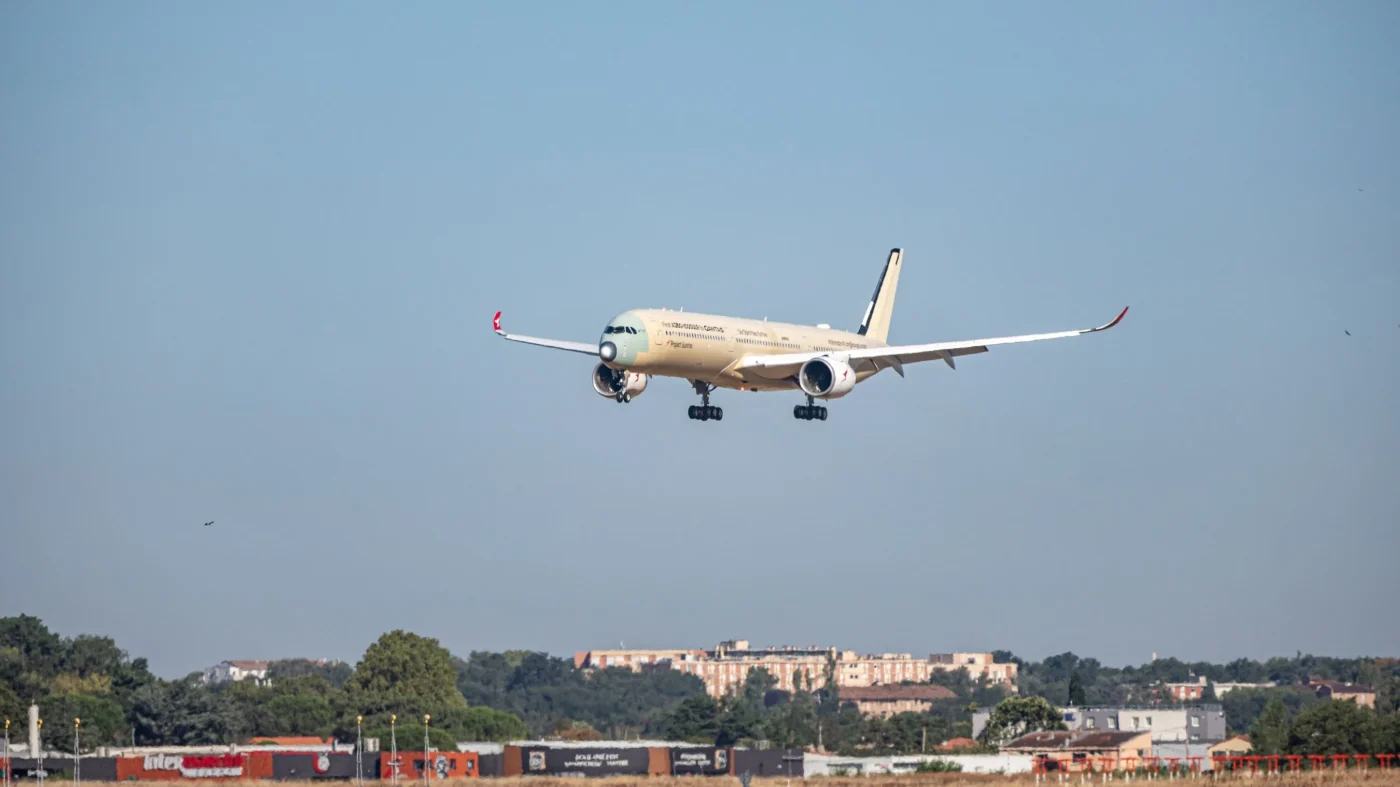
However, on Tuesday, a twin-engine Airbus A350 took off from Melbourne and flew east instead of west to Singapore or north to Dubai. It crossed the Pacific Ocean, flew over South America, crossed the Atlantic, and landed in Toulouse, France 24 hours and 24 minutes later. The flight covered 12,460 nautical miles (23,075 kilometres) without stopping, making it the longest certification test flight ever recorded. The aircraft landed in Toulouse with fuel remaining.
Qantas operated the flight as a demonstration to show aviation regulators that the A350-1000ULR, the Ultra Long Range version of the plane, can fly the routes planned for Project Sunrise starting in 2027. Qantas has ordered 12 of these planes. On the same day, Qantas announced that the next confirmed route for Project Sunrise will be from Sydney to New York, following the Sydney to London route.
What is Project Sunrise
Passengers flying from Sydney to London usually leave in the evening, make a stop in the Middle East, and arrive in London after crossing night, dawn, and part of a morning in the air. With Project Sunrise, they will leave Sydney and fly nonstop for about 20 hours west, landing in London at sunrise. The journey skips the typical stops in Dubai or Singapore that have been part of Australian long-haul flights for the last fifty years.
Project Sunrise started in 2019 when Qantas wanted to buy a specific version of the Airbus A350-1000. The version has extra fuel capacity and improved aerodynamics, allowing it to fly longer routes that were not previously profitable. The project was delayed for two years due to COVID. In 2022, Qantas officially ordered 12 A350-1000ULR aircraft. The first of these planes flew from the Airbus factory in Toulouse to Melbourne on July 24, 2026, and was in the air for 19 hours and 13 minutes.
Three days later, the same aircraft type flew from Melbourne to Toulouse. This time, it took a longer route over the Pacific Ocean instead of Asia to test the aircraft’s maximum range in a controlled setting. By flying east from Melbourne, the plane crossed the Pacific Ocean, flew over or near South America, crossed the Atlantic, and reached France from the west. The route is the longest practical way to travel between these two cities, making it the toughest certification test. The aircraft completed the journey in 24 hours and 24 minutes, with fuel still available.
The previous record for the longest nonstop passenger flight was held by Singapore Airlines, which flies about 9,534 nautical miles (17,659 kilometres) from Singapore to New York. The flight takes around 18 hours and 40 minutes. In comparison, a recent test flight covered 12,460 nautical miles, showing the impressive engineering of the aircraft by Airbus and highlighting what Qantas is counting on for its long-haul future.
The engineering
The Airbus A350-1000 is a long-range aircraft. It can hold about 158,000 litres of fuel and has a maximum take-off weight of 308 tonnes. It can fly approximately 8,700 nautical miles. However, this range is not enough for the distance from Sydney to London, which is about 9,009 nautical miles.
The ULR variant improves the aircraft’s capabilities through several changes that are not dramatic on their own but add up to a significant upgrade. It has a larger fuel tank, allowing for more usable fuel. There are weight reductions in the cabin and systems, which decrease the take-off weight for the same payload.
The wing trailing edge and engine nacelles are aerodynamically refined to lower drag during cruise flight. The engines are still the Rolls-Royce Trent XWB-97, with a thrust of 97,000 pounds, just like the standard A350-1000. However, their fuel-consumption efficiency at high cruise altitudes makes a big difference.
The aircraft can weigh up to 316 tonnes when fully loaded in the ULR configuration. To fly from Sydney to London, it needs about 140,000 litres of fuel, including reserves. The difference between this fuel requirement and the plane’s total fuel capacity is important. It helps regulators and operations controllers plan for weather changes, airspace delays, and varying winds during trans-oceanic flights.
Qantas has designed the cabin of these aircraft for very long flights, focusing on what passengers need during a 20-hour journey. The layout emphasises premium seating, with first class and business class making up more than 40 per cent of the plane. It reflects the idea that on ultra-long flights at regular speeds, filling premium cabins is more profitable than having more economy seats.
Sydney to New York: The second route
Sydney to New York will be the second route for Project Sunrise, following London. The distance from Sydney to New York is about 8,818 nautical miles, which is slightly shorter than the distance to London. However, it is still too far for a standard widebody aeroplane to fly directly.
Travelling from Sydney to New York usually goes through Los Angeles, adding a layover and making the total travel time about 22 to 24 hours. Qantas’s nonstop flight will take about 19 to 20 hours of actual flying time, depending on wind conditions. The service saves travellers three to five hours compared to the best current option for trips between Sydney and New York.
The US Federal Aviation Administration recently proposed a rule to lift the 53-year ban on supersonic flights in the US, which gains significance. Project Sunrise and supersonic travel do not compete with each other; they cater to different markets, have different price points, and address different needs. However, they are both aiming to reduce travel time between the Indo-Pacific region and the rest of the world and will begin operations around the same time.
Boom Supersonic’s Overture aims for commercial service around 2030, offering flights from New York to Sydney at Mach 1.7 in about 10 to 11 hours. On the other hand, Project Sunrise plans to provide the same route nonstop at traditional speeds starting in 2027, taking around 20 hours.
In the early 2030s, passengers will have to choose between two travel options. One option offers 20 hours of comfort in a well-designed cabin. The other option is a 10-hour flight at supersonic speed, which may affect the seating arrangement and ticket price. Both options require a mandatory stop somewhere in the middle of the world.
The Australian context
A layover does more than add time to a journey. It creates a psychological distance and a mental separation between Australia and the places its people visit for work, school, or family. The long journey becomes an event in itself rather than just a way to travel. A stopover not only extends the trip but also involves planning, the risk of needing to rebook flights, handling luggage, navigating terminals, and dealing with the exhaustion of relaxing in an airport lounge in places like Dubai or Singapore before continuing the journey.
Project Sunrise makes travel easier. A passenger who boards in Sydney arrives in London without needing to do anything else except sit, sleep, eat, and wait to arrive. The same is true for New York. It will impact business travel, family connections, and how Australians view their distance from the rest of the world.
Qantas’s first A350-1000ULR arrived in Melbourne on July 24, and it flew a record certification test flight from July 27 to 28. It can fly 12,460 nautical miles in one trip. Starting in 2027, it will operate on the world’s longest nonstop routes. The first route will be Sydney to London, and about 10 aircraft will be needed to make this service successful. The next route will be Sydney to New York.