Key ideas
- •Defense giants including Israel Aerospace Industries, Hyundai Rotem, and Lockheed Martin are adapting military drones and robots to detect wildfires and assist firefighters.
- •Technologies such as AI, thermal imaging, GPS-denied navigation, and autonomous robotics are equally valuable in firefighting and modern warfare.
- •Civilian firefighting missions are becoming real-world proving grounds, helping validate and improve the next generation of military autonomous systems.
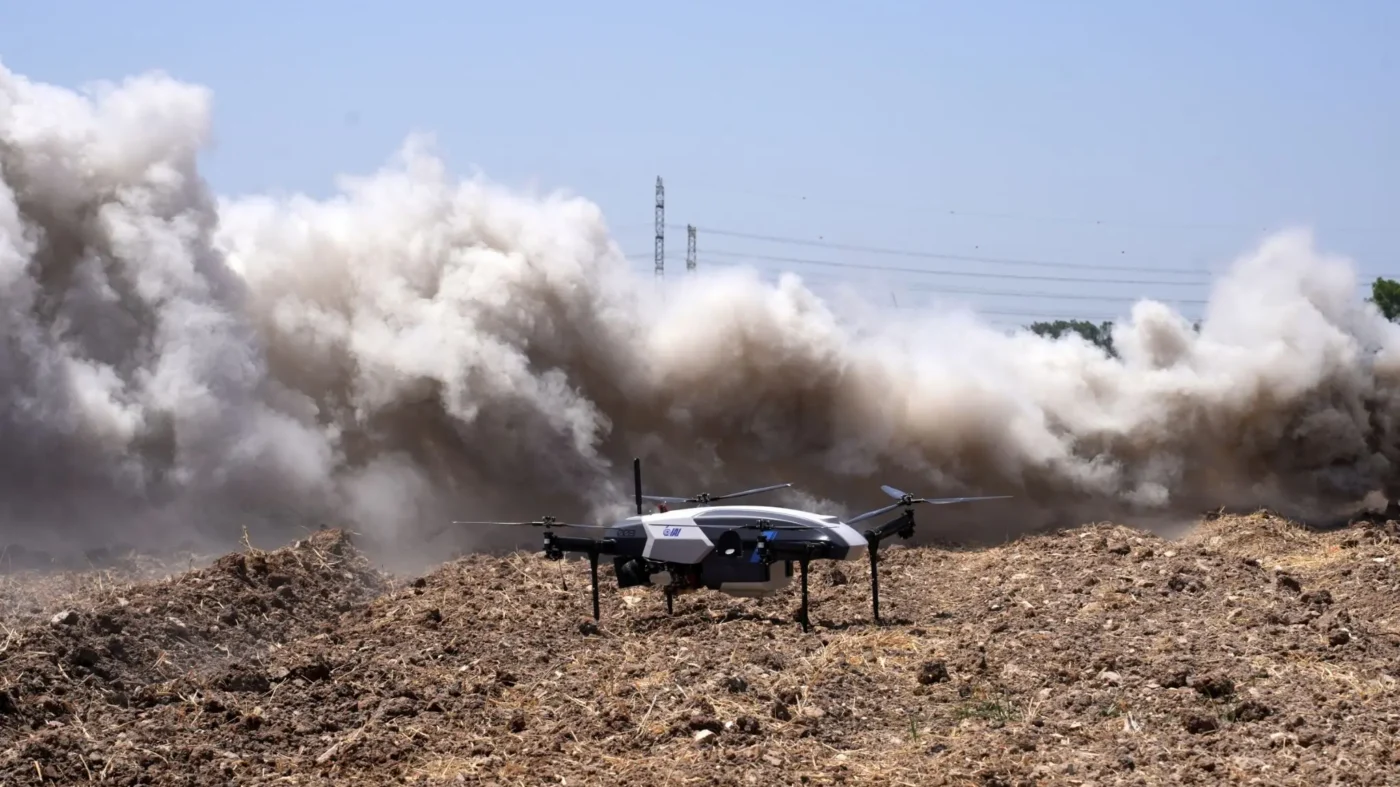
On July 28, Israel Aerospace Industries (IAI) published a press release about a drone programme for early forest fire detection as part of a civilian safety initiative. However, IAI is one of the world’s most sophisticated defence aerospace companies. The same company produces air, space, land, naval, and cyber technologies for the Israeli Defense Forces and export customers across four continents.
Still, the company decided its drone technology, AI processing, and sensor integration capability should be applied to detecting fires early before they become catastrophic wildfire events that have devastated communities across the Mediterranean and the Middle East in recent years.
However, IAI is not the only defence company that is developing such firefighting robots. There are others in different countries and on different continents. But why are defence companies suddenly caring about firefighting? The answer lies in maturing AI.
Turning main gun into water cannon
In February 2026, Hyundai Motor Group donated four unmanned firefighting robots to South Korea’s National Fire Agency as part of its corporate social responsibility efforts to support firefighters. According to the National Fire Agency, firefighters in Korea have experienced 1,788 injuries and deaths at fire scenes over the past decade.
Hyundai Motor Group Executive Chair Euisun Chung said at the ceremony that the company would continue providing the technologies and support needed to ensure that firefighters can carry out their missions in a safer environment.
The robots were built on the HR-Sherpa platform, a multi-purpose unmanned ground vehicle developed by Hyundai Rotem. Hyundai Rotem is the same company that manufactured the K2 Black Panther main battle tank. The HR-Sherpa chassis was originally developed for military applications.
In its firefighting configuration, the platform carries a water cannon, a self-spraying cooling system, vision-enhancing cameras, and thermal imaging sensors. Two units went into immediate deployment with South Korea’s Capital and Yeongnam 119 Special Rescue Units. Two more were delivered to Gyeonggi and Chungnam Provincial Fire Headquarters.
A military chassis with a water cannon instead of a weapons system. The sensors, autonomous navigation, thermal imaging, and the platform are all the same. The autonomous navigation is the same. What changed is a water gun instead of a main cannon.
Also at CES 2026 in January, a South Korean company called Widemout Dynamics showed an AI-powered Smart Firefighting Robot designed to navigate and identify early-stage fires in environments where GPS signals are unavailable and visual data is degraded.
In May 2026, Thermite, an American company under the Howe and Howe Technologies brand, launched the RS3-X. This new firefighting robot uses AI and thermal imaging to make real-time decisions.
In the same month, Lockheed Martin, the largest defence contractor in the world, signed a contract for automated emergency response platforms. Lockheed Martin does not have experience in building fire trucks.
What brings the change
To understand why defence companies are getting into firefighting, it is important to know what firefighting robots need to work effectively. These robots have to enter a burning building and navigate through it on their own.
They face many challenges, such as collapsing walls, weakening floors, and almost no visibility. They also have to survive extreme heat, so their electronic parts must withstand temperatures that would damage regular electronics.
Robots can’t rely on GPS to know where they are because GPS signals don’t work well inside buildings and the layout changes as the fire spreads. As a result, they have to identify hazards like gas cylinders, weak structures, and trapped people by using a blend of thermal, visual, and sound sensors.
Lastly, they need to operate on their own or semi-autonomously because the connection between the operator and the robot can weaken or fail due to interference from smoke and fire-suppression foam.
Each requirement relates directly to a challenge in military robotics. For example, GPS-denied navigation is a problem caused by drone jamming. Thermal imaging helps identify targets and is also used in military reconnaissance. Drones have to operate independently even when communication is poor, which is similar to loitering until a target is found.
Heat resistance is crucial for unmanned ground vehicles that need to withstand explosions and fires. The technology that makes a robot useful in a burning building is very similar to the technology that helps a robot in a contested urban battlefield. Building and testing one type of robot also helps improve the other type.
The demography
In June 2026, Japan’s Fire and Disaster Management Agency reported more than 2,700 fires in city areas. Over the past ten years, South Korea has recorded 1,788 firefighter deaths.
In Israel, wildfires, worsened by heat and wind patterns due to climate change in the Eastern Mediterranean, have caused serious events. This has led to strong political calls for better detection and quicker responses.
All three countries also share a demographic constraint that makes robotic firefighting more urgent than it would be in a younger society. Japan’s workforce is declining, South Korea’s birth rate is the lowest of any country on earth, and Israel’s professional emergency response capacity is stretched by the demands of an active military conflict environment that has been running for years.
In each case, deploying robots that can enter burning buildings ahead of human firefighters is a workforce planning response to a population that is shrinking faster than it can train replacements. The same demographic pressure applies to the military.
Japan’s Self-Defense Forces are struggling to meet their recruitment goals, and South Korea is managing its needs with a smaller youth population. Both countries are investing in autonomous military systems because there are fewer human soldiers available.
The robotics programmes that these countries are funding for firefighting are being developed by engineering teams, in companies, and with institutional knowledge that will be applied to the same autonomous systems problem in a military context.
IAI’s approach
IAI has created a fire detection program that uses drone swarms instead of ground robots. The approach is different but suits Israel’s geography and operational needs.
Israel’s wildfire risk is concentrated in forested terrain that is difficult to monitor by ground-based systems and that spreads rapidly once ignited, driven by the Sharav wind patterns that periodically bring hot dry air from North Africa across the Mediterranean.
Early detection, identifying a fire in its first minutes when it covers tens of square metres rather than hundreds of hectares, is the intervention that most significantly changes outcomes. Ground-based firefighting robots are relevant once a fire has been located and contained to a specific site.
Drone-based AI detection is relevant before that, at the scale of regional monitoring across terrain that spans thousands of square kilometres.
IAI’s system uses autonomous drones equipped with multispectral imaging sensors that can distinguish the thermal signature of an early fire from the background temperature variation of sunlit terrain.
The AI processing layer filters false positives, which in fire detection terms means distinguishing a campfire or a sun-heated rock from an uncontrolled ignition, and triggers alerts to fire response infrastructure within a response window measured in minutes rather than the hours that characterise satellite-based fire detection.
IAI is using a sensor suite for tasks like multispectral imaging, flying autonomously in changing wind, and using AI to detect and classify signatures. The same sensor suite is also used for intelligence, surveillance, and reconnaissance operations.
The drones that spot fires in Israel are similar to those used for military reconnaissance in contested areas, and IAI develops both types of drones.